Computer Space: The First Commercial Arcade Video Game
Before the well-known Pong made video games a household name, a futuristic fiberglass spaceship presented an entertainment marvel that accepted a quarter for an industry that still did not have a name.
 Narrated by Jonny 8-Bit6 min read · Published 8/20/2026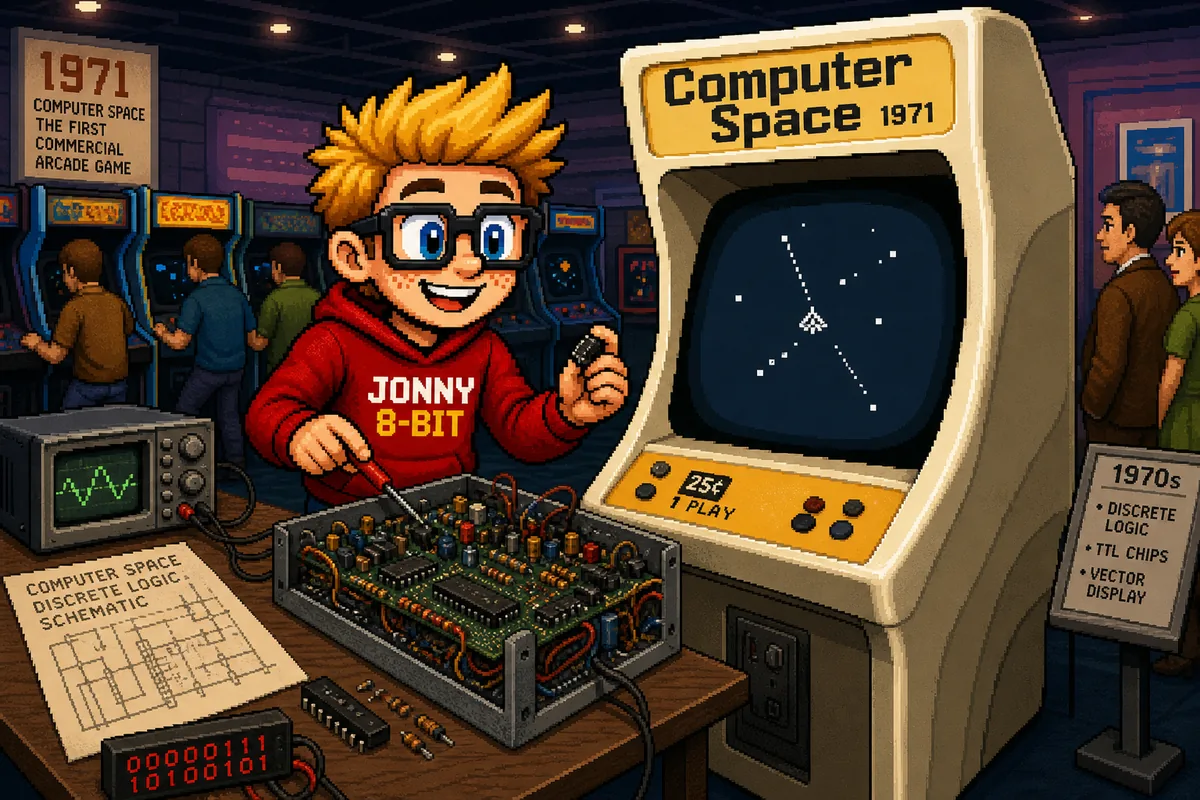
In October 1971, arcade operators at the Music Operators of America show saw something unusual. It looked more like a science-fiction prop than a typical wooden game cabinet. Its curved fiberglass shell held a 15-inch black-and-white television. Four buttons controlled a tiny rocket fighting two flying saucers. Nutting Associates called it Computer Space, and one quarter bought a 99-second battle. It was not the first electronic game or computer game. It was the first coin-operated video game manufactured and sold commercially in quantity. Stanford's one-off Galaxy Game also charged players in 1971, but Computer Space was designed for commercial production and distribution. It showed that video games didn't have to remain in a university lab: they could sit next to pinball machines and earn money. It also taught its creators a major lesson: a new idea will not thrive if players do not understand how to play it.
Two young engineers with two different kinds of experience
Nolan Bushnell was 28 when Computer Space reached the market. He was born in Ogden, Utah, in 1943. As a child, he experimented with ham radios and learned to repair televisions. He later studied electrical engineering at the University of Utah. During the summer, he worked at Lagoon Amusement Park. There he watched people spend money on midway games and learned quickly how costly machines needed to pay for themselves. Bushnell began wondering whether the excitement of a computer game could be built cheaply enough to entice quarters at an arcade.
While working at Ampex in California, Bushnell met Ted Dabney. He was an experienced technician and engineer who understood television signals, sound, and circuit design. They worked on the game after hours and called their partnership Syzygy, a word used when three objects in space line up. Computer Space was not the work of a single inventor. Bushnell pushed the business idea and much of the game design. Dabney made sure the hardware produced a clear picture and worked reliably inside an arcade cabinet.
The expensive inspiration called Spacewar!
Spacewar! gave Bushnell the basic idea. Created at MIT in 1962 for the PDP-1 computer, the game let two players control spaceships. They could turn, use their engines, and fire torpedoes. Their ships kept moving through space even after the players stopped pressing the thruster control. Bushnell played the game during college and later saw it at Stanford’s Artificial Intelligence Laboratory. It was exciting, but it ran on a large computer used by trained students and researchers. Bushnell wanted to bring that kind of excitement to regular people in an arcade.
The biggest problem was cost. The Strong National Museum of Play states that computers powerful enough to run this type of game could cost more than $100,000 in the 1960s—roughly $800,000 or more in 2025 dollars, depending on the year used for comparison. Bushnell first considered using a cheaper Data General Nova computer. It still cost around $4,000, and he soon discovered that it was too slow for his plan. An arcade operator could not afford to place an expensive computer inside every game cabinet. Bushnell and Dabney needed another solution.
The breakthrough to remove the computer
Their breakthrough was to remove the computer from the plan. Instead, Computer Space used electronic parts wired to perform only the tasks needed for this one game. The hardware created the ships, shots, movement, collisions, score, and television picture directly. There was no modern computer program that could be easily changed or replaced. This made development harder in some ways, but it also made each cabinet much cheaper to build. For the first time, the idea had a chance to work as a coin-operated game.
The team also simplified Spacewar!. Computer Space removed the large star and its gravity. It replaced the second player with two flying saucers controlled by the machine. Four buttons let the player turn left, turn right, move forward, and fire. Each game lasted 99 seconds, and a win earned another round. The rules sounded simple, but the ship kept drifting after a button was released. New players had to control that unexpected motion while also aiming and shooting. That was a lot to learn after dropping in a quarter.
A dentist, a boat builder, and a cabinet from the future
Finding a manufacturer happened through an unexpected connection. In Hansen Hsu’s Computer History Museum - oral history of Nolan Bushnell article, Bushnell said his dentist introduced him to Dave Ralston of Nutting Associates. The Mountain View company already made a coin-operated trivia machine called Computer Quiz. Nutting agreed to manufacture the new game while Bushnell and Dabney licensed their design. The company also gave it the name Computer Space. This deal gave the two first-time game builders access to factories, distributors, arcade operators, and a major trade show. Those business connections were just as important as the electronics.
The cabinet became the game’s biggest advertisement. Bushnell remembered shaping its design in clay on his kitchen table. Dabney then took the model to a boat builder that knew how to work with molded fiberglass. The finished cabinet had smooth curves and bright metallic colors. It looked like a machine from the future. A white Computer Space cabinet even appeared in the 1973 science-fiction movie Soylent Green. In 1971, most customers had never heard the words “video game.” The cabinet had to catch their attention before the screen could explain what it did.
Was Computer Space really a failure?
A common version of this story says Computer Space failed because it was too complicated. That is partly true, but the full story is more involved. Initial tests at the Dutch Goose bar near Stanford reportedly went well. Players there likely grasped the game play quicker because they had more experience with technology. Unfortunately, people at other locations often struggled. Written instructions could never fully teach the turning, drifting, aiming, and scoring during such a short game. Location and audience mattered. This made it difficult for Arcade owners to warrant buying a machine they had never seen before.
Nutting sold about 1,500 cabinets. That was small compared to future arcade hits, but it was not a total failure. Bushnell later claimed about $2.5 million in sales and stated a coin-operated game needed closer to $10 million to be successful. He recollected each cabinet selling for about $1,000 to $1,200, while the parts cost around $320. Most important, the real machines taught Bushnell and Dabney about factory production, pricing, arcade locations, and player clientele.
The lesson that became Pong—and a future industry
Bushnell and Dabney founded Atari in 1972. Their next major game used what they had learned from Computer Space. Pong asked players to move two paddles and keep a square ball in play. Its instructions were easy to understand: avoid missing the ball for a high score. A person could watch for a few seconds and know what to do. Pong did not erase the accomplishments of Computer Space. It showed that a new game should be easy to begin, even if it becomes harder as the player improves. This design principle—easy to learn but difficult to master—became known as Bushnell's Law.
Computer Space also inspired people outside Atari. The Strong National Museum of Play reports that Jerry Lawson was influenced by seeing it. Lawson later led the development of the Fairchild Channel F, an early home console with removable game cartridges. Designer Ed Logg named Computer Space as an influence on the arcade classic Asteroids. Its screen, controls, coin slot, artwork, and special cabinet helped establish what an arcade video game should look like. Computer Space did not create the industry by itself. It turned a lab experiment into a real product and gave future games a place to start.
Videos and further viewing
These videos add demonstrations, interviews, or visual context to the story. A privacy-enhanced YouTube player loads only after you choose a video. Review YouTube’s privacy policy.
Computer Space (1971) - First video game with sound (Real Hardware)
Video by Ultimate History of Video GamesWatch Computer Space running on original-style hardware and see how its unusual controls shaped the experience.