
OXO: The 1952 Computerized Game of Tic-Tac-Toe
A rotary telephone dial and a tiny memory display turned a familiar pencil-and-paper game into an early conversation with a computer.
 Narrated by Jonny 8-Bit6 min read · Published 8/20/2026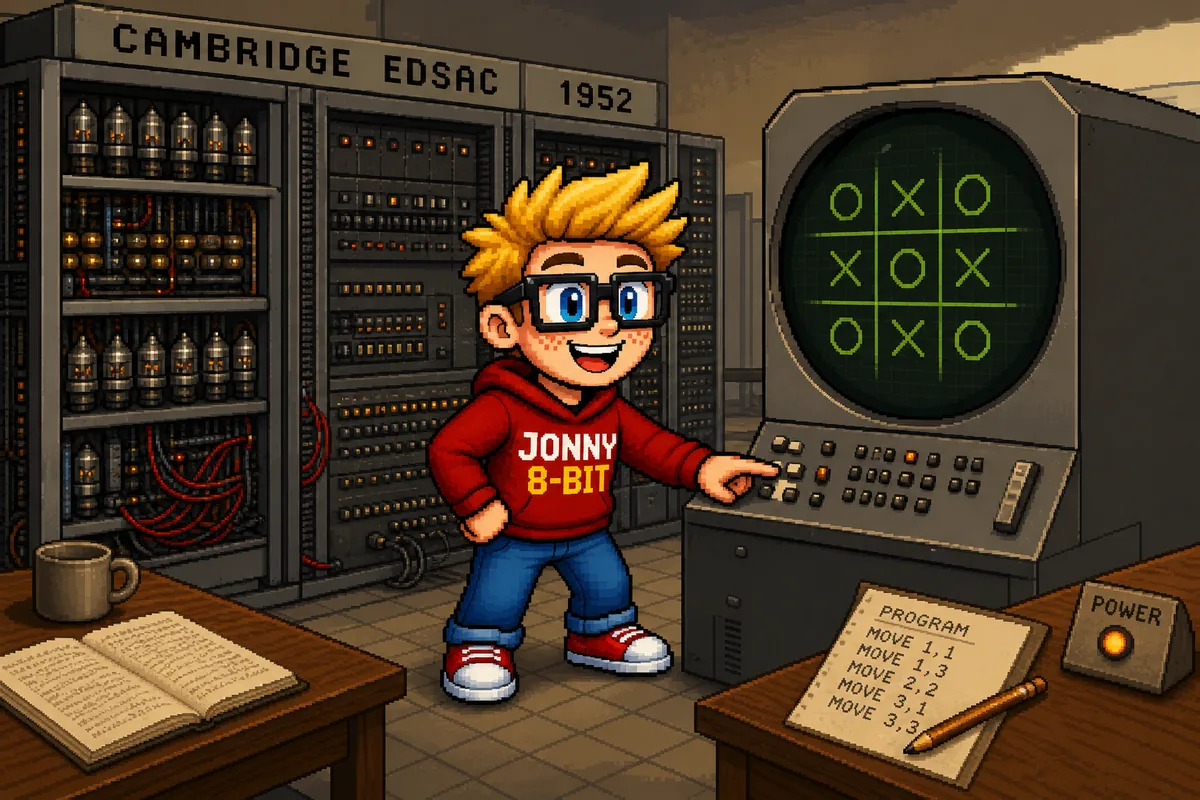
Imagine playing tic-tac-toe without a keyboard, mouse, controller, or normal television screen. You choose a square by turning a rotary telephone dial. A small round display lights up with your move, then a room-sized computer chooses its response. That was the experience Alexander S. Douglas created at the University of Cambridge in 1952. British players knew the game as noughts and crosses. Today, Douglas’s program is commonly called OXO.
OXO was not sold in stores or placed in an arcade. It was written for EDSAC, one of the first practical stored-program computers, while Douglas was a Cambridge doctoral student. The project helped demonstrate something that was still a new idea: a person could give a computer information during a program, see a visual result, and continue the exchange. The computer was not simply printing the answer to a long calculation. It was taking turns with a human being.
A game born inside a working laboratory
EDSAC stood for Electronic Delay Storage Automatic Calculator. A team led by Maurice Wilkes built it at Cambridge’s Mathematical Laboratory, and the machine ran its first successful program in May 1949. EDSAC was not a game system. Researchers used it for serious work in subjects such as meteorology, genetics, chemistry, and X-ray crystallography. It also helped make Cambridge an important center for the new practice of computer programming.
Douglas was working in that scientific setting, not pitching a toy company. He needed a clear way to show interaction between a person and a computer. Tic-tac-toe was a smart example because nearly anyone could understand the board and rules. A viewer did not need to know mathematics or EDSAC’s machine code to recognize a move. When a mark appeared in a square and the computer answered with another mark, the exchange was immediately visible.
The room-sized machine behind nine squares
The hardware behind that simple grid was enormous by modern standards. Cambridge records list about 3,000 electronic valves, the British term for vacuum tubes. EDSAC consumed roughly 12 kilowatts of power and occupied a room about 16 feet by 13 feet. It averaged around 650 instructions per second. A modern phone completes vastly more work while fitting in a pocket, but EDSAC was built when storing and running a program electronically was still a major achievement.
Its memory held 1,024 words of 17 binary digits in mercury-filled ultrasonic delay lines. Data traveled through each “tank” as sound pulses and had to keep circulating to remain available. Programs normally entered the machine on punched paper tape, and results came out through a teleprinter. That process worked well for calculations, but it was awkward for a game in which a person had to make several choices while the program was running.
How a telephone dial became a game controller
Cambridge added a telephone dial to EDSAC in 1952. The dial let a person enter a number while a program was running instead of preparing every input on paper tape in advance. For OXO, the nine positions of the tic-tac-toe board could be treated as numbered choices. The player turned the dial for the desired square, the program recorded the move, and EDSAC calculated its own response. The Computer History Museum notes that the player could choose whether to move first or let the machine begin.
The picture appeared on a cathode-ray tube, or CRT, but this was not a regular monitor created for games. EDSAC’s tubes let operators inspect patterns stored in memory. Cambridge programmers called this “peeping.” Douglas arranged memory values so one of those displays showed a grid and game marks on a field of roughly 35 by 15 dots. The laboratory’s own history notes that the monitor was unofficially used for noughts and crosses and even a dancing Highland figure. Useful diagnostic equipment had quietly become a place for visual experiments.
Why tic-tac-toe was the right test
Tic-tac-toe is simple enough to learn in a minute, yet it still requires the computer to follow rules and react to another player. Every square can be empty, hold a nought, or hold a cross. That creates 19,683 possible patterns before impossible positions and repeated arrangements are removed. For a modern machine, that is tiny. For a computer with only 1,024 short memory words, careful programming mattered.
The familiar game also made Douglas’s point easier to see. A printed number at the end of a calculation showed that a computer could produce an answer. OXO showed a continuing relationship: the player chose, the display changed, the machine responded, and the player chose again. The rotary dial acted like an early controller, while the CRT acted like an early game screen. Neither part was designed for entertainment, but Douglas joined them into an understandable interactive system.
A game almost nobody could play
OXO never received a commercial release. EDSAC was a unique research machine that could not be carried to a trade show or copied into people’s homes. Access to it was limited, and useful university calculations had priority. The Computer History Museum says few people outside Cambridge ever played the game. There was no box, price, advertising campaign, or group of arcade operators spreading it from one city to another.
That limited reach explains why OXO did not launch a game business in 1952. Later games reached larger audiences because their hardware traveled. Tennis for Two let visitors play at Brookhaven National Laboratory in 1958, and Spacewar! spread among computer laboratories after 1962. In 1972, Spacewar! even inspired the earliest known organized video game tournament. OXO remained closely tied to the single machine and academic question that produced it.
Was OXO really the first video game?
The answer depends on what someone means by “video game.” Earlier electronic amusement devices used screens or lights. The 1951 Nimrod computer played the strategy game Nim using a panel of lights, and other researchers had written programs related to chess. OXO was not the first time electronics, computers, screens, or games had ever met. Calling any one project the first can hide the different experiments that led toward modern games.
OXO still holds an important place. It was one of the earliest known computer games to show a changing game board on an electronic display, and one of the clearest early examples of a person playing directly against a computer. It had visible game state, player input, programmed rules, and a machine-controlled opponent. Those features feel familiar because modern games still use the same basic loop, even though today’s screens and controllers are far more advanced.
The small game with a lasting idea
Douglas did not need realistic art or fast animation to demonstrate interaction. Nine squares were enough. OXO showed that a display could communicate the state of a program and that an input device could let a person change what happened next. Those ideas later became normal parts of computer use, from game controllers and touchscreens to menus and visual feedback.
Its importance is therefore larger than winning or losing a round of tic-tac-toe. OXO captured a moment when computers began to feel less like distant calculating engines and more like machines a person could operate in real time. The program was small, the audience was tiny, and the screen was built to inspect memory. The interaction it demonstrated was a preview of everyday computing.
Videos and further viewing
These videos add demonstrations, interviews, or visual context to the story. A privacy-enhanced YouTube player loads only after you choose a video. Review YouTube’s privacy policy.
OXO: The Surprising Story of the World's First Video Game
Video by History BuffSee how OXO ran on EDSAC and why its interactive tic-tac-toe display holds an important place in game history.