
Tennis for Two: The 1958 Game Played on an Oscilloscope
Before home consoles and coin-op arcades, laboratory visitors lined up to volley a glowing dot across an oscilloscope.
 Narrated by Jonny 8-Bit6 min read · Published 8/20/2026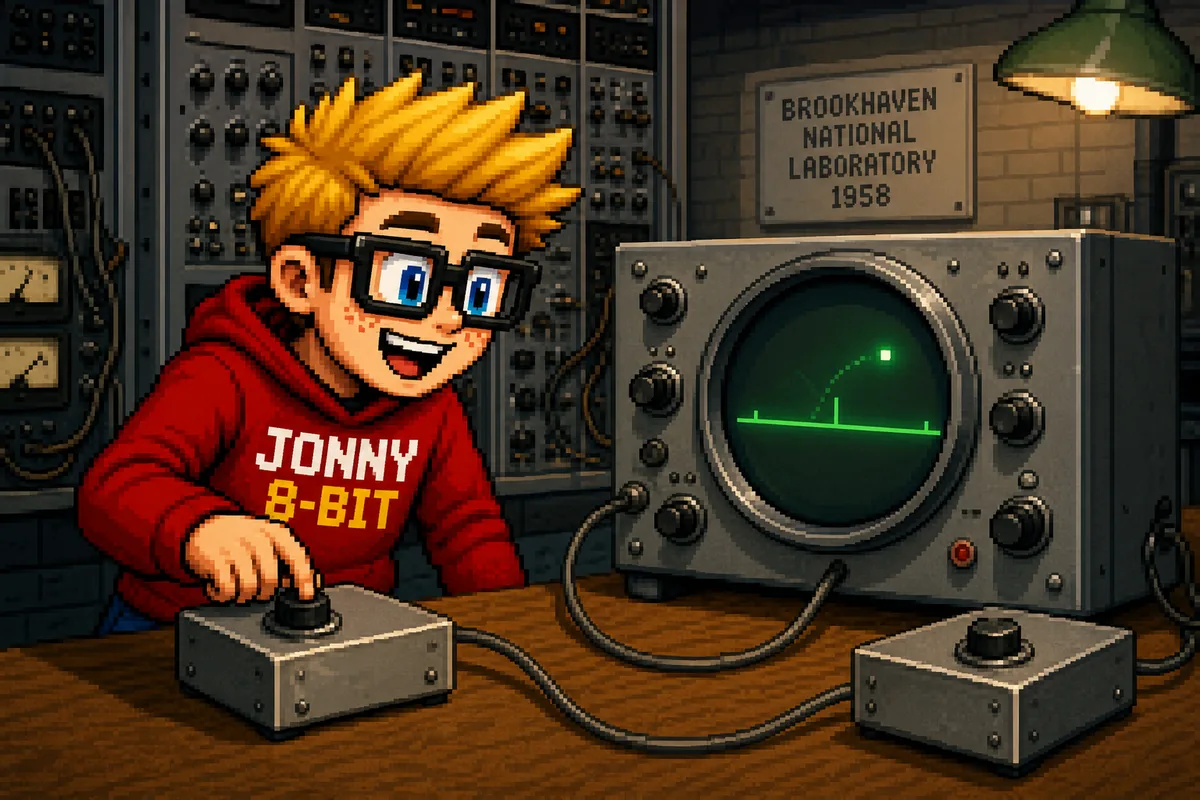
On October 18, 1958, visitors entered a gymnasium at Brookhaven National Laboratory on Long Island, New York, expecting the usual scientific displays. Most exhibits relied on photographs, text, and equipment that guests could observe but not touch. One station was different. A bright dot bounced across a tiny oscilloscope while two people turned knobs and pressed buttons to send it over a glowing line.
The display did not have colorful graphics, a scoreboard, or even a computer monitor as we now understand one. It was a simple electronic simulation of tennis. Yet people lined up for a turn, sometimes in crowds that stretched beyond the room. Long before a video game cabinet accepted a quarter, this laboratory experiment showed the power of putting controls in a visitor’s hands.
The game is now known as Tennis for Two. It also raises a question with no simple answer: was this the first video game, or one important stop in a much longer beginning?
A physicist turned a bouncing ball into tennis
William Alfred Higinbotham was 47 when he designed the game. He had studied physics at Williams College and Cornell University, worked on radar displays at MIT, and led an electronics group at Los Alamos during the Manhattan Project. He later became a major supporter of nuclear arms control.
Higinbotham joined Brookhaven in 1947 and eventually headed its Instrumentation Division. The laboratory’s annual Visitor’s Day brought thousands of people onto the grounds, but Higinbotham thought many displays were too static. He wanted an exhibit that would entertain guests while showing that scientific work could connect with ordinary life.
His goal was not to launch a game company. He wanted to “liven up the place.” Tennis was familiar, two players understood it immediately, and a moving ball made the equipment feel responsive instead of distant.
Brookhaven’s group had a Donner Scientific Model 30 analog computer. Instead of processing stored numbers like a digital computer, it represented changing values through electrical signals. Its manual explained how to model the path of a bullet, missile, or bouncing ball under gravity and wind resistance.
The bouncing-ball example reminded Higinbotham of tennis. He estimated that the basic design took about two hours. Technician Robert Dvorak then spent roughly two to three weeks assembling it from Higinbotham’s drawings and available parts. They needed another day or two for debugging.
The game presented the court from the side rather than from above. A horizontal line represented the ground, a short vertical line formed the net, and a moving point of light served as the ball. The computer calculated the ball’s arc and bounce as it traveled from one side to the other.
The controllers made a physics display feel like a game
Each player held a small metal controller with a rotating dial and a button. The dial changed the angle of the next return. Pressing the button while the ball was on that player’s side sent it back across the court. A poor angle or badly timed shot could drive the ball into the net or send it out of play.
The program did not track points, announce a winner, or display athletes. Players kept score themselves. What mattered was the immediate cycle: judge the arc, select an angle, press the button, and watch the result. Everyone waiting could understand what happened.
The ball’s path remained a physics calculation, but visitors supplied the decisions. The machine became a game because its audience could change what appeared on the screen.
An oscilloscope is not the same as a television
The original display was a 5½-inch DuMont oscilloscope. Oscilloscopes are instruments for viewing changes in electrical voltage. They direct a spot across the screen according to incoming signals rather than drawing a television picture one horizontal row at a time. Tennis for Two therefore did not produce the kind of raster video signal later used by home consoles and arcade machines.
Higinbotham’s circuit rapidly switched among the outputs for the court, net, and ball. Brookhaven physicist Peter Takacs later put the rate at about 36 times per second—fast enough for the eye to combine those parts into one scene. The moving dot also left a faint trail.
This technical distinction is one reason some historians hesitate to call it the first “video” game. If video specifically requires a raster signal, an oscilloscope game may not qualify. If the term means an electronic game with moving images on a screen, Tennis for Two fits much more comfortably.
The second version let visitors play on the Moon
The game became one of the most popular exhibits at the 1958 event. It returned for Visitor’s Day in 1959 with a larger screen, reported as somewhere between 10 and 17 inches. The revised version also let players change the strength of gravity. They could try tennis under Earth-like conditions, low gravity like the Moon, or the much stronger pull associated with Jupiter.
Even the name has changed with retelling. The 1958 exhibit appears to have been unnamed. The 1959 version was called Computer Tennis. “Tennis for Two” came from Higinbotham’s later description of a tennis game for two people, and it became the title historians commonly use.
“First video game” depends on what is being counted
Electronic play did not suddenly appear in 1958. A cathode-ray-tube amusement device had been patented in the 1940s. Machines such as Nimatron and Bertie the Brain demonstrated electronic versions of traditional games at public exhibitions. In 1952, Alexander Douglas created the computerized tic-tac-toe game OXO on Cambridge University’s EDSAC computer.
Each candidate earns a different kind of “first.” Some used screens; others used rows of lights. Tennis for Two matters because it was designed for public entertainment, showed moving action, and allowed two people to compete. The Strong calls it possibly the public’s first opportunity to play a video game.
It was not a direct prototype that Atari copied to create Pong. The original equipment was dismantled after the 1959 event and reused for other work. When Pong turned electronic tennis into an arcade business in 1972, Tennis for Two had been mostly forgotten.
The game disappeared, then returned through records
Higinbotham did not apply for a patent. He had already patented other inventions, but did not consider the tennis game a major breakthrough. A patent created through his federal laboratory work would also have belonged to the government rather than making him personally wealthy. The surviving evidence consists mainly of photographs, engineering drawings, work logs, later notes, and legal depositions.
The game reentered public history during video game patent disputes in the 1970s, when Higinbotham was asked about his earlier invention. An article in Creative Computing brought wider attention in 1982. Brookhaven researchers later rebuilt it with period-style hardware for the laboratory’s 50th anniversary in 1997 and again for the game’s 50th anniversary in 2008.
Researchers discovered that the surviving schematic omitted corrections made while the 1958 machine was being assembled. One of gaming’s oldest playable experiences therefore survives not as a cartridge or cabinet, but as an experiment reconstructed from incomplete traces.
Videos and further viewing
These videos add demonstrations, interviews, or visual context to the story. A privacy-enhanced YouTube player loads only after you choose a video. Review YouTube’s privacy policy.
Tennis for Two - The Original Video Game
Video by The Dot EatersWatch a reconstruction of Tennis for Two and see how an oscilloscope displayed its side-view court and moving ball.