Why Magnavox Odyssey Games Used Plastic TV Overlays
The first home console combined moving light with physical pieces, asking families to complete the world with imagination.
 Narrated by Jonny 8-Bit6 min read · Published 8/20/2026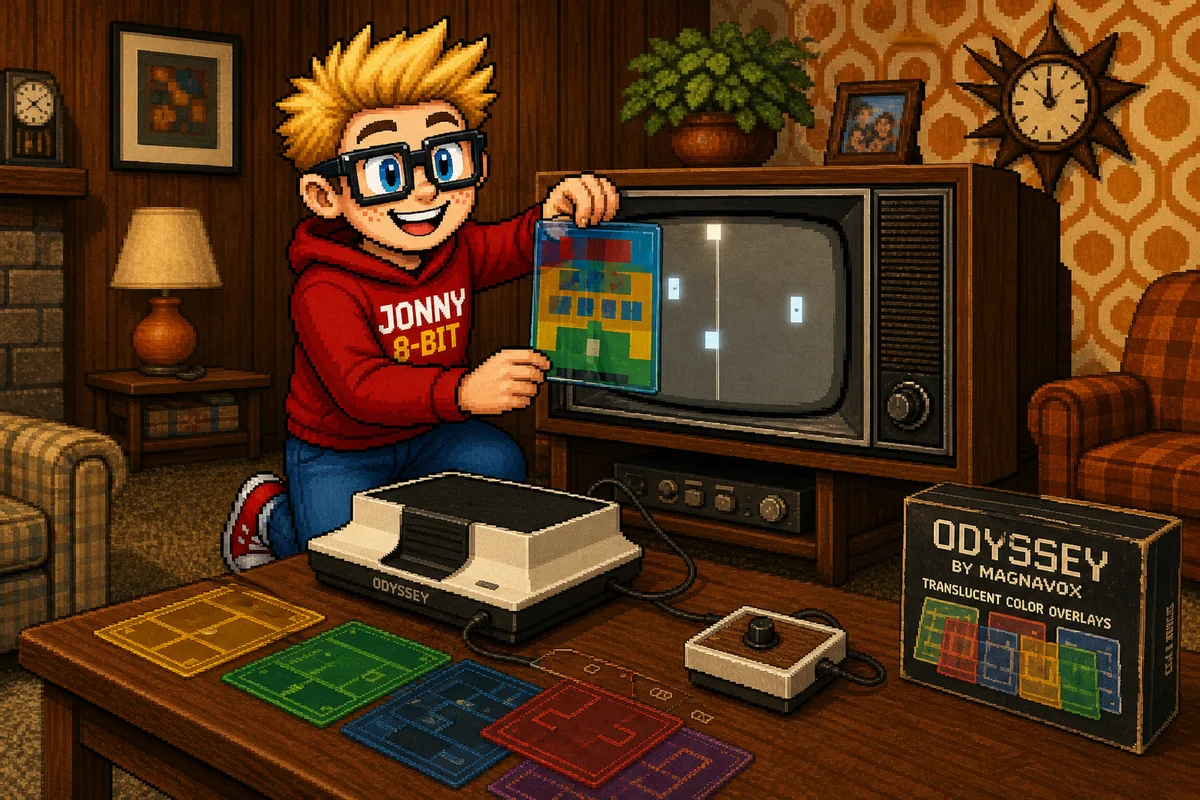
Imagine opening the first home video game console, connecting it to the family television, and seeing only a few white shapes on a black screen. There was no colorful field, crowd, haunted house, ski trail, or submarine. There was not even a score. The Magnavox Odyssey could create movement, but it could not draw the world around that movement. Its solution was wonderfully physical: players pressed a clear plastic picture against the television screen. Static electricity held it in place. Suddenly, the same glowing blocks appeared to be playing tennis, exploring a strange house, or moving through deep water. The overlays were not bonus decorations. They were an important part of how many Odyssey games worked. Together with cards, dice, tokens, and printed rules, they helped the first home console turn simple electronic signals into many different kinds of play.
Ralph Baer wanted people to play the television
The idea began with engineer Ralph Baer at Sanders Associates in New Hampshire. In 1966, when Baer was 44, most families used their television only to watch programs chosen by a broadcaster. Baer wondered whether people could control something on the screen themselves. He wrote down ideas for games that could be played on an ordinary home television. This was a bold question at a time when computers were large, expensive, and rarely found in a family home.
Baer worked with engineers Bill Harrison and Bill Rusch on a series of test machines. Their best-known prototype was later called the Brown Box because of its plain wood-grain covering. It allowed two people to control spots of light and play several games on a television. Sanders licensed the design to Magnavox, which turned it into the Odyssey and released it in 1972. It became the first commercial home video game console. That made it the living-room partner to Computer Space, the first commercial arcade video game, which had appeared the year before.
What the Odyssey could actually draw
Modern consoles store detailed art, animation, sound, rules, and entire worlds in software. The Odyssey did not work that way. It had no microprocessor, no computer memory, and no software code in the modern sense. Its electronic parts produced only a few bright shapes and a vertical line. Two shapes could be controlled by players, while another could act like a ball. The system could move these signals, detect some interactions, and change their behavior, but it could not fill the screen with scenery.
The controllers were also unlike today’s gamepads. Each one used dials to move a player’s light horizontally and vertically. Another dial changed the motion of the ball, a control Magnavox called “English.” Players had to keep score themselves because the console could not display numbers. It produced no sound effects and no color. Even on a color television, the electronic picture remained white. The machine supplied movement; the people in front of it supplied much of the meaning.
The overlays supplied the missing world
Magnavox printed game scenes on thin, see-through plastic sheets. A player placed the correct overlay against the front of the television and smoothed it into position. Static electricity usually held the sheet to the glass. The printed colors remained visible while the Odyssey’s white shapes shone through from behind. Because television sizes varied, Magnavox supplied overlay sets designed for the common screen sizes of the period. The process took more effort than choosing a game from a menu, but it also made setting up each game feel like opening a board-game box.
The clever part was how much the meaning could change without changing the basic electronic shapes. On one overlay, a bright block might be a tennis player returning a ball across a court. On another, it could become a person moving through rooms in Haunted House. In Submarine, the same light could represent a vessel or target beneath the water. The electronics did not know whether the players were skiing, playing football, solving a geography challenge, or chasing each other. The overlay and rulebook told the players what the signals meant.
Why the box included cards, dice, and money
The Odyssey package contained more than a console and controllers. It also included playing cards, dice, poker-style chips, scoreboards, tokens, and play money. Some games used only a few of these pieces, while others depended on them. Players might draw a card, move a token, answer a question, keep score on paper, or handle money while the television displayed the moving part of the game. To someone familiar with modern consoles, the box can look like several different products mixed together.
In 1972, however, board games were already a familiar form of family entertainment. Video games were not. The physical pieces gave families rules and actions they already understood. They also allowed the designers to create ideas that the electronic hardware could not manage by itself. This does not mean the Odyssey was pretending to be more powerful than it was. It means the designers treated the television as one part of a larger game. The screen handled motion, while people and physical pieces handled scoring, chance, memory, and imagination.
The game cards were not software cartridges
The Odyssey came with six plug-in game cards, but they were not cartridges filled with different programs. The cards contained no game software. Instead, each one connected parts of the console’s existing circuits in a different way. In simple terms, a card acted more like a switchboard than a storage device. Inserting one changed which shapes appeared and how they moved. The overlay, printed rules, and physical pieces then turned that electronic setup into a specific game.
This is why one game card could support more than one experience. A different overlay and rule set could give the same moving lights a new purpose. The original American package offered twelve named games using six electronic card setups. This approach required more work from the players, but it stretched a small amount of hardware across sports, chase games, education, strategy, and make-believe. The Odyssey was limited, yet its designers used every layer available to them.
Selling a kind of play nobody had seen before
Magnavox also had to teach customers what a home video game was. The Strong Museum notes that more than 60 million American homes had televisions in 1972, but people thought of them as devices for watching, not playing. Magnavox dealers used a small theater display and a five-minute promotional film to demonstrate the Odyssey. The film showed that the console could connect to any brand of television from 18 to 25 inches, explained how to insert a game card, and showed a family placing an overlay on the screen.
Later consoles could draw colorful backgrounds, play music, show scores, and store complete rules in software. Plastic television overlays quickly became unnecessary. Still, the Odyssey’s approach should not be dismissed as a strange mistake. It was a bridge between familiar tabletop games and a new electronic medium. Modern games still mix screens with cards, toys, musical instruments, cameras, and phone apps. The technology has changed, but the design idea remains useful: sometimes the best game is created not by the screen alone, but by everything happening around it.
Videos and further viewing
These videos add demonstrations, interviews, or visual context to the story. A privacy-enhanced YouTube player loads only after you choose a video. Review YouTube’s privacy policy.
The History of the Magnavox Odyssey Video Game Console 🕹️ Documentary
Video by IcebergDocsSee how Odyssey’s simple screen output, physical accessories, and television overlays worked together as complete games.