
Asteroids and the Beauty of Vector Graphics
Bright vector lines gave Atari’s 1979 hit a visual precision and physical feel unlike ordinary raster games.
 Narrated by Jonny 8-Bit6 min read · Published 8/20/2026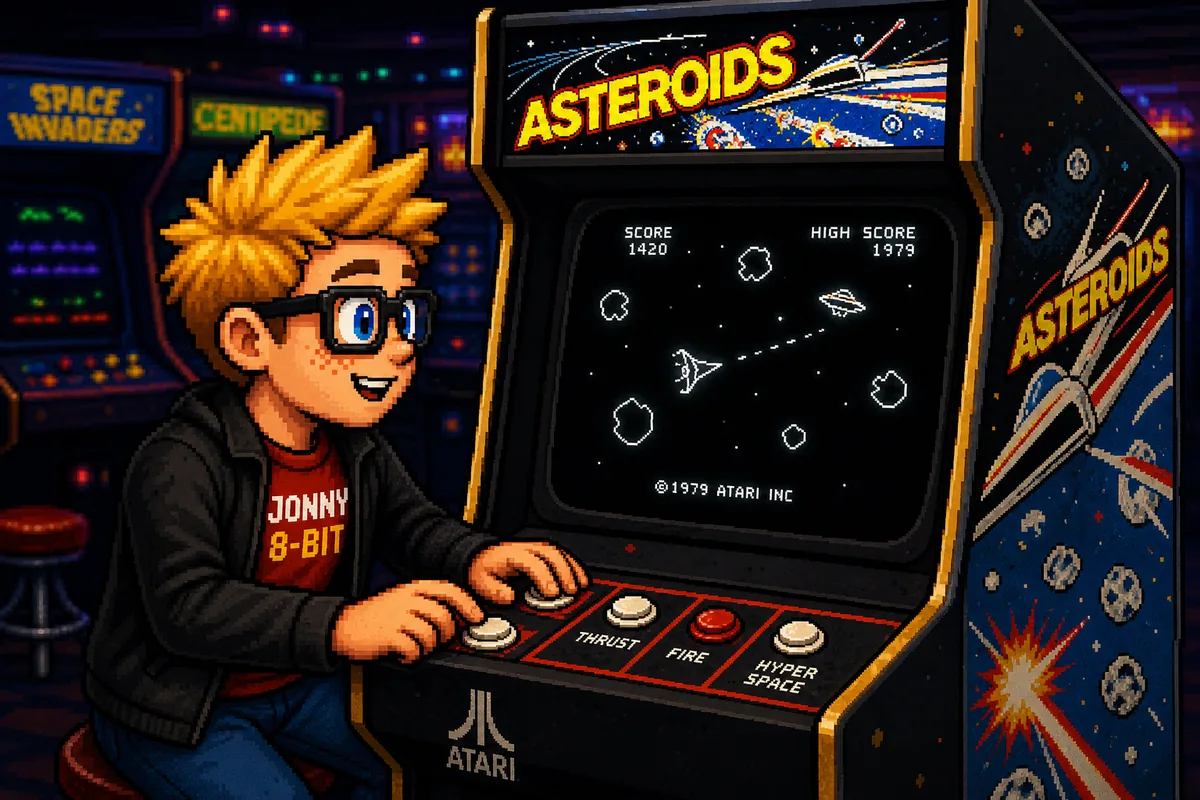
In a dark arcade, Asteroids did not look like a tiny television showing a cartoon. Its ship, rocks, bullets, and saucers appeared as sharp white lines in black space, almost too bright for the glass. Thrust made the triangular ship leap forward and leave a faint glow. A rotation button pointed its nose toward trouble, but momentum kept carrying it sideways.
Atari released Asteroids in November 1979, when Space Invaders had already turned the arcade market toward relentless science-fiction action. The new game answered that hit without copying its marching formation. It joined precise vector graphics to movement inspired by real inertia, then placed the player inside a field that could become more dangerous with every successful shot. Its beauty was not decoration placed over the rules. The display, motion, sound, and strategy all described the same lonely struggle in space.
The game began with a rock players wanted to shoot
The idea grew from an unsuccessful Atari project with a large asteroid serving as cover while players chased one another. Test players kept shooting the rock, but nothing happened. Engineering leader Lyle Rains saw a better possibility: make destroying rocks the goal. In 1979, he brought that idea to programmer and designer Ed Logg, whose recent work included Super Breakout.
Logg proposed having large asteroids split into medium pieces and then smaller, faster hazards. Shooting wildly could fill the screen with dangerous fragments. He also added flying saucers to attack players who left one asteroid untouched and played too safely. Rains supplied the starting idea; Logg shaped much of the design and programmed it. Asteroids was a collaboration, not a finished vision handed down by one inventor.
The game continued a line of space combat. MIT's Spacewar! let two ships turn, thrust, fire, and drift under gravity in 1962. Computer Space carried similar action into a 1971 coin-operated cabinet, as explored in our history of the first commercial arcade video game. Asteroids removed the second player and central star but kept momentum-based flight.
Vector graphics drew light directly onto darkness
Most arcade displays scanned horizontal rows to build a rectangular raster image. A vector monitor instead directed its electron beam between selected points and traced the required lines. The machine drew the ship, asteroid outlines, bullets, saucers, and score while leaving the rest of the screen black.
The technique produced exceptionally crisp shapes. Logg knew Atari's vector hardware and believed its clarity would show exactly where the ship was pointing. A few degrees could separate a clean shot from a collision. He remembered it as offering far higher effective resolution than the raster hardware available to him. Black-and-white graphics were a limitation, but empty space gave that limit a perfect home.
The display also produced an unplanned effect. Its slow phosphor glowed briefly after the beam moved, leaving delicate trails behind shots and ships. The streaks suggested speed and gave the outlines a presence that modern flat screens can imitate but not reproduce exactly. The moving beam was drawing the picture as light.
The controls made empty space feel dangerous
The cabinet used five buttons: rotate left, rotate right, thrust, fire, and hyperspace. With no immediate brake, players learned to tap thrust, rotate while drifting, and fire in a direction that might not match their travel. Flying well meant planning where the ship would be a moment later.
The playfield wrapped around its edges. A ship or rock leaving one side returned from the opposite side, so the black space had no safe wall. Hyperspace could move the ship to a random location, making it an emergency gamble rather than a carefully aimed teleport. The rocks also wrapped around, and breaking a large one created several smaller targets. The player constantly changed the problem while trying to solve it.
Saucers kept the action from settling. The large one fired less accurately, while the smaller one aimed dangerously. After testers called an immediate shot from beyond the screen edge unfair, Logg added a delay. It gave players time to react but also encouraged “lurking” strategies in which experts hunted valuable saucers. A rule meant to stop cautious play created another form of mastery.
Sound and scoring gave the lines a heartbeat
With no colorful scenery or melody, every sound carried weight. Firing, thrusting, saucers, and explosions had distinct electronic voices. A two-tone pulse quickened as a wave continued. Less clutter did not mean safety; the remaining fragments were faster and pressure was rising.
Scoring made the pressure public. Asteroids was among the early coin-operated games that let top players enter three initials. The initials became a signature for friends, rivals, and strangers. Long after the player walked away, the cabinet remembered who had survived longest.
Asteroids became Atari's biggest arcade machine
The combination worked immediately. Logg recalled Atari employees waiting for him to leave so they could play the unfinished version, then returning the next morning to find new high scores. The field test confirmed that the attention was not limited to coworkers: earnings stayed high week after week. Asteroids arrived just after Space Invaders helped ignite Japan's arcade boom, and it soon replaced that game in many North American locations.
The Strong National Museum of Play reports that Atari sold more than 70,000 Asteroids cabinets, earning an estimated $150 million and making it the company's best-selling arcade game. Operators collected an estimated $500 million in quarters. Those numbers are historical estimates rather than an exact worldwide audit, but they show the scale. A design built from monochrome lines outperformed machines with more obvious visual detail.
The Atari 2600 could not reproduce the vector monitor's glow, so its port used raster graphics. Even so, The Strong reports sales of 3.8 million cartridges. Sequels and inspired designs spread the idea across arcades and home computers, proving that the rules could survive a change in display technology.
Why the vector look remains beautiful
Asteroids was not the first vector arcade game. Cinematronics and Vectorbeam had released Space Wars in 1977, and Atari used its own vector system for Lunar Lander earlier in 1979. More vector titles followed, including Battlezone, Tempest, and Atari's Star Wars. The approach faded as raster hardware improved, color became expected, and developers wanted filled characters and detailed scenes that vector lines could not provide efficiently.
Yet technical progress does not make every older image less effective. These lines communicate direction, distance, speed, and collision. The darkness is not missing art; it is room for motion. The glow comes from how the monitor makes the picture. Vector graphics gave Asteroids an appearance inseparable from its play, so an original cabinet can still feel more vivid than a precise modern copy.
Videos and further viewing
These videos add demonstrations, interviews, or visual context to the story. A privacy-enhanced YouTube player loads only after you choose a video. Review YouTube’s privacy policy.
Atari's Quadrascan Explained
Video by Retro Game Mechanics ExplainedA technical visual explanation of the vector-display system behind Asteroids and other Atari arcade machines.