The Brown Box That Became the Magnavox Odyssey
Ralph Baer looked at the television in millions of homes and asked a radical question: what if viewers could play it?
 Narrated by Jonny 8-Bit6 min read · Published 8/20/2026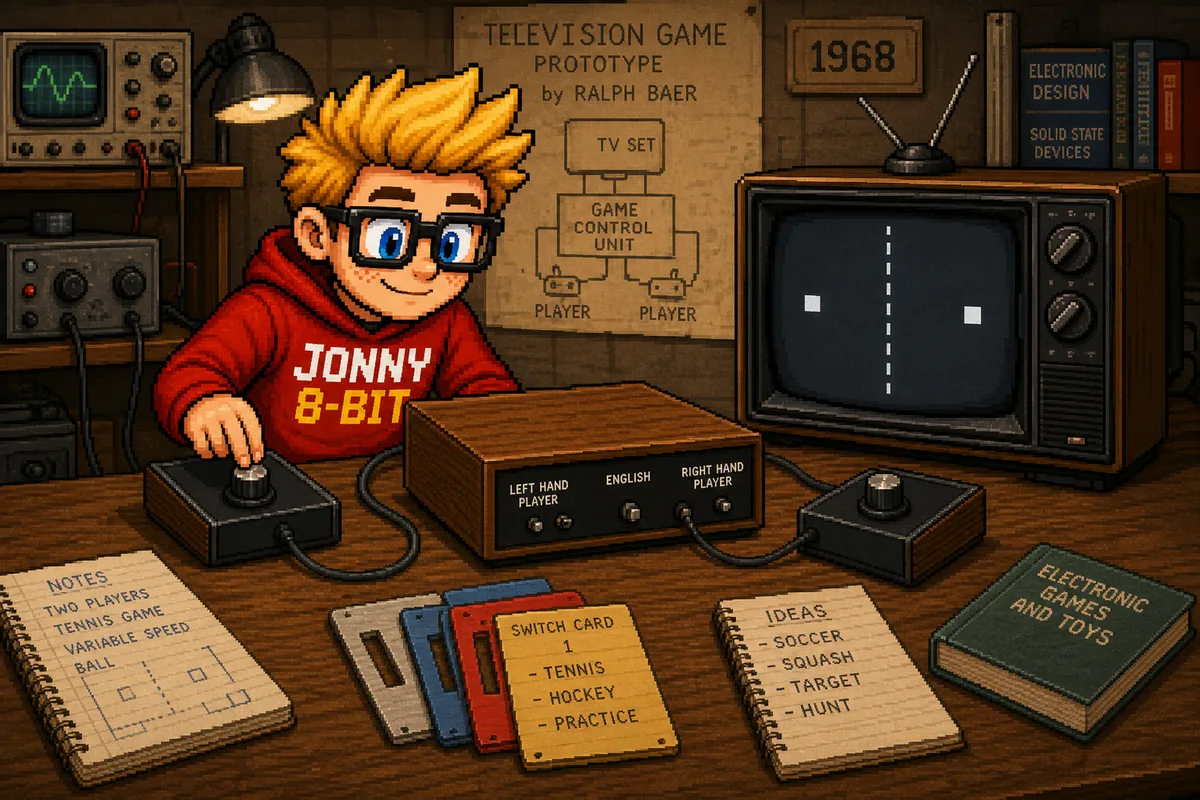
On the last day of August 1966, Ralph Baer sat in a New York City bus terminal with a small notebook balanced on his knee. He was waiting for another engineer to arrive for a business meeting, but his thoughts had drifted to the television sets inside American homes. Baer later recalled jotting down ways that people might do more than watch those screens. What if they could control objects on them and play games?
The next morning, back at Sanders Associates in New Hampshire, he turned those notes into a four-page disclosure document. Baer was not describing a coin-operated arcade machine or a program for an expensive university computer. He imagined a small box that could connect to an ordinary television and support many kinds of games. Six years later, the idea reached stores as the Magnavox Odyssey—the first commercial home video game console.
Baer saw a second job for the family television
Ralph Baer was born in Germany in 1922. His Jewish family fled Nazi rule and came to the United States in 1938, when he was 16. He trained as a radio technician, served in U.S. Army Military Intelligence during World War II, and earned a degree in television engineering in 1949. By 1966 he was a division manager at defense contractor Sanders Associates, responsible for nearly 500 engineers, technicians, and support workers.
Television had been on his mind for years. While working at Loral in the 1950s, Baer suggested adding a game to a television set so it would stand apart from competitors. Management rejected the idea. By 1966, Baer estimated that about 40 million televisions were already in American homes. Those sets spent most of their time receiving programs chosen by broadcasters. To an engineer, that looked like a huge installed network of screens waiting for another purpose.
Baer’s September 1 document proposed action, board, sports, and chase games. He imagined that a game box might sell for around $25. The term “video game” was not yet common, so he called the concept “TV games.” The important shift was simple: viewers would no longer be passive. Their controls would affect what appeared on the television.
A quiet side project became official research
Building the idea did not fit Sanders’ usual military-electronics business. Baer initially put a technician to work in a room away from the company’s main projects. After demonstrations convinced Sanders’ research leadership that the concept had value, the company gave it a modest official budget and protected the work through patents.
The first test unit produced a spot that a person could move on a television screen. That sounds tiny, but it proved the essential connection: an external device could generate an image, send it through a standard television’s antenna connection, and let a player control its position. The television did not need to be rebuilt from the inside.
Baer then worked with Bill Harrison and Bill Rusch. Harrison turned ideas into dependable electronic hardware, while Rusch contributed game concepts and pushed the system toward stronger competition. From 1967 through 1968, the team built increasingly capable numbered prototypes rather than jumping directly to one finished console.
The Brown Box gathered the best experiments
By 1968, the final demonstration system could generate two player-controlled spots, another spot that could act like a ball, and a vertical line. It supported games resembling ping-pong, handball, volleyball, soccer, checkers, and target shooting. The team also created a light gun that sensed targets on the television, placing shooting games near the very beginning of home console history.
This advanced prototype became known as the Brown Box because its case and controllers were covered in brown wood-grain vinyl. The finish made a bundle of experimental electronics look more like a product that belonged near living-room furniture. Its plain nickname hides what it demonstrated: one reusable system could become many games instead of performing only one electronic trick.
The Brown Box used switches to select different arrangements of its circuitry. Paper guide cards fit between the rows of switches and showed players which positions to use for each game. They did not hold software. They were instructions for configuring electronics already inside the box.
It was a platform without a processor or software
Neither the Brown Box nor the Odyssey contained a microprocessor. They did not load programs from memory, and their bright rectangles were not computer graphics in the later cartridge-console sense. Hardware circuits generated and controlled the television signals directly. The results were limited, but they responded instantly to the two handheld controllers.
Magnavox later replaced the Brown Box’s switches with plug-in game cards. Inserting a card connected different parts of the internal circuitry; it did not add a program. That makes Odyssey very different from the later Atari 2600 and its interchangeable software cartridges. Odyssey acted like a multi-game platform, but most of its variety came from rearranging a fixed set of electronic abilities.
Many games added printed rules, dice, tokens, score sheets, and clear scenery placed over the television. These physical pieces helped a few white shapes become tennis players, explorers, skiers, or submarines. Our separate history of the Odyssey’s plastic television overlays explains why they were part of the game rather than simple decoration.
Magnavox turned the prototype into a product
Sanders built technology but did not sell family entertainment systems, so Baer demonstrated the Brown Box to television manufacturers. Representatives from companies including RCA, Sylvania, General Electric, Motorola, and Magnavox saw it. Interest did not immediately become a deal. Baer’s team had created a product category that companies did not yet know how to manufacture, explain, or sell.
Magnavox committed to the project in 1970 and completed a licensing agreement with Sanders in 1971. Its engineers converted the hand-built prototype into a consumer device, changed the cabinet to a clean white-and-black design, created plug-in selector cards, and named the system Odyssey. Baer and Sanders remained the inventors and licensors; Magnavox performed the production engineering and brought it to market.
The Odyssey reached American consumers in 1972 for about $100. It was sold through Magnavox dealers and was demonstrated with Magnavox televisions. That approach helped create the mistaken belief that it worked only with the company’s TVs, even though it was designed for ordinary sets. Consumers also had no familiar word such as “console” to explain why they might want the unfamiliar box.
A modest machine created a permanent category
Sales figures vary by source and accounting period, but MIT’s Lemelson program reports roughly 100,000 units in the first year and more than 350,000 by 1975. That was not enough to make Odyssey a mass-market giant, yet it put controllable television games into homes before the console business had established rules, stores, or an audience.
The system’s table-tennis game also became part of the story of Atari’s arcade hit Pong. Sanders and Magnavox later enforced television-game patents against Atari and other companies. Those lawsuits made the Brown Box important legal evidence, but the patents should not hide the design achievement that came first.
Baer’s group treated the television as both a display and a play space. They established the basic arrangement still recognized today: a reusable box beside the TV, separate controllers in players’ hands, and several experiences available through one machine. The Brown Box did not merely become the Odyssey. It showed manufacturers what a home game platform could be.
Videos and further viewing
These videos add demonstrations, interviews, or visual context to the story. A privacy-enhanced YouTube player loads only after you choose a video. Review YouTube’s privacy policy.
1972 Magnavox Odyssey | The First Console | Video Game History Channel
Video by Video Game History ChannelSee the commercial Odyssey hardware that grew out of Ralph Baer’s Brown Box prototypes.