How the Atari 2600 Popularized Interchangeable Cartridges
The cartridge slot separated one long-lived machine from an expanding—and eventually difficult to control—market of games.
 Narrated by Jonny 8-Bit6 min read · Published 8/20/2026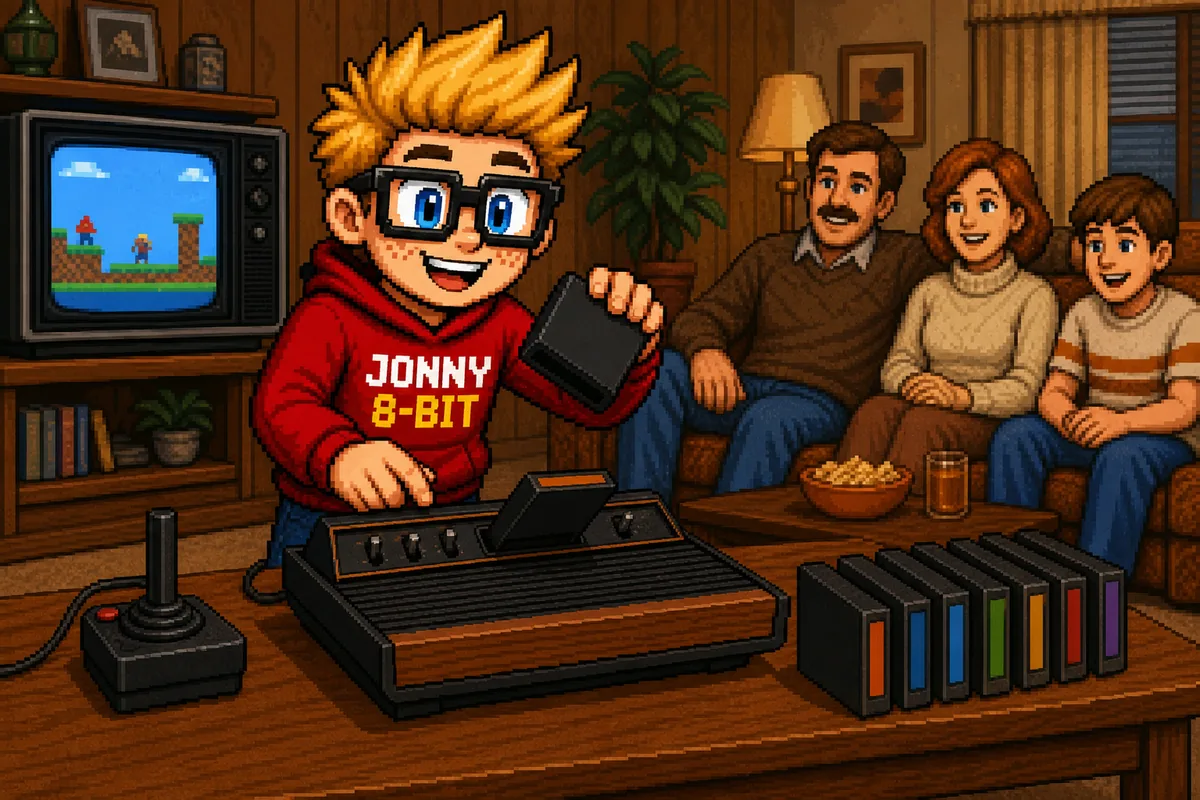
Before interchangeable cartridges became normal, buying a home video game often meant buying one permanent set of games. A machine designed for Pong could offer several variations of paddles and a ball, but it could not become a racing game or a space adventure when the player wanted something new. Even the original Magnavox Odyssey used cards mainly to change circuits and screen rules; the game information did not live on those cards as software.
The Atari Video Computer System, released in 1977 and later renamed the Atari 2600, helped replace that idea with a lasting one: keep the console, then build a library. It did not invent the programmable cartridge console. Fairchild’s Channel F reached stores in 1976. What Atari did was make the model widely successful through strong retail distribution, familiar arcade games, clever engineering, and a software catalog that kept growing for years.
Atari needed a machine that could change
Atari had already sold dedicated home versions of Pong, but a custom game machine carried a serious problem. Hardware took time and money to design, while public taste moved quickly from one arcade hit to the next. An IEEE Spectrum history explains that a custom chip could take a year or more and cost over $100,000 to develop. By the time a home version arrived, players might have moved on.
Engineers at Atari and its Cyan Engineering group began developing a programmable system, code-named Stella, in 1975. Instead of building a new console for every idea, they wanted a low-cost machine that software could reshape. The falling price of microprocessors made that possible. Atari selected a version of MOS Technology’s affordable 6502 processor family and designed custom display hardware around it.
What the cartridge actually changed
An Atari cartridge contained read-only memory, or ROM, holding the instructions and data for a game. In simple terms, the console supplied the reusable engine while the cartridge told it what experience to create. Insert Combat and the machine drew tanks or airplanes. Insert Adventure and it became a world of rooms, dragons, objects, and a hidden surprise. The plastic cartridge was small, but the idea behind it was enormous.
That separation changed how a family bought games. The console was no longer judged only by what it could play on launch day. Every new cartridge could add value to hardware already sitting under the television. Stores gained a continuing product category, players gained collections they could trade or lend, and publishers could sell software without asking customers to buy another complete machine.
A tiny machine left room for big tricks
The 2600’s flexibility did not come from powerful hardware. It used an 8-bit MOS 6507 processor and only 128 bytes of working memory. Early cartridges held just 2 kilobytes of ROM. The console did not store a complete picture in a normal frame buffer. Instead, software had to feed the display hardware at the right moments while a television drew the picture one line at a time—a demanding style often described as “racing the beam.”
Those limits made programming difficult, but they also allowed developers to discover effects the original designers had not planned. They reused and changed simple screen objects while a frame was being drawn. Later cartridges used techniques such as bank switching to access more than the cartridge connector’s original 4-kilobyte address range. The same 1977 console could therefore run games that looked far more advanced than its earliest releases.
The library became the best advertisement
The system launched with Combat, a cartridge containing tank and airplane variations. That was a useful demonstration, but the 2600 became far more desirable when it began bringing famous arcade experiences home. The 1980 conversion of Space Invaders was especially important. The Computer History Museum reports that it caused a major increase in console sales. Instead of asking whether the VCS had interesting games, shoppers could recognize a hit they already wanted.
More arcade conversions and original releases followed. Asteroids, Missile Command, Pac-Man, Pitfall!, and many others gave the cartridge shelf its own identity. The Computer History Museum says the 2600 sold more than 20 million units through the 1980s and that more than 500 games were eventually available for the console. Other counts are higher when international, homebrew, and unlicensed releases are included, but the central point is clear: the library became much larger than Atari’s designers first imagined.
Cartridges also opened the door to outside publishers
At first, Atari expected to control the software made for its machine. Some of its programmers wanted more credit and better rewards for games that produced large sales. In 1979, former Atari developers formed Activision, an independent company that made cartridges for the VCS without being owned by the console maker. Atari sued, but Activision continued and became a major publisher.
That fight helped establish another feature of the modern game business: hardware made by one company can support software from many others. Independent publishers increased competition and gave players more choices. They also made individual designers more visible; Activision’s boxes and manuals promoted the people who created the games rather than treating them as anonymous factory workers.
The strength of the model exposed a weakness
A cartridge market could grow faster than a hardware maker could control it. By the early 1980s, many companies were producing 2600 games, and quality varied widely. Retailers faced too many consoles and too much software, including weak games that were difficult to sell. The Computer History Museum identifies poor game quality and oversupply as two causes of the North American video game crash of 1983.
It would be too simple to blame that crash on one cartridge or one company. Atari’s troubled E.T. release became the famous symbol, but the market had larger problems. Still, the crash showed that a successful platform needed more than an open slot and a flood of products. Later console makers paid close attention to licensing, quality rules, and the number of games reaching stores.
There is also a fun contradiction at the center of its history. Atari’s engineers designed a low-cost console they expected to last only a few years. Programmers kept finding new tricks, publishers kept filling shelves, and players kept buying games. The hardware was limited, but the cartridge made its future expandable—and that idea still powers consoles, app stores, and downloadable game libraries today.
Videos and further viewing
These videos add demonstrations, interviews, or visual context to the story. A privacy-enhanced YouTube player loads only after you choose a video. Review YouTube’s privacy policy.
History of Atari's Crazy Consoles, Clones & Adapters of the VCS/2600 (2nd Gen Game Console Hardware)
Video by HeroJournalismExplore the Atari VCS hardware family and the cartridge ecosystem that grew around the long-lived console.