Why Nintendo Used R.O.B. to Help Introduce the NES
The little robot played only two games, but its most important job happened in the toy aisle before the console reached a television.
 Narrated by Jonny 8-Bit6 min read · Published 8/20/2026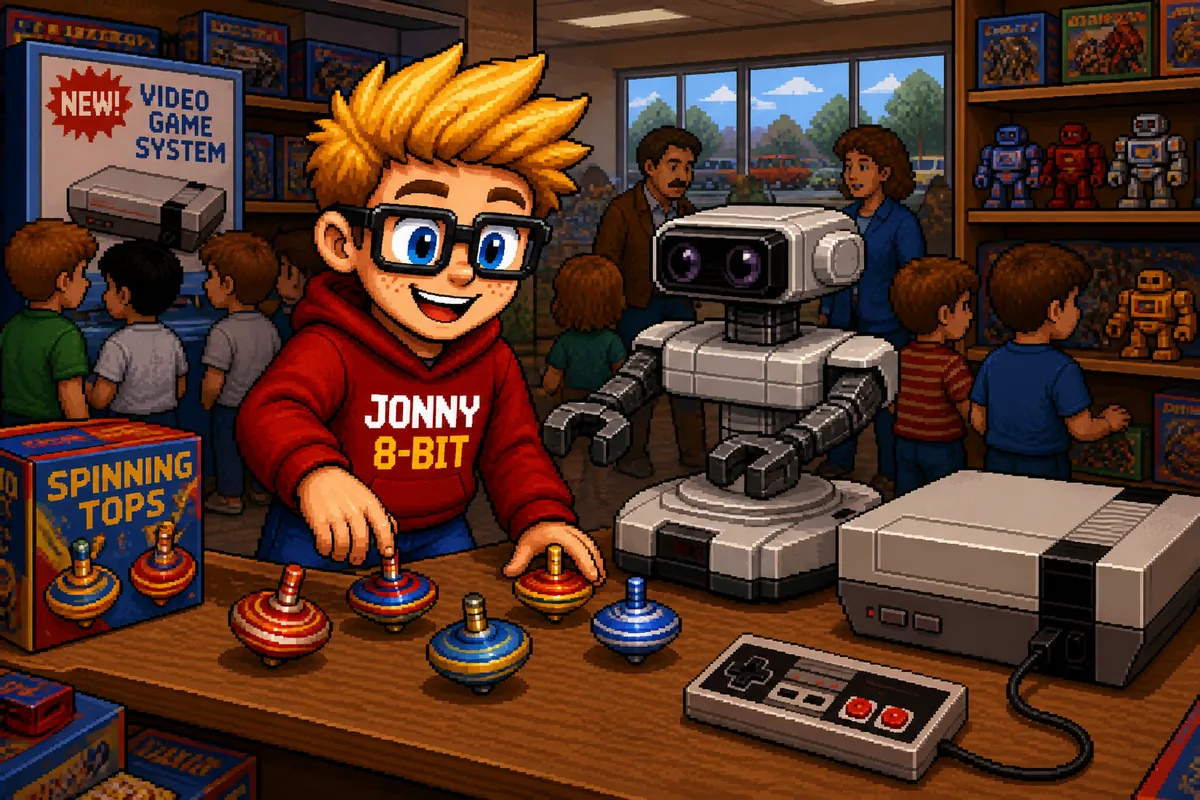
At a 1985 electronics show, Nintendo had a strange problem. Its new game machine worked, its Japanese version was already a hit, and its software included some of the company’s best ideas. Yet American retailers had little reason to trust another home console. Nintendo’s answer soon stood beside the machine: a small gray robot with red plastic hands and eyes aimed at the television.
R.O.B.—the Robotic Operating Buddy—was slow, complicated, and supported by only two games. Judged only as a controller, it looks like an idea that disappeared almost immediately. Judged as part of Nintendo’s U.S. launch strategy, it makes much more sense. R.O.B. gave stores and families something visibly different to notice while the Nintendo Entertainment System worked to prove that console games were worth buying again.
Selling a console after the crash
The North American video game crash had left stores with discounted cartridges, failed systems, and customers who no longer trusted every colorful box. Atari’s rushed E.T. release became the event’s most famous symbol, although the landfill story was only one part of a much larger market collapse. By 1985, “new video game console” was not automatically an exciting sales pitch. To a retailer, it could sound like another shelf full of future clearance items.
Nintendo had better news in Japan. Its Family Computer, or Famicom, had sold about 2.5 million units in its first 18 months, according to material preserved by the Video Game History Foundation. The challenge was translating that success for the United States. Nintendo of America needed a product retailers would stock, parents would consider valuable, and children would recognize as something more interesting than the consoles that had recently vanished from stores.
The NES almost wore a very different costume
Nintendo first showed an American concept called the Advanced Video System at the Winter Consumer Electronics Show in Las Vegas in January 1985. The AVS looked like high-end consumer electronics. Its proposed accessories included wireless controllers, keyboards, and a tape drive. It suggested that Nintendo was offering a stylish home-technology center rather than a simple toy.
That version did not become the final product. Some proposed technology was not practical for mass production, and the design failed to give the system a clear path into a cautious retail market. At the Summer Consumer Electronics Show in Chicago five months later, Nintendo presented a simpler machine, removed many of the computer-like extras, added R.O.B., and began positioning the Nintendo Entertainment System as a toy. The change was not just a new shell. It was a new answer to the question, “What kind of product is this?”
What the robot actually did
R.O.B. first appeared in Japan as the Family Computer Robot in July 1985. The North American version arrived with the NES test launch that October. A sensor in the robot’s head watched the television for coded flashes produced by a compatible game. Those signals told its motorized body to turn, raise or lower its arms, and open or close its hands. The console did not need a cable connecting it to the robot.
Only Gyromite and Stack-Up used the device. In Gyromite, R.O.B. handled spinning gyros that could press the A or B button on a second NES controller, raising and lowering colored gates for Professor Hector on the screen. Stack-Up used trays and colored blocks that the robot physically rearranged. The motions were slow, setup required patience, and the play rarely felt as smooth as controlling an ordinary action game. But watching a television send commands to a moving robot looked futuristic in 1985.
R.O.B.’s most important game happened in the store
Nintendo placed the robot at the center of its Deluxe Set, alongside the Control Deck, two controllers, the Zapper light gun, Gyromite, and Duck Hunt. The package looked less like a repeat of an old console and more like a complete electronic play system. A salesperson could demonstrate light-gun shooting and a robot moving real objects. A magazine advertisement could show more than another joystick beside a plastic box.
Nintendo’s language supported the same presentation. Cartridges became “Game Paks,” the console was the “Control Deck,” and early game boxes used pixel-like images that resembled what buyers would actually see on the screen. Nintendo marketing manager Gail Tilden later explained that the packaging was meant to avoid overselling games with artwork that promised more than the hardware delivered. R.O.B. supplied spectacle, while the straightforward boxes and terminology tried to rebuild confidence.
It was not a secret plot or a one-robot rescue
R.O.B. is often called a “Trojan horse” that tricked retailers into accepting a game console. The phrase captures its usefulness as a door opener, but it can make Nintendo’s plan sound more cynical and certain than it was. Tilden recalled that the team genuinely believed robots were cool and would attract attention. She said they were not thinking, in effect, “we are fooling everyone.” They wanted a convincing point of difference in a market whose future was unclear.
It is also too much to claim that R.O.B. single-handedly saved the American game business. Nintendo used a New York test market, demonstrations, distinctive hardware, careful packaging, a growing catalog, and continued retail work. Within four to six months, Tilden recalled, the Los Angeles test offered a less expensive base-style set built around Mario rather than forcing every buyer to purchase both R.O.B. and the Zapper. The robot attracted the first look; games such as Super Mario Bros. gave the system its lasting value.
A tiny library with an unusually large legacy
Because only two games supported R.O.B., the device quickly stopped being central to the NES. It was not a platform that developers continued expanding. For many owners, the robot became a shelf decoration after the novelty of spinning gyros and moving blocks wore off. From a normal accessory perspective, that is a very short life.
Nintendo nevertheless kept the character alive through later cameos, collectibles, and appearances in the Super Smash Bros. series. That afterlife fits the robot’s original strength: R.O.B. is instantly recognizable. Its round base, binocular eyes, and mechanical arms communicate “Nintendo robot” before anyone explains the rules of Gyromite. The design did its job as an image even longer than it did as a controller.
The real lesson is not that marketing can replace a good product. It is that a good product sometimes needs a bridge into the room. R.O.B. caught people’s attention long enough for Nintendo’s software, quality controls, and ordinary gamepad to make the stronger argument.
Videos and further viewing
These videos add demonstrations, interviews, or visual context to the story. A privacy-enhanced YouTube player loads only after you choose a video. Review YouTube’s privacy policy.
R.O.B. Saved The Gaming Industry
Video by JustSayStevenSee how Nintendo presented R.O.B. as a robotic toy while introducing the NES to cautious American retailers.