Space Invaders and the Beginning of Japan’s Arcade Boom
A marching formation and a relentlessly accelerating rhythm changed the arcade business.
 Narrated by Jonny 8-Bit6 min read · Published 8/20/2026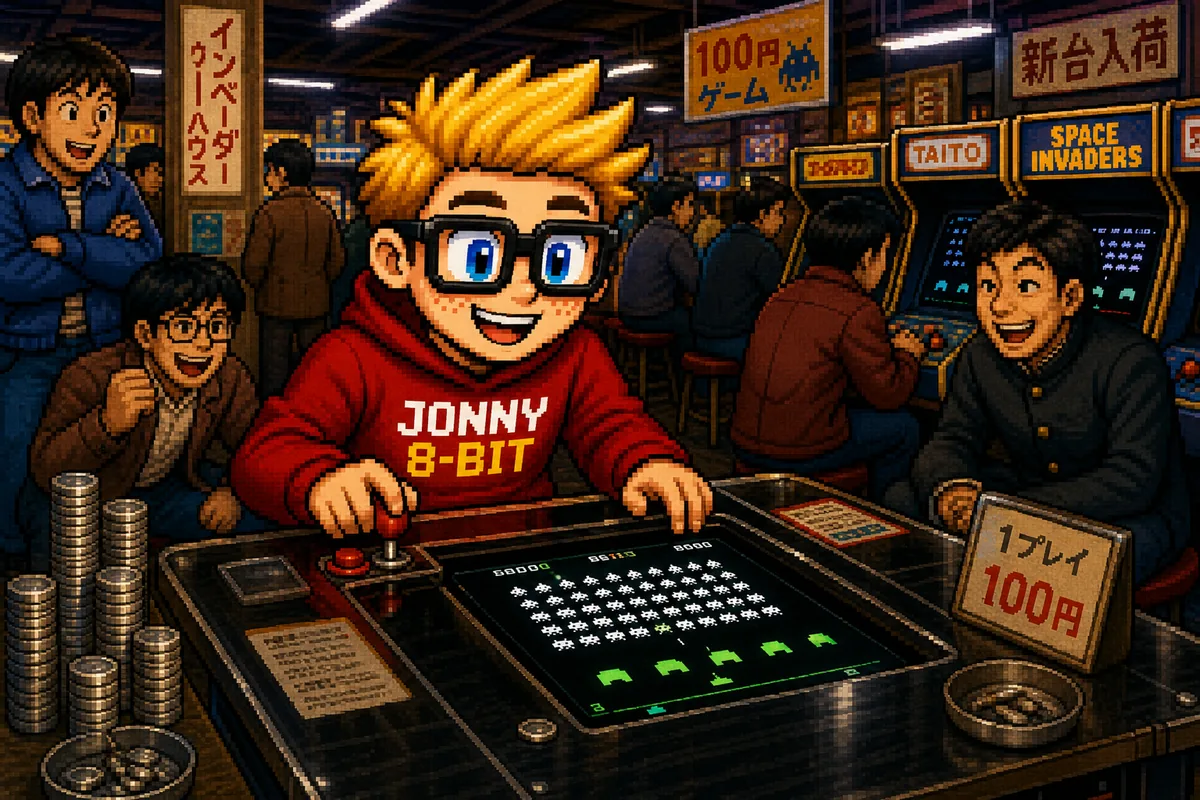
In 1978, an ordinary Japanese coffee shop could feel like the front line of an alien invasion. Customers sat at tables with built-in screens, inserted a 100-yen coin, and moved a laser base beneath descending creatures. Four heavy notes repeated as the formation crept lower. The rhythm quickened, the safe space disappeared, and somebody nearby waited for a turn.
The game was Taito's Space Invaders, created by engineer Tomohiro Nishikado. It did more than become a popular machine. Dedicated “Invader Houses” filled rooms with its cabinets, coffee shops replaced regular tables with game tables, and competing manufacturers rushed out similar shooters. Japan already had an amusement business and earlier video games, so Space Invaders did not create the country's arcade industry from nothing. It did give that industry a breakthrough large enough to change its scale, audience, and direction.
Trying to build something beyond Breakout
Nishikado had experience with electronics long before he faced the invaders. As a child, he built a homemade pinball machine, and as a teenager he experimented with radios and amplifiers. At Taito, he worked on mechanical amusements and designed about ten video games before Space Invaders, including Speed Race and Western Gun. This was a period when one designer might plan a game, assemble its circuits, draw its graphics, and test the machine.
The immediate challenge came from Atari's Breakout. Nishikado saw its success in Japan in 1977 and wanted to make a game that improved on its simple idea of clearing a wall of blocks. Instead of bouncing a ball, the player would shoot targets that could move and attack. This placed his work in a longer arcade conversation that began with hits such as Pong, which made Atari an arcade powerhouse. The difference was that Nishikado wanted the targets to feel like an organized enemy rather than passive shapes.
One designer had to build his own tools
Turning that idea into a machine took about a year and a half, including time spent creating development tools. Earlier Taito games were largely controlled through circuits built for one design. For Space Invaders, Nishikado assembled a microcomputer-based system and wrote the game in assembly language. Commercial equipment was too expensive, so he made much of his working setup. His job combined roles now divided among hardware engineers, programmers, artists, and designers.
The theme changed several times. Tanks and battleships did not move well, while shooting the better-animated soldiers made people inside Taito uncomfortable. Science fiction provided an answer. News about Star Wars, already a U.S. sensation before its Japanese release, made space timely. H. G. Wells's The War of the Worlds helped inspire the creatures' sea-animal shapes. With few pixels available, squid-like, crab-like, and octopus-like invaders were strange, readable, and memorable.
Hardware limits created perfect suspense
The rules were simple enough to learn by watching. The player moved left and right, fired upward, and hid behind shields that broke apart under fire. The invaders crossed together, dropped at the edge, and continued until they reached the player's level. A mystery UFO offered bonus points. There was no final rescue; surviving one wave brought another attack.
The game's most famous effect came partly from its hardware. At the start of a wave, the processor had to update and draw a large formation. As aliens were destroyed, there were fewer objects to handle, so the survivors moved more quickly. The four-note pulse followed their movement and accelerated with them. Nishikado wanted the challenge to rise and keep players trying again, but the exact speedup emerged from the machine's limited capacity rather than a normal instruction that simply increased a speed number. A restriction became a difficulty curve that still feels carefully dramatic.
That curve supported the coin-operated business. A beginner could shoot several aliens, while an expert chased scores and safer patterns. Yet every hit made the remaining formation more dangerous. A session could be brief, but failure looked correctable: move earlier, aim better, protect a shield, or face the final alien without panicking. One more coin promised another chance.
Invader Houses spread across Japan
The response moved beyond traditional amusement locations. Compact table cabinets fit inside coffee shops, restaurants, and businesses that might reject a large upright machine. The table still held drinks while its screen created an arcade. Former Taito president Yoichi Wada later remembered students searching for coffee shops with authentic Taito tables and playing all night. Some locations became Invader Houses devoted mainly or entirely to Space Invaders.
Historian Andrew Williams reports that more than 100,000 machines were sold during the game's Japanese debut. Its success attracted direct copies and games built around the same basic idea of a lone defender firing at a formation. It also encouraged companies to invest in new video games and gave location owners a clear example of how much money an appealing cabinet could earn. Nishikado later said that Japan's game industry grew significantly after the release and that the number of game companies boomed.
Players contributed by discussing scores, patterns, and tricks. The “Nagoya shot” exploited how enemy fire behaved when the formation moved extremely close to the player. Friends heard tactics through conversation and broadcasts, then tested them at a machine. The arcade was becoming more than a row of coin boxes; game knowledge, competition, and reputation circulated among players.
The 100-yen shortage story needs an asterisk
The most repeated story says Space Invaders swallowed so many 100-yen coins that Japan faced a national shortage and the mint multiplied production. The success makes the tale sound believable, but the documented numbers do not support it. Arcade operators also emptied profitable machines and deposited the earnings, returning coins to circulation.
Williams notes that Japan minted 292 million 100-yen coins in 1978, down from 680 million in 1973. Production rose after 1979, but not to the level claimed in common versions of the legend. Older 100-yen coins contained silver, and hoarding or melting those coins provides another possible reason for tight circulation. Local shortages near busy arcades may have occurred, but evidence does not establish a nationwide crisis caused by one game. The real boom does not need the myth: packed Invader Houses and more than 100,000 machines are dramatic enough.
A turning point rather than a starting line
Before Space Invaders, Japanese companies including Taito, Sega, and Namco already made amusement machines and electronic games. Pong, Breakout, racing games, and shooting games had already taught operators and players how a video arcade could work. Calling 1978 the beginning of Japan's arcade boom therefore means identifying a turning point, not pretending nothing came before it.
What changed was the audience's size and the business's confidence. Space Invaders showed that a game could become a national phenomenon, support specialized locations, inspire strategy talk, and make abstract characters recognizable. The boom made room for more Japanese design, including the character-driven approach behind Pac-Man's pizza-shaped origin story. The invaders did not build Japan's arcade culture alone, but their march opened the gates.
Videos and further viewing
These videos add demonstrations, interviews, or visual context to the story. A privacy-enhanced YouTube player loads only after you choose a video. Review YouTube’s privacy policy.
How Space Invaders Birthed Japanese Games
Video by Game Maker's ToolkitA design-focused history of Space Invaders and the Japanese arcade industry that expanded around its success.