
The Atari E.T. Landfill: What Was Actually Buried?
Atari really buried E.T. cartridges in New Mexico, but the landfill held a much broader—and more revealing—collection of unwanted inventory.
 Narrated by Jonny 8-Bit6 min read · Published 8/15/2026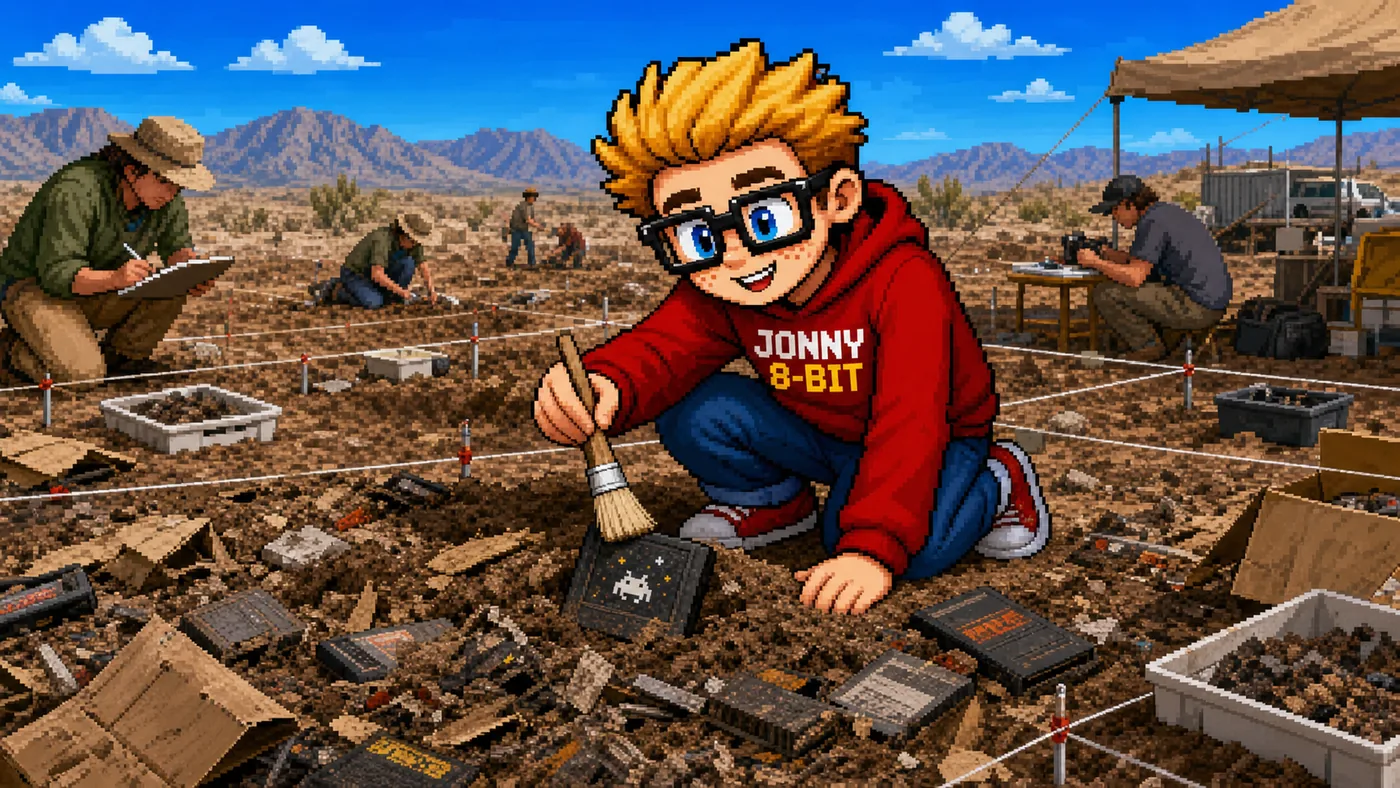
On April 26, 2014, an excavation crew dug nearly 30 feet into an old landfill in Alamogordo, New Mexico. A crowd waited above the pit as workers searched through layers of ordinary trash. Then an Atari joystick appeared. Soon the team held up a dirt-covered copy of E.T. the Extra-Terrestrial for the Atari 2600. A gaming legend had become a physical object.
The popular story claimed Atari secretly buried millions of unsold E.T. cartridges after the game failed. The dig proved that Atari products were there, including E.T., but it also revealed the legend’s biggest mistake. This was not one game’s private grave. It was a mixed load of excess cartridges, hardware, packaging, and returned merchandise from an Atari operation in El Paso, Texas.
The burial was reported in 1983
Atari’s dumping was never completely secret. Local newspapers reported trucks arriving at the Alamogordo landfill in September 1983, and the story soon reached national news. Residents knew something unusual had been buried. Young scavengers even entered the site and carried away Atari products before officials took stronger steps to seal the material.
What became uncertain was the exact content and amount. Reporters could not carefully inspect a crushed deposit under tons of later waste, and Atari changed ownership as its business declined. Over the following decades, a documented disposal turned into an urban legend. Each retelling focused more heavily on E.T., until “Atari dumped old inventory” became “Atari hid millions of copies of the worst game ever made.”
The load came from Atari’s El Paso operation
James Heller was an Atari manufacturing manager who arranged the Alamogordo disposal. In a 2014 interview, he explained that the company wanted excess inventory removed while it reorganized work at its El Paso facility. Cartridge production there had ended earlier in 1983 as manufacturing moved overseas. The site was also receiving merchandise returned by retailers and distributors.
Heller remembered 12 truckloads containing approximately 750,000 cartridges. The Henry Ford Museum uses a rounded estimate of about 700,000. Those are informed estimates, not a count made when the pit was opened. Heller said about 95 percent of the cartridges were new and that they represented many titles. He also recalled discarded consoles, trackballs, and other accumulated material. The burial was a warehouse-clearing job meant to save money, not a shipment made entirely of one failed game.
E.T. was there, but it was not alone
The 2014 excavation recovered roughly 1,300 cartridges from a small part of the deposit. E.T. was among the first recognizable titles, but workers also uncovered games such as Centipede, Asteroids, Missile Command, and others. Boxes, manuals, controller pieces, and damaged hardware appeared in the same layer. The recovered material matched Heller’s description of mixed Atari inventory.
That sample cannot tell us the exact percentage of every title in the full burial. Heavy equipment had crushed and pushed the load around, and the excavation did not remove the entire deposit. Hundreds of thousands of items likely remained underground when the site was closed again. The strongest conclusion is narrower: Atari buried a large mixed shipment, and some of it was E.T.. The dig did not prove that millions of E.T. cartridges were there.
Even the concrete story needs context
One version of the legend said Atari covered everything with concrete to keep people from taking the games. Heller confirmed that concrete was used, but not immediately and not evenly. He said children began scavenging after the third day of dumping. Six truckloads of concrete were then ordered for the following Monday, though the amount was not enough to cover every part of the game deposit.
That detail explains why the 2014 team found limited concrete in the area it sampled. Heller said the excavation reached a spot just outside the main dumping area, while earlier test drilling had located the concrete cap elsewhere at a depth of about 31.5 feet. Once again, the legend contained a true event that became too simple. Concrete was poured, but the entire Atari load was not sealed inside one perfect slab.
Why E.T. became the face of the landfill
Atari licensed one of the biggest movies of 1982 and expected its name to sell a huge number of games during the holiday season. Designer Howard Scott Warshaw was given only about five weeks to finish the project. The rushed game confused many players, generated returns, and became an easy symbol for Atari’s overconfidence. A recognizable alien also made a better headline than a warehouse full of mixed accounting problems.
However, E.T. did not single-handedly destroy the American game business. Retail shelves were crowded with competing consoles and uneven software, companies had made overly optimistic production forecasts, prices were falling, and stores were losing confidence in game inventory. The burial took place during that wider North American video game crash. Turning one cartridge into the sole villain hides the decisions made across an entire industry.
Trash became historical evidence
The excavation team included professional archaeologists who treated the Atari layer as more than a publicity stunt. They documented where objects appeared and preserved examples with their landfill damage still visible. The City of Alamogordo attached numbered certificates to recovered items, creating a record that separated genuine excavation pieces from ordinary old cartridges covered in dirt later.
Some recovered games were auctioned, while others went to museums including The Henry Ford and the Smithsonian. A Centipede cartridge or broken controller can now help explain manufacturing, retail returns, corporate forecasting, and the physical waste behind software. That connection reaches back to the Atari 2600 cartridge system, which made games easy to buy separately—and made unsold games into separate pieces of plastic that had to go somewhere.
Videos and further viewing
These videos add demonstrations, interviews, or visual context to the story. A privacy-enhanced YouTube player loads only after you choose a video. Review YouTube’s privacy policy.
Excavating the Atari E.T. Video Game Burial Site-Game|Life-WIRED
Video by WIREDWatch footage from the 2014 Alamogordo excavation that confirmed Atari material was buried in the landfill.
The Atari Landfill Myth - Gaming Historian
Video by Gaming HistorianA documentary history of the Atari disposal story and the evidence uncovered decades later.