
What Really Caused the Video Game Crash of 1983?
The North American console market collapsed when runaway supply, bad forecasts, price cuts, and lost retail confidence struck at once.
 Narrated by Jonny 8-Bit6 min read · Published 8/20/2026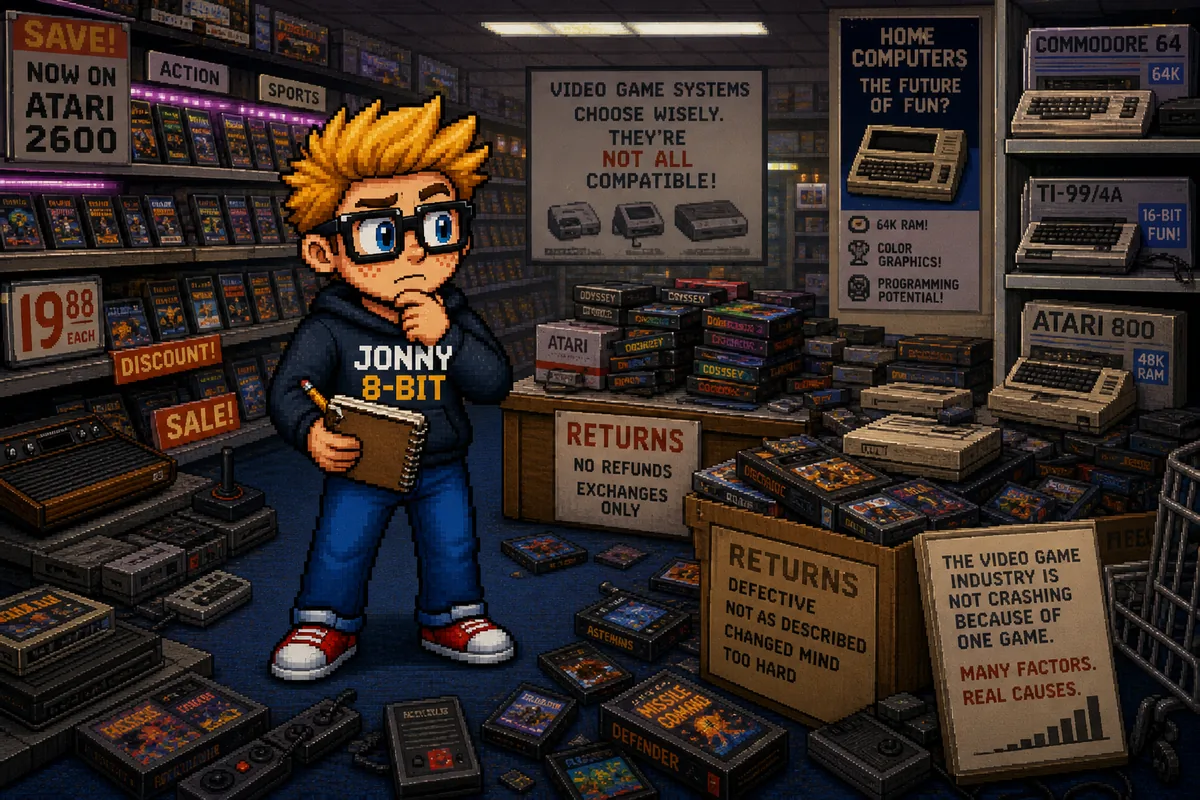
Imagine entering a toy store in 1983 and finding cartridges that had cost $30 only months earlier marked $5.99. The boxes represented famous companies, tiny startups, movie licenses, and businesses already gone. To retailers and publishers, those discounts were a warning: the market had produced far more games than customers would buy at full price.
The event is usually called the video game crash of 1983. It was really a North American home-console collapse that unfolded over several years. Arcades and computer games continued, Japan’s console industry grew, and people did not stop enjoying games. What broke was a business built on endless growth, loose publishing controls, and the belief that almost any cartridge would sell.
E.T. became the crash’s mascot, not its cause
Atari’s E.T. the Extra-Terrestrial is the easiest villain to remember. It was built on a rushed schedule for the 1982 holiday season, disappointed many buyers, and became part of the inventory Atari buried in a New Mexico landfill. The image of unwanted cartridges under the desert turned a complicated business failure into one unforgettable scene.
But one poorly received game could not bankrupt unrelated publishers, overload stores, and weaken competing console makers. The Strong National Museum of Play rejects the one-game explanation. E.T. showed Atari’s larger habits: expensive licensing, short schedules, optimistic production, and confidence that a famous name guaranteed demand. It was evidence of the problem, not the entire problem.
Atari’s Pac-Man conversion also complicates the story. It sold more than seven million copies, yet the company had expected still more. Complaints about its graphics and flicker hurt trust, while excess stock produced returns. Even millions of sales could disappoint when forecasts and manufacturing commitments were larger.
Too many companies chased the same shelf space
The Atari 2600 made interchangeable cartridges widely popular, but its success also attracted competitors. By 1982, homes could choose among the Atari 2600, Atari 5200, Intellivision, ColecoVision, Odyssey2, Vectrex, and other systems. Their cartridges were usually incompatible, so every console asked families to bet on a separate library.
Software multiplied even faster. Activision had proved that an independent company could make excellent games for Atari’s machine. Other businesses followed, including toy makers, entertainment companies, and startups formed to join the boom. The Atari 2600 lacked a technical lock that limited who could release a cartridge, and Atari could not reliably control how much outside software reached stores.
That freedom produced classics, so “third-party” did not mean “bad.” The problem was scale and unevenness. A box gave shoppers few clues about whether the game was polished or barely understandable. TIME reported that at least 30 firms were competing by the end of 1982. Good games fought for attention beside rushed products and familiar licenses.
Retail returns turned a glut into a chain reaction
Publishers and retailers planned as if the boom would continue at the same speed. Stores ordered heavily before the holidays, manufacturers produced to meet those orders, and everyone counted a shipment as progress. When games sold more slowly than expected, cartridges piled up. Retail agreements often allowed stores or distributors to return unsold merchandise, pushing the loss back toward publishers.
In October 1983, TIME estimated that the industry held about 35 million games in inventory—more than half the number sold the previous year. Stores cut prices, and $30 games could fall to $5.99. Unit sales were up an estimated 33 percent, yet revenue was flat because so much product was discounted.
That collapse damaged healthy games along with weak ones. A carefully made $30 release competed with several clearance cartridges costing the same total. Failed publishers could not always accept returns, and their remaining inventory sold even more cheaply. Another round of discounts made stores less willing to order future games.
Atari’s fall shook confidence across the business
Atari was the market leader, so its troubles became a signal about the entire category. The company had grown from a successful console maker into a major part of parent company Warner Communications. That rapid rise encouraged aggressive forecasts, large production runs, costly advertising, and the expectation that the next holiday would always be bigger.
When demand failed to match those plans, the reversal was brutal. TIME reported in October 1983 that Atari had lost $356 million that year and cut 3,000 employees from a workforce of about 10,000. Mattel’s electronics division and publishers also lost money. These were layoffs, canceled products, and companies unable to finance another season.
Retailers responded to the risk they could see. A shelf devoted to video games could become a pile of returns within months, and even a famous company might not be stable. Stores reduced orders or abandoned the category. Once that trust disappeared, a publisher with a good new game faced a second problem: convincing someone to stock it.
Home computers changed the value comparison
At the same time, home computers were becoming less expensive. Commodore and Texas Instruments fought a major price war, and TIME noted that some computers fell below $200. An Atari 2600 that had once sold for about $150 could be found for $59.95, but a computer offered a keyboard, programming, schoolwork, and games. For some families, it looked like the more flexible purchase.
Computers did not “kill” consoles any more than E.T. did. They added pressure while console makers struggled with too much inventory and too little confidence. Computer gaming and arcades continued producing major releases. The Strong points to 1983 games such as M.U.L.E., Ultima III, Dragon’s Lair, and Star Wars as proof that creativity did not stop.
The crash was also not equally global. Nintendo released the Family Computer in Japan in 1983. The Video Game History Foundation reports that by January 1985 the Famicom had sold 2.5 million units in its first 18 months and held 90 percent of Japan’s home-game market. Calling the event a worldwide death of video games erases the markets that were developing along different paths.
Nintendo had to rebuild the retailer relationship
When Nintendo prepared to bring the Famicom to the United States, good software was not enough. Retailers remembered the returns and bankruptcies. Nintendo first presented a computer-like Advanced Video System in January 1985, but stores were hesitant. The company simplified the concept, called it the Nintendo Entertainment System, packaged it like a toy, and added R.O.B. as an attention-grabbing companion.
The final NES entered a limited New York test market in October 1985 before expanding nationally. Nintendo used recognizable packaging and tighter control over which cartridges appeared on its console. Those choices did not magically guarantee quality, but they answered the failures retailers feared: uncontrolled supply, confusing products, and manufacturers that left stores holding the loss.
The recovery explains the crash better than the landfill. Players knew games could be fun; stores needed reasons to believe the business would not repeat its mistakes. The market returned when a new system offered appealing games and a more controlled relationship among hardware maker, publishers, retailers, and customers.
E.T. became the famous face because a landfill makes a great picture. The better lesson is less cinematic: when supply grows faster than demand and nobody protects trust, even millions of willing players cannot make the math work.
Videos and further viewing
These videos add demonstrations, interviews, or visual context to the story. A privacy-enhanced YouTube player loads only after you choose a video. Review YouTube’s privacy policy.
The Video Game Crash of 1983 - Gaming Historian
Video by Gaming HistorianA documentary explanation of the companies, market conditions, and business failures behind the North American crash.