How PLATO Predicted the Future of Online Gaming
On orange plasma terminals, students built multiplayer worlds and the social tools that modern online players now take for granted.
 Narrated by Jonny 8-Bit7 min read · Published 8/20/2026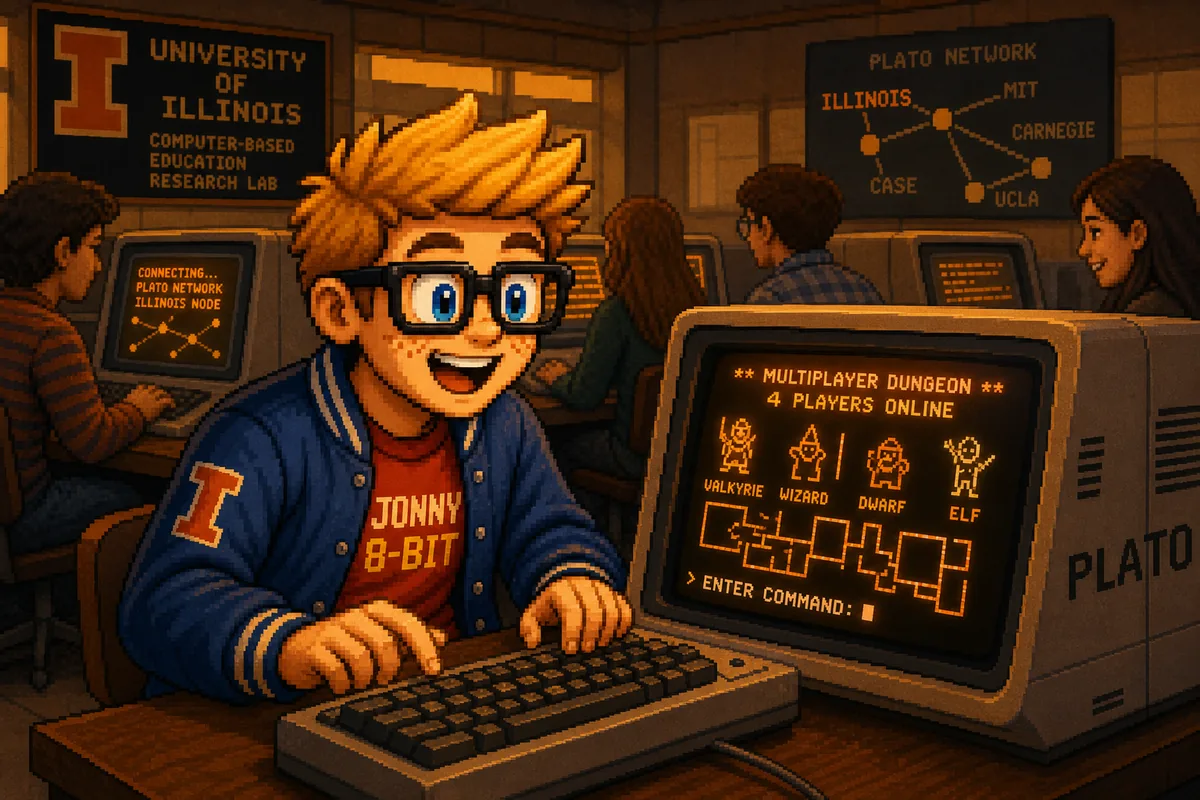
Imagine sitting at a university terminal in the 1970s. The screen glows orange. There is no web browser, home Wi-Fi, Steam, Discord, or Xbox Live. Yet you can see who else is connected, send a message, join a conversation, and enter a game where other people are already flying starships or exploring a dungeon. If you return later, the community is still there.
That experience was possible on PLATO, a computer system created at the University of Illinois. The name was an acronym for Programmed Logic for Automatic Teaching Operations. It was built to teach students, not to create an entertainment network. But once people shared the same computer, they began using it to play, talk, compete, cooperate, and form friendships. PLATO did not invent every feature of modern online gaming, and it was not the public internet. It did, however, show what could happen when games became places people visited together.
A teaching machine becomes a shared system
The PLATO project began at the University of Illinois in 1959 and launched under electrical engineering professor Donald Bitzer in 1960. Bitzer worked with physicist Chalmers Sherwin and laboratory director Daniel Alpert on a large question: could computers help teach students? Early PLATO equipment connected a television display and keyboard to the university's ILLIAC I mainframe. A lesson could present information, ask a question, check the answer, and immediately offer help or another attempt. Bitzer described the basic idea as a “book with feedback.”
The first version served one student at a time. Later versions reached more classrooms and offered better graphics. PLATO IV, introduced in the early 1970s, used the system's famous flat plasma terminal. Its orange display could show text, diagrams, and game graphics. Terminals in different buildings and schools connected to a central mainframe. After a 1972 upgrade, as many as 1,000 users could work on PLATO at once. That shared design made a new kind of play possible: the computer already knew about many users, their accounts, and their activity.
Students turned spare computer time into game time
PLATO's programming language and authoring tools were meant for lessons, but students and staff also used them to build games that were difficult or impossible on a stand-alone machine. Empire placed multiple players in a space battle inspired by Star Trek. Airfight let players challenge one another in aerial combat. Fantasy games such as dnd and Avatar offered characters, dungeon exploration, treasure, and cooperation. The graphics look simple today, but the important action was happening between people.
Games were not a tiny side activity. The University of Illinois reports that gaming accounted for more than 20 percent of PLATO use from 1975 through 1978. That popularity also caused arguments over a limited resource. Games could slow the system or keep terminals occupied when students needed them for classes. Administrators restricted games during busy teaching hours and generally allowed them at night and on weekends. Young players became so determined to get access that the Urbana Police Department approached Bitzer about the problem, leading to a 9 p.m. curfew for users under 16.
Online games became social worlds
Games such as Empire proved that a connected computer could offer more than a score comparison. A human opponent could surprise you, remember your tactics, and return for another match. Multiplayer dungeon games pushed the idea further. Players could develop characters, gather into parties, divide responsibilities, and help less experienced adventurers. Success depended on knowing both the rules of the software and the habits of the people using it. That combination is familiar to anyone who has joined a guild, organized a raid, or learned a competitive game from a regular teammate.
The Computer History Museum describes PLATO titles including Avatar, dnd, and Empire as early social and immersive digital environments that influenced later commercial games and massively multiplayer games. Not every modern developer copied PLATO directly. Programmers elsewhere explored similar ideas, and later internet games ran on different hardware and networks. PLATO's achievement was demonstrating the pattern early: shared play created reputation, rivalry, teamwork, and a reason to return.
Chat and message boards completed the experience
PLATO's social tools were just as important as its games. David Woolley's Notes allowed people to post topics and responses in shared note files, much like a forum or message board. Personal Notes worked more like email. Term-talk let one person contact another in real time, and Talkomatic divided the screen so several people could type in the same conversation. Messages appeared character by character, including mistakes and backspaces, which made a distant person's presence feel surprisingly immediate.
Ray Ozzie, who later led the development of Lotus Notes and served as Microsoft's chief software architect, used PLATO as a student programmer in the 1970s. In a Computer History Museum oral history, he remembered roughly 1,000 terminals connected to the system. He explained that Notes, Term-talk, and Talkomatic helped users learn one another's personalities across distance. PLATO began to feel like a place rather than merely a tool. Modern online games repeat that lesson with friends lists, guild chat, voice channels, forums, and status indicators.
PLATO saw the opportunities and the problems early
The system's users encountered many behaviors now associated with online life. They made friends and flirted in chat rooms. They cooperated on projects, debated rules, and built reputations. Programmers created software for other users instead of waiting for a company to approve every idea. At the same time, administrators dealt with overuse, limited computing capacity, rule breaking, and the question of when entertainment should give way to the system's official purpose. Those were early versions of today's debates about moderation, screen time, access, and who controls an online community.
PLATO remained mostly inside schools, universities, government programs, and businesses because its mainframes, data connections, and special terminals were expensive. It could not become a household game network on the scale of today's services. Personal computers, modems, and eventually the internet brought connected play to a much larger audience. Even so, PLATO had already shown that the appeal of an online game was not only the software. It was the possibility that another real person might be waiting on the other side of the screen.
The future PLATO predicted
PLATO predicted that connected games would become ongoing services instead of isolated matches. Accounts could represent continuing identities. Game worlds could support teamwork and competition. Communication tools could keep a group together between sessions. Players could create culture around a game, while administrators tried to manage behavior and demand. Decades later, those ideas shaped online role-playing games, competitive ladders, live-service games, community servers, and the organized culture explored in our story about how StarCraft became a major esport in South Korea.
It is tempting to call PLATO an internet before the internet, but that description goes too far. PLATO was a centrally managed system with access controlled by participating institutions. The internet grew from a different collection of networks and standards. A more accurate conclusion is also more interesting: PLATO gave a limited group of people an unusually early preview of online social life. They discovered that once a network lets people meet, somebody will build a game—and once the game is running, the players will build a community around it.
Videos and further viewing
These videos add demonstrations, interviews, or visual context to the story. A privacy-enhanced YouTube player loads only after you choose a video. Review YouTube’s privacy policy.
PLATO@50: An Early Community of Multiplayer Games
Video by Computer History MuseumComputer History Museum speakers revisit the multiplayer games and communities that grew across the PLATO network.
1960's PLATO Computer System - Computer Aided Learning CAI CBT CDC Control Data Educational
Video by Computer History Archives Project ("CHAP")Archival material shows PLATO terminals and the educational network that later hosted pioneering online games.