
How StarCraft Became a Major Esport in South Korea
A strategy game met the right network infrastructure and social spaces, producing a professional culture years before global esports boomed.
 Narrated by Jonny 8-Bit6 min read · Published 8/20/2026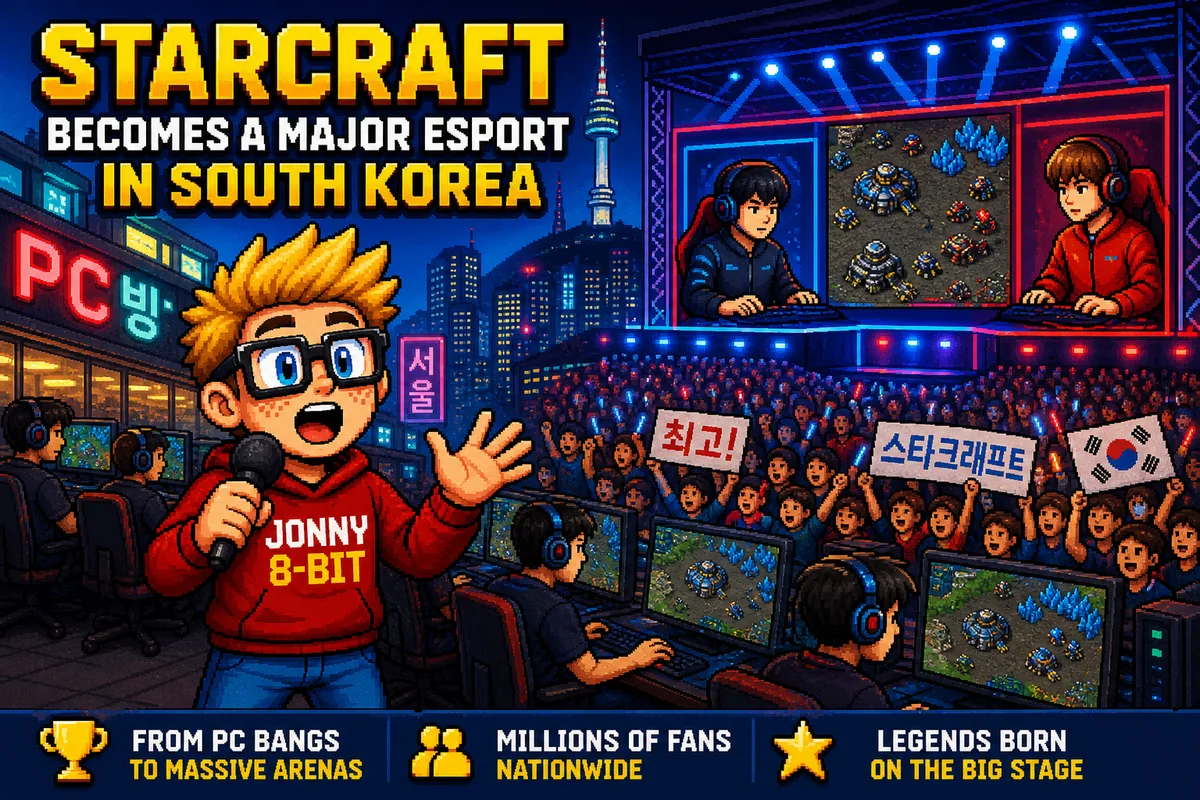
In 1999, Blizzard cofounder Mike Morhaime traveled to South Korea for an event celebrating two million copies of StarCraft and its expansion, Brood War, sold in the country. He expected a company celebration. Instead, he found a packed hall watching a competitive match. The crowd understood the game so well that it reacted when a worker was destroyed or an important flying unit went down. Morhaime later called it the first live esports event he had attended.
That scene was not created by the game alone. StarCraft arrived while South Korea was rapidly connecting to the Internet, neighborhood computer cafés were becoming social centers, and broadcasters were searching for inexpensive programs. Players, café owners, television producers, sponsors, and government-backed organizations each added a piece. Together, they built one of the first professional esports systems in the world.
StarCraft arrived at exactly the right moment
Blizzard released StarCraft on March 31, 1998. The real-time strategy game had players gather resources, build a base, scout the map, and command an army. Its three groups—Terran, Zerg, and Protoss—used different units and methods instead of sharing nearly identical pieces. Brood War followed nine months later with more units and balance changes. Blizzard reported that the original became 1998’s best-selling PC game.
South Korea was also recovering from the 1997 Asian financial crisis. Computers and game copies were expensive for many households, while workers who left large companies were looking for new businesses. Some opened PC bangs, or Internet cafés, where customers rented fast computers by the hour. National investment in communications helped expand broadband, but historians warn against the simple story that the government intentionally created PC bangs. Business opportunity, existing computer communities, falling access costs, and the arrival of popular network games all worked together.
PC bangs made competition cheap and social
A PC bang solved several problems at once. A player did not need to buy a powerful computer, pay for a home connection, or persuade friends to carry machines to a private network party. An academic history reports that hourly fees in the late 1990s could cost less than one U.S. dollar. Customers received a ready computer, a quick connection, nearby opponents, and access to Blizzard’s Battle.net service.
The room mattered as much as the network. Friends could sit together, trade build orders, watch a skilled regular, and try the same strategy. Owners noticed customers gathering behind strong players even when they were not playing. They began holding informal StarCraft contests, sometimes awarding free café time or cash prizes. Local reputations became rivalries and fan followings. A PC bang was a playing field, training room, audience, and recruiting ground.
This community model extended the ideas behind earlier organized scorekeeping at Twin Galaxies. The difference was speed. Battle.net connected opponents immediately, while people nearby could see the performance unfold. A promising player did not have to mail a score or wait for a national tournament.
A game deep enough to study and clear enough to watch
Elite StarCraft demanded two kinds of attention at once. “Macro” meant keeping the economy running, building units, and expanding to new resource locations. “Micro” meant controlling individual units during a fight. A player also had to scout, guess an opponent’s plan, hide information, and change strategies in real time. The three races created distinct matchups, so mastering one opponent did not solve the entire game.
Those demands rewarded heavy practice. The academic history identifies Shin Ju-young as an important early professional. After winning a Blizzard ladder tournament in December 1998, he became the first registered Korean player in the Professional Gamers League. The study reports that he sometimes practiced for more than 15 hours a day and could earn roughly $2,000 to $10,000 for a tournament victory. His schedule was extreme, but it showed that gaming skill could produce money and public recognition before regular salaries were common.
The same depth gave commentators a story to explain. A scout entering a base could reveal hidden technology. A delayed expansion could leave one player short of resources minutes later. A small attack might fail yet create an opening elsewhere. Viewers learned to recognize these turning points, and broadcasters learned where to point the in-game camera. Watching became its own skill rather than a substitute for playing.
Television turned strong players into stars
The first productions were modest. In March 1999, cable channel Tooniverse began televising the Hitel Korea Pro Gamers League. Producer Hwang Hyun-joon reportedly struggled to find studio space because games still carried a poor public image. His team built a miniature set on top of a table-tennis table. That improvised studio helped prove that a strategy game could become scheduled television.
In 2000, Tooniverse and Hitel launched OnGameNet, a channel devoted to games and esports. It initially aired game-related programming for 12 hours each day. MBC Game followed with round-the-clock programming in 2001. Producers added commentators, player cameras, graphics, edited introductions, and observers who controlled what spectators saw inside a match. Instead of staring over a stranger’s shoulder in a café, fans could follow leagues and learn the personalities behind the usernames.
Players such as Lim “BoxeR” Yo-hwan became stars through repeated broadcasts, creative strategies, and memorable rivalries. Canadian player Guillaume “Grrrr…” Patry even moved to Seoul and won the first individual Starleague, showing that the scene could attract talent from abroad. The broadcasts did not merely document an existing sport. Regular schedules, storylines, and audiences helped turn competitive play into one.
Sponsors and institutions built a profession
South Korea began formalizing the industry in 2000 with a national pro-game association that later became the Korea e-Sports Association, or KeSPA. It helped establish rules and organize leagues. Companies including Samsung, SK Telecom, and KT sponsored teams as television audiences grew. Players gained managers, coaches, practice structures, and a path from amateur qualification to broadcast competition.
Individual leagues created stars, while Proleague gave fans teams to follow. An academic history counts 31 Brood War Proleague competitions between March 2003 and September 2012. Finals moved beyond television studios into public venues. Attendance reports for events at Busan’s Gwangalli Beach reached tens of thousands, even though exact crowd estimates vary. By then, the image of a professional gamer performing before a roaring audience no longer seemed impossible.
Professionalization also carried a cost. The long practice schedules that produced skill could create exhaustion and short careers. Young players operated inside systems controlled by teams, broadcasters, sponsors, and league officials. The achievement was not simply that people could earn money playing StarCraft. It was that competitive gaming developed enough structure to require the same questions about contracts, working conditions, fair rules, and player welfare faced by older sports.
The model South Korea gave global esports
South Korean StarCraft succeeded because every part strengthened the others. Affordable PC bangs created players and local spectators. Battle.net created constant competition. A deep game rewarded practice. Television introduced stars and rivalries. Sponsors funded teams, and leagues gave audiences a reason to return. Remove any one part and the result might have remained a popular game rather than a durable spectator sport.
The model influenced how later esports were presented around the world: professional teams, dedicated commentators, dramatic player introductions, controlled spectator views, seasonal leagues, and live finals in large venues. StarCraft did not invent video game competition, and South Korea was not the first country to hold gaming tournaments. Its achievement was bringing the pieces together early and showing that people would follow elite players week after week.
Videos and further viewing
These videos add demonstrations, interviews, or visual context to the story. A privacy-enhanced YouTube player loads only after you choose a video. Review YouTube’s privacy policy.
How StarCraft Changed An Entire Country
Video by IGN CompeteA documentary look at PC bangs, professional leagues, television, and the culture that formed around Korean StarCraft.