The First Video Game Tournament: Spacewar! in 1972
Long before esports arenas and livestreams, a Stanford computer lab offered skilled Spacewar! players free beer, bragging rights, and a magazine subscription.
 Narrated by Jonny 8-Bit6 min read · Published 8/15/2026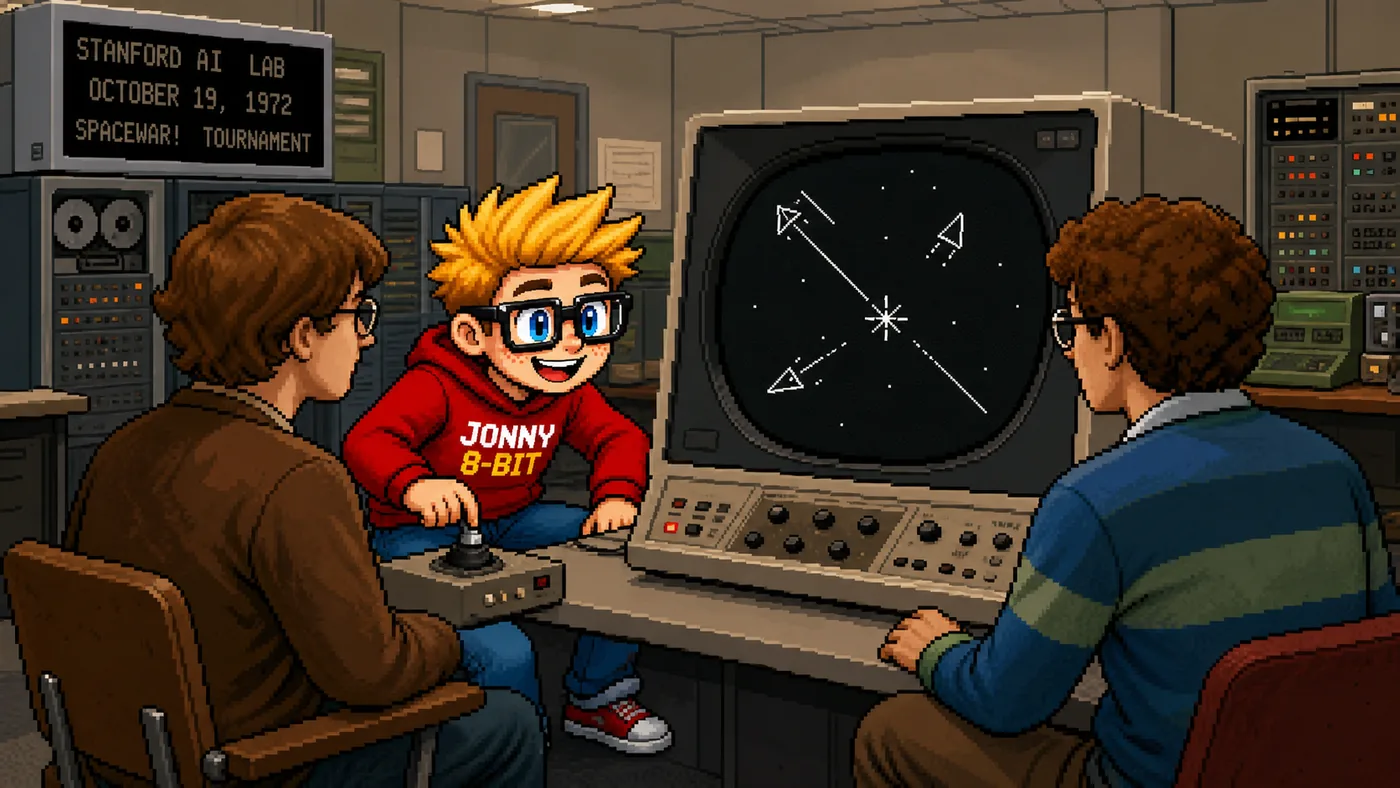
At 8 p.m. on October 19, 1972, roughly two dozen people crowded into a dim console room at the Stanford Artificial Intelligence Laboratory. The building sat in the foothills above Palo Alto, far from any modern esports arena. Its main attraction was an expensive PDP-10 computer, and the evening’s promotional notice ended with two irresistible words: “Free Beer!”
The gathering was called the “Intergalactic Spacewar Olympics.” Contestants battled in Spacewar!, a ten-year-old computer game, while Rolling Stone writer Stewart Brand reported and Annie Leibovitz took photographs. The advertised first prize was a one-year subscription to the magazine.
Histories often call it the first video game tournament. Informal competitions almost certainly happened earlier wherever two players shared a game. Stanford’s event has a stronger claim: it was announced, sponsored, divided into organized contests, played before spectators, and recorded in a major magazine. It is the earliest tournament for which a remarkably detailed public account survives.
Spacewar! began as a computer demonstration
Spacewar! was created at the Massachusetts Institute of Technology in 1962. Steve Russell led the programming, with important contributions from other members of MIT’s computing community. They were exploring a new Digital Equipment Corporation PDP-1 and its cathode-ray-tube display. Instead of demonstrating the machine with a passive pattern, they built something people could control.
Two players piloted spaceships around a central star. They could rotate, thrust, and fire torpedoes while gravity pulled both ships toward destruction. Later additions included an accurate starfield and a risky hyperspace escape. The rules were easy to recognize, but momentum and gravity rewarded practice. A player had to aim while moving through an orbit rather than simply pointing a ship in a straight line.
The program spread among universities and research centers as programmers copied and modified it for other computers. There were no cartridges or download stores carrying Spacewar!; access came through institutions that owned costly hardware. The same open laboratory culture eventually inspired Nolan Bushnell’s coin-operated Computer Space, but the original game remained a favorite among programmers with after-hours computer access.
Stewart Brand turned a lab habit into an event
Brand was 33 years old, a Stanford biology graduate, and the former editor of the Whole Earth Catalog. He was interested in the culture forming around computers—especially the idea that these enormous institutional machines could become creative and personal tools. He began spending time with the programmers who played Spacewar! late at night.
For his Rolling Stone story, Brand helped turn that regular play into a named competition. His notice promised the magazine subscription, reporting by a “Stone Sports” correspondent, photography, and beer. The grand language of an intergalactic Olympics was clearly playful, but the event itself had structure and visible stakes.
Ralph Gorin, Stanford AI’s head system programmer, loaded the lab’s version of the game. Unlike the original two-player PDP-1 program, this version could place as many as five ships on screen. Players used separate sets of control buttons while one computer calculated every orbit, shot, collision, and score.
The tournament created three kinds of champion
The competitors quickly organized three events: a five-player free-for-all, two-against-two team competition, and one-on-one singles. The free-for-all added four space mines and randomized starting positions around the central star. A kill earned one point, being killed lost one point, and surviving a battle added another.
That scoring encouraged more than constant shooting. A reckless player might earn a kill and then lose the point by crashing into the star. Someone who avoided an early fight could collect a survival bonus, but waiting too long gave rivals time to establish a better orbit. Torpedoes also had a short reload delay, so firing both too quickly left a ship unable to answer an attack.
Bruce Baumgart won the five-player free-for-all and became the tournament’s best-known champion. Slim Tovar won the singles contest. Tovar and Robert E. Maas—known at the computer by his initials, REM—won the team competition. Retellings sometimes combine those results into one winner, but Brand’s contemporary report names all three victories.
Baumgart received the Rolling Stone subscription and bragging rights. Decades later, he remembered practicing with the button controller in different hands and even learning to operate two ships at once. His goal was to stop thinking consciously about individual buttons and react directly to what he saw on the screen. That sounds familiar to anyone who has watched an expert player make a difficult game appear effortless.
Skill involved gravity, timing, and reading opponents
The ships did not stop when players released the thrust button. They continued drifting, while the central sun bent their paths. Skilled competitors learned to enter useful orbits, turn without losing control, and fire where an opponent would be rather than where it was. A shot could travel off one edge of the display and return from the opposite side.
The five-player game added confusion. Every ship had a different outline, and players first had to identify which one they controlled. Torpedoes, mines, and several moving opponents filled the display. Brand described personalities emerging through play: one pilot was a strong shot but panicked in crossfire, while another avoided early fights and fired around the wrapped screen.
This was already the language of competitive games. Players had styles, tactics, rivals, team communication, and knowledge unavailable to beginners. Spectators could recognize both mistakes and impressive recoveries. The technology was unusual, but the appeal of watching mastery was not.
Was this truly the first tournament?
The safest description is the earliest well-documented organized video game tournament. People had played Tennis for Two, Spacewar!, and other early games against one another before 1972. Two players competing beside a computer did not automatically leave a poster, prize list, photograph, or published report for historians to find.
The Stanford Olympics supplied all of those markers. It had a scheduled time and place, multiple formats, a sponsor, a prize, spectators, named winners, and contemporary journalism. However, it was not yet a professional esports industry. The contestants did not make careers from the event, the audience numbered in the dozens, and access depended on belonging to a rare computing community.
Calling it “esports” can therefore be useful if the term describes organized skill-based video game competition. It becomes misleading if it suggests leagues, salaries, broadcasts, or mass participation already existed. The event was a seed, not a miniature version of everything that followed.
Rolling Stone preserved more than the scores
Brand’s article appeared in the December 7, 1972, issue of Rolling Stone. It recorded approximately four hours of shouting, jokes, button clicks, team planning, and side trips through the laboratory. Leibovitz’s photographs showed competitors holding their control boxes instead of posing with trophies. The coverage made software play visible as a social culture rather than a private technical experiment.
That record is why the tournament still matters. Later events grew far beyond it, from national arcade score competitions to the online qualifiers and spectacular prize at Red Annihilation in 1997. The path was not direct, but Stanford already demonstrated the basic pattern: a community mastered a game, organized rules, gathered an audience, and created heroes worth remembering.
The magazine subscription seems tiny beside modern prize pools. In 1972, however, the stranger fact was that an event existed at all. A computer built for serious research had become an arena, and a counterculture magazine recognized that the contest was news.
Videos and further viewing
These videos add demonstrations, interviews, or visual context to the story. A privacy-enhanced YouTube player loads only after you choose a video. Review YouTube’s privacy policy.
Uncovering the World's First Video Game Tournament - Random Video Game Facts, Ep. 1
Video by The Bit GarageA short history of the 1972 Spacewar! competition at Stanford and the people who took part.