
Gunpei Yokoi’s “Lateral Thinking With Withered Technology”
For one of Nintendo’s most important designers, innovation meant finding a surprising new use for technology that everyone else already understood.
 Narrated by Jonny 8-Bit6 min read · Published 8/20/2026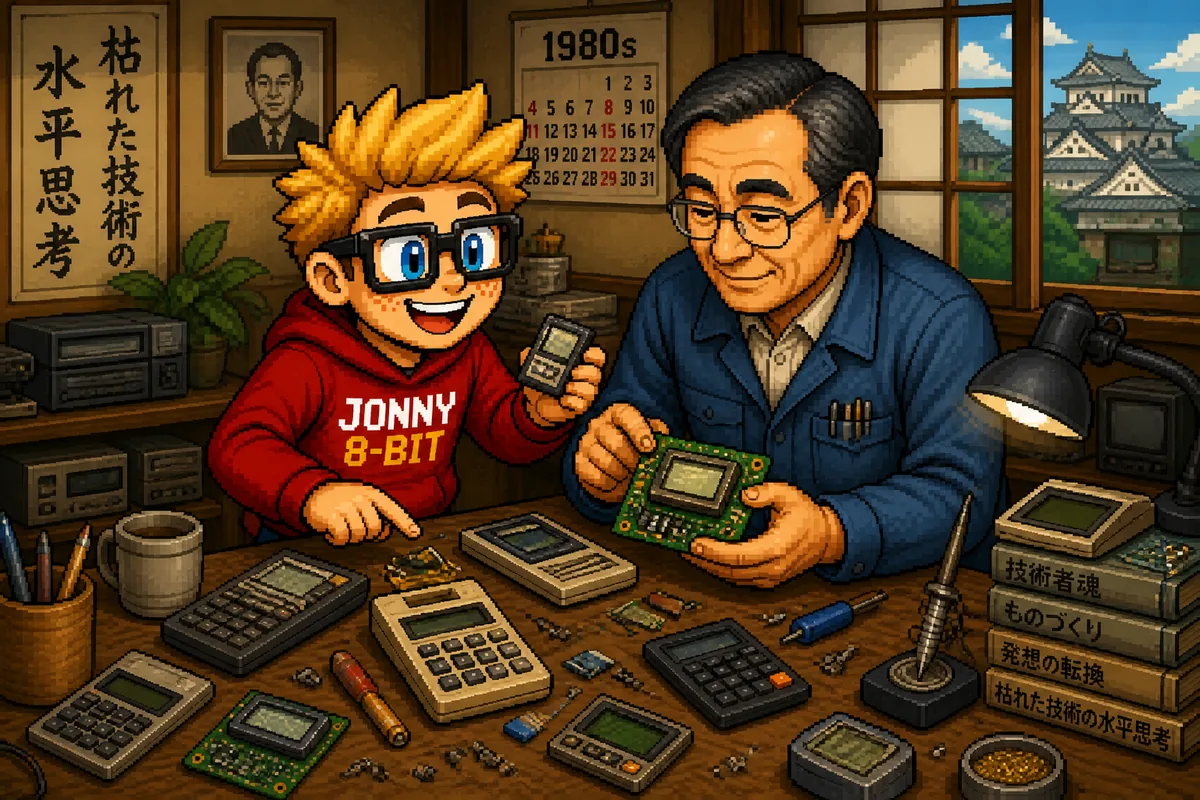
In 1989, the new Atari Lynx offered a color screen and flashy visual effects. Nintendo’s Game Boy arrived with a small gray-green display that could show only four shades. If innovation meant using the newest hardware, Nintendo appeared to have entered the handheld race from behind.
The Game Boy won anyway. Its modest screen helped Nintendo sell a smaller, less expensive machine that ran much longer on fewer batteries. That choice reflected a design philosophy closely associated with Gunpei Yokoi, the Nintendo engineer behind Game & Watch and a leader of the team that created Game Boy. The Japanese phrase is often translated as “lateral thinking with withered technology.” It sounds as if Yokoi wanted old, weak parts. His real point was much smarter: use mature technology that has become dependable and affordable, then combine it in a way that gives people a fresh reason to play.
An engineer who started by keeping machines running
Yokoi was a college-educated electrical engineer, not the janitor he is sometimes described as in simplified versions of his story. Nintendo hired him to maintain equipment used in its playing-card business. The work left room for a curious engineer to experiment in the company machine shop. During that spare time, he built a mechanical extending arm from crisscrossed pieces. Nintendo president Hiroshi Yamauchi noticed the device and asked Yokoi to turn it into something the company could sell.
The resulting Ultra Hand reached stores in 1966. Its user squeezed two handles to extend a grabber toward plastic balls resting on stands. Nothing inside it was a scientific breakthrough. The familiar pantograph mechanism had existed long before Nintendo, but Yokoi packaged its movement as a funny physical challenge. The toy became a hit and moved him from factory maintenance into product development. The episode is an early example of his method: the part can be ordinary if the experience built around it feels new.
What “withered” technology actually means
The word “withered” can make the philosophy sound negative. A clearer interpretation is “seasoned” or “mature” technology—components that manufacturers know how to produce reliably and at a reasonable cost. The “lateral thinking” part means looking sideways instead of following the obvious path. Rather than asking how to make a familiar product slightly faster, brighter, or more powerful, the designer asks what else an available technology could do.
This was not a rule against invention. Yokoi’s teams developed new controls, game formats, and ways for people to interact with machines. The goal was to place the risk in the idea rather than in every component. A proven part offered known limits, stable production, and a lower price. Designers could then spend their attention on play. The result might look less impressive on a specification chart while working better in a child’s hands, a commuter’s pocket, or a family’s budget.
Game & Watch turned calculator parts into pocket play
Game & Watch made the philosophy easy to see. The Video Game History Foundation’s discussion of Yokoi describes his interest in bringing play into everyday moments, while museum histories identify the series as a major step in portable gaming. Nintendo launched the first Game & Watch in 1980, when small liquid-crystal displays and calculator-style electronics were already established products. Those parts could not draw a free-moving arcade world. Each game instead used fixed LCD shapes that appeared and disappeared in set positions.
That limitation shaped the games. Characters jumped between a few clear locations, caught falling objects, or avoided hazards with carefully timed button presses. The same device also displayed the time, giving its owner a reason to carry it even when not playing. Later Game & Watch models introduced the cross-shaped directional control used for movement in games such as Donkey Kong. That control idea became far more influential than the basic LCD beneath it. Stangmedia’s story about how Game & Watch helped establish the D-pad follows that part of Yokoi’s legacy.
Game Boy made the trade-off visible
By the late 1980s, Nintendo could have chased a color handheld display. Instead, the Game Boy used a non-backlit monochrome LCD. The screen could blur during motion and looked best under good lighting, but it used less power than the color displays in its rivals. Smithsonian reports that four AA batteries could provide roughly 10 to 14 hours of play, while the Lynx and Sega Game Gear used six batteries and lasted only a few hours. Game Boy also supported interchangeable cartridges, so the hardware could grow through new software.
That balance mattered more than color alone. The system was portable enough to carry, durable enough for regular travel, and inexpensive enough to reach a wide audience. Tetris gave adults as well as children an immediate reason to understand it. Nintendo ultimately sold nearly 120 million Game Boy and Game Boy Color systems combined. The famous Gulf War Game Boy that continued to operate became an extreme symbol of the durability buyers experienced in ordinary life.
The rival Atari Lynx was not foolish for taking the opposite approach. Its color, scaling effects, linked multiplayer, and reversible controls were remarkable in 1989. It simply demonstrates Yokoi’s question: which technical improvements make the complete product better, once price, battery life, size, software, and daily use are counted too?
A philosophy is a guide, not a magic formula
“Lateral thinking with withered technology” is often treated as a secret recipe that explains every Nintendo success. History is messier. Products also need good software, manufacturing, distribution, marketing, and timing. Mature parts can support a dull idea just as easily as a clever one. Nintendo also experimented with technology that did not find a large audience, most famously the Virtual Boy. Yokoi’s principle did not remove risk or guarantee that every design decision would be right.
Its lasting value is the question it forces designers to ask. Is a new feature useful to the player, or is it present because the part is fashionable? Could a cheap sensor, simple screen, or familiar control create a different kind of experience? Nintendo’s later systems often followed that broad pattern without merely copying Game Boy: the Nintendo DS built play around two screens and touch input, while Wii made motion controls understandable through familiar physical gestures. The important inheritance was not old hardware. It was the habit of judging technology by what people could do with it.
Videos and further viewing
These videos add demonstrations, interviews, or visual context to the story. A privacy-enhanced YouTube player loads only after you choose a video. Review YouTube’s privacy policy.
GUNPEI'S LEGACY | Lateral Thinking With Withered Technology - Blast Processing
Video by Blast ProcessingExplore Gunpei Yokoi’s design philosophy and how familiar technology powered inventive Nintendo products.