Why the Sega Game Gear Used Batteries So Quickly
Sega brought a bright color screen to handheld gaming in 1990, but the display technology turned every portable play session into a power-budget problem.
 Narrated by Jonny 8-Bit6 min read · Published 8/20/2026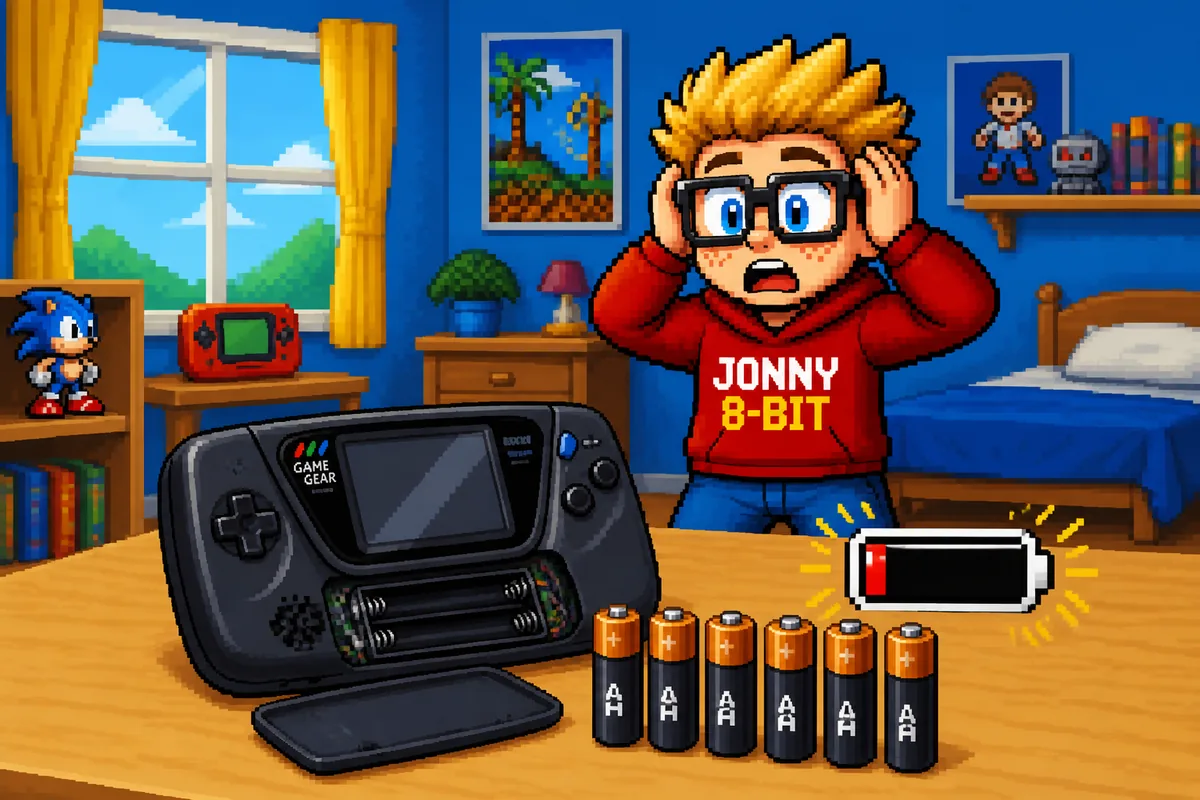
Picture opening a new Sega Game Gear, loading Columns or Sonic the Hedgehog, and feeding six fresh AA batteries into its two rear compartments. The color screen glows without a lamp shining over your shoulder. For a player used to Nintendo’s dark gray-green Game Boy display, it feels like a portable glimpse of the future. Then, only a few hours later, the power light begins warning that those six batteries are nearly finished.
That familiar complaint became part of the Game Gear’s identity, but the machine was not wasting power for no reason. Sega built a handheld around a backlit color LCD at a time when that kind of display was demanding, expensive, and inefficient. The Game Gear also carried console-style graphics hardware, sound, and voltage-conversion circuits. Each decision supported the product Sega wanted to sell. Together, they explain why a device powered by more batteries could run for much less time than Game Boy.
Sega chose color as the main attraction
Sega released the Game Gear in Japan on October 6, 1990, for ¥19,800. It followed the Atari Lynx into the color-handheld market and reached North America in 1991. Sega’s official hardware history lists a 3.2-inch backlit color LCD, a Z80A processor running at 3.58 MHz, and graphics capable of showing 32 colors at once from a palette of 4,096. The screen gave Sega a clear sales pitch: this portable looked more like the colorful games people knew from televisions and arcades.
The design borrowed heavily from Sega’s 8-bit Master System. That connection made it easier to adapt familiar games, and the optional Master Gear Converter let the handheld run many Master System cartridges. Stangmedia’s history of the Master System around the world explains why that software family already mattered in several regions. Compatibility was useful, but shrinking a home-console-style experience did not automatically make every circuit energy-efficient.
The fluorescent backlight carried the largest burden
A liquid-crystal display does not produce its own light. Game Boy used a reflective screen that depended on light from the room or the sun. Game Gear placed a small fluorescent lamp behind its LCD so the picture remained visible in the dark. That lamp needed an inverter circuit to turn battery power into the higher-voltage electrical signal required by the tube. Sega’s service manual identifies the display, power components, and six-AA supply, while the company’s specifications rate total consumption at about three watts.
The color LCD also blocked much of the lamp’s output. Light had to pass through layers that controlled red, green, and blue portions of the image, so the source behind the panel needed to stay bright. Modern phones use far more advanced screens, efficient LEDs, and rechargeable lithium-ion batteries. In 1990, the fluorescent tube and its supporting electronics were practical ways to create portable color, but they turned stored battery energy into light and heat at a rapid rate.
Six batteries delivered only three or four hours
Sega’s current historical specifications state that six alkaline AA batteries provided about three to four hours of continuous use. A period brochure reproduced on the same page advertised as much as five hours, which likely reflected favorable test conditions. Real play time changed with battery brand, screen brightness, volume, temperature, and the age of the machine. The exact number could move, but the basic experience was consistent: one set of batteries rarely lasted through many long sessions.
Game Boy made a very different trade. Its non-backlit monochrome screen was difficult to see in dim rooms and blurred during fast motion, but it needed far less energy. The Science Museum notes that the color Lynx and Game Gear were more advanced in obvious ways yet were bulkier and had much shorter battery life. Nintendo’s simpler display helped four AA batteries run for many more hours. That choice fits Gunpei Yokoi’s “lateral thinking with withered technology”: proven parts were valuable when they made the full product cheaper and easier to use.
The rest of the machine still needed power
Blaming everything on the lamp is tempting, but the Game Gear was a complete color console. Its processor, video hardware, memory, audio amplifier, cartridge, and LCD-control electronics all drew current. The power board also had to regulate the falling voltage of six batteries into the stable supplies different components expected. No single chip created the famous battery problem. The screen and backlight were simply the largest parts of a system designed for visual impact rather than maximum endurance.
The comparison with the Atari Lynx is revealing. Both machines offered illuminated color displays and both consumed six AA batteries in only a few hours. Their internal designs were different, but they faced the same period limits. Portable color was possible; portable color that was small, inexpensive, bright, and gentle on disposable batteries was not yet an easy engineering package.
Accessories quietly admitted the compromise
Sega sold several ways around the battery habit. Owners could use an AC adapter near a wall outlet, a car adapter during travel, or external rechargeable battery packs. The official Japanese history page highlights these accessories and even shows a Game Gear loaded with a TV Tuner, magnifier, and battery equipment. It was technically portable, although the complete setup could become much larger and heavier than the basic handheld.
The TV Tuner made the power decision even more understandable. Sega was not merely selling small games; it promoted the Game Gear as a pocket entertainment screen that could become a portable television. That sounded extraordinary in 1990. Playing near an outlet weakened the promise of freedom, but many owners accepted the cord at home so they could enjoy color without buying another package of batteries.
Why the reputation survived longer than the limitation
Later screen replacements reveal how much display technology has changed. Enthusiasts can replace the original fluorescent-lit panel with modern LCD hardware and LED lighting, often improving clarity and reducing power use. That does not mean Sega designed the original badly. It means engineers in 1990 did not have access to the panels and batteries available decades later.
The Game Gear’s battery appetite survives as a joke because it was easy to measure. Players remembered buying six batteries, watching a beautiful screen, and repeating the process soon afterward. Yet the same complaint proves Sega delivered something people noticed. The machine brought bright portable color to millions of players before the technology made that choice comfortable.
Videos and further viewing
These videos add demonstrations, interviews, or visual context to the story. A privacy-enhanced YouTube player loads only after you choose a video. Review YouTube’s privacy policy.
The History Of The Sega Game Gear
Video by Top Hat Gaming ManA full retrospective on Sega’s color handheld, its hardware ambitions, game library, and heavy appetite for batteries.