
Game & Watch and the Origin of Nintendo’s D-Pad
Nintendo needed arcade-style movement in a pocket-sized game. Its compact solution became one of the most recognizable controls ever made.
 Narrated by Jonny 8-Bit6 min read · Published 8/20/2026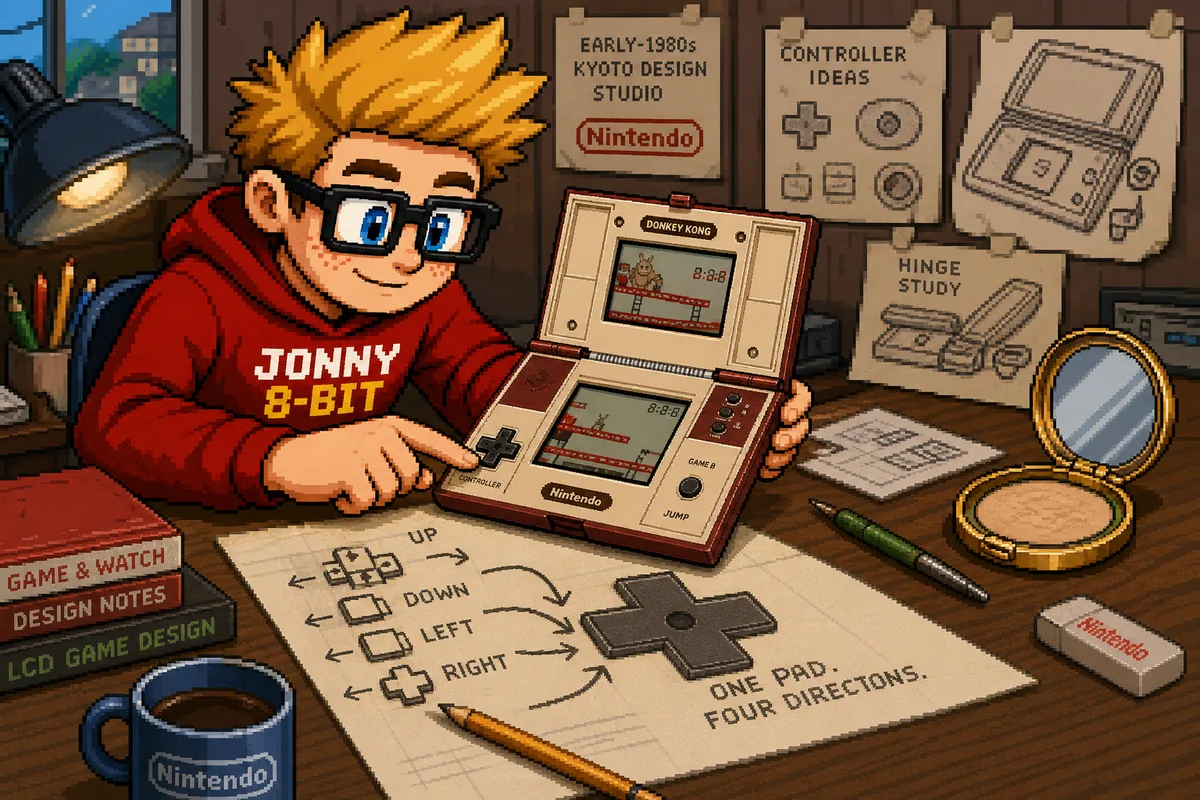
Open Nintendo’s 1982 Donkey Kong Game & Watch and the lower half looks strangely modern. The screen and orange jump button belong to an early LCD handheld, but the black cross beneath the player’s left thumb could have come from a much later controller. Press one arm and Mario moves in that direction. Rock the thumb to another arm and he responds without the player having to hunt for a separate button.
Nintendo called it the +Control Pad. Players usually call it a directional pad, or D-pad. The idea seems obvious after four decades of use, yet it solved a real design problem: how could a pocket game provide four clear directions without a tall arcade joystick or a wide group of individual buttons? The answer moved from Game & Watch to the Famicom and NES, then became a basic part of controller language.
Game & Watch began with calculator-era technology
Nintendo released the first Game & Watch title, Ball, in Japan on April 28, 1980. Each thin unit contained one LCD game along with a clock and alarm. Unlike a Game Boy cartridge, its display used fixed shapes that appeared in different combinations. The inexpensive, low-power approach let Nintendo build a game that could fit in a pocket and run for long periods on small batteries.
The famous origin story says Gunpei Yokoi thought of the product after seeing a bored passenger pressing buttons on a calculator during a train ride. Nintendo’s own later interview treats the calculator inspiration as credible, although designer Makoto Kano said he joined after Yokoi and Satoru Okada had already built a prototype. Yokoi, who led Nintendo’s Research & Development 1 group, became known for turning established, affordable technology into playful products—a philosophy explored in our story about his “lateral thinking with withered technology”.
Early Game & Watch controls could be simple because their games often required movement along one line. Separate left and right buttons were enough for Ball and several other titles. As the series grew, Nintendo tried wider screens, color printed backgrounds, and more complicated play. That success created pressure to reproduce arcade ideas inside hardware much smaller than an arcade cabinet.
Donkey Kong needed more than two movement buttons
Nintendo’s arcade Donkey Kong had become a major hit in 1981. Bringing it to Game & Watch meant representing platforms, ladders, rolling barrels, jumping, and movement in more than two directions. Four separate direction buttons would consume precious space and force the thumb to move between controls. A normal joystick would be too tall for a handheld designed to fold shut.
The solution appeared on the Donkey Kong Multi Screen model, released in June 1982. It was the second clamshell Game & Watch after Oil Panic. The top screen extended the playfield while the lower half held another display and the controls. Designer Kano later recalled buying makeup compacts to study their hinges because portable electronics with that folding shape were not yet common.
Nintendo’s developers identified Donkey Kong as the company’s first game to use the +Control Pad. That wording matters. Joysticks, circular control discs, and groups of directional buttons had already allowed four-way movement in earlier games. Nintendo did not invent the general idea of telling a character to go up, down, left, or right. Its breakthrough was a compact, one-piece cross that worked naturally under one thumb and fit a thin handheld.
The pad was refined through touch, not appearance alone
In Nintendo’s Game & Watch interview, engineer Hirokazu Yamamoto remembered the hardware team producing many D-pad prototypes for Yokoi to test. The answer was often that the latest version still did not feel right, so the team tried again. Masao Izushi said Yokoi was especially concerned that a player should operate it without looking at their hands. A depression in the center helped the thumb locate itself by touch.
Mechanically, the cross behaves like a small rocking platform. Pressing an arm tilts the connected piece around its center and activates a contact underneath that direction. The player feels one control, but the game receives separate digital signals. Here “digital” means a direction is pressed or not pressed; it does not measure a range of movement the way an analog stick can.
A later Nintendo patent documents a refined multidirectional switch with four arms, electrical contacts, and a central fulcrum. Its U.S. version lists Ichiro Shirai as the inventor, gives an August 5, 1983 priority date, and was granted in 1987. The record is a good warning against reducing team engineering to a single famous name. Yokoi directed the experience and evaluated prototypes, while other Nintendo designers and engineers helped turn that goal into reliable hardware.
The Famicom carried a pocket control into the living room
Nintendo released the Family Computer, or Famicom, in Japan in July 1983. Instead of copying the separate joystick boxes common on systems such as the Atari 2600, Nintendo placed a D-pad on the left of a slim rectangular controller and action buttons on the right. The player could hold the controller with both hands, move with the left thumb, and act with the right.
That layout was compact, inexpensive, and well suited to games such as Donkey Kong, Super Mario Bros., and The Legend of Zelda. When Nintendo redesigned the system for North America as the NES, the same basic control arrangement came with it. The NES would help rebuild American confidence in console games, placing Nintendo’s D-pad in millions of homes.
Competitors created their own directional controls, sometimes changing the visible shape or surrounding the cross with a circular base. The details varied, but the basic lesson traveled across the industry: a player could understand four directions immediately, feel them without looking, and use them without placing a joystick on a table.
Analog sticks did not make the D-pad disappear
Three-dimensional games eventually made analog sticks essential because they could report direction and degree. A character might walk when the stick is tilted slightly and run when pushed fully. The D-pad remained better for tasks that benefit from exact presses, including menu navigation, puzzle games, fighting-game commands, and many two-dimensional platformers.
Modern controllers often include both systems. Even devices that change the cross into four separated buttons preserve Nintendo’s familiar left-side position and four-direction logic. The symbol appears in accessibility controls, television remotes, handheld systems, and software icons because people understand it before any instructions appear.
Game & Watch did more than preview Nintendo’s later handheld business. The D-pad shows how one of its smallest machines could produce an idea larger than the product itself: a control designed for one pocket adaptation became a shared language for playing thousands of games.
There is also a perfect bit of Nintendo history here: the company shrank an arcade control to fit a folding toy, then enlarged the same idea into the center of its home-console future. Sometimes the most important bridge between generations is small enough to cover with one thumb.
Videos and further viewing
These videos add demonstrations, interviews, or visual context to the story. A privacy-enhanced YouTube player loads only after you choose a video. Review YouTube’s privacy policy.
Who Invented the D-Pad?
Video by Gaming HistorianA documentary on Gunpei Yokoi, Game & Watch, and the cross-shaped control that became a gaming standard.