Atari Lynx: The Color Handheld With a Reversible Design
The Lynx brought color, hardware scaling, linked multiplayer, and an unusually thoughtful control option to handheld gaming in 1989.
 Narrated by Jonny 8-Bit6 min read · Published 8/20/2026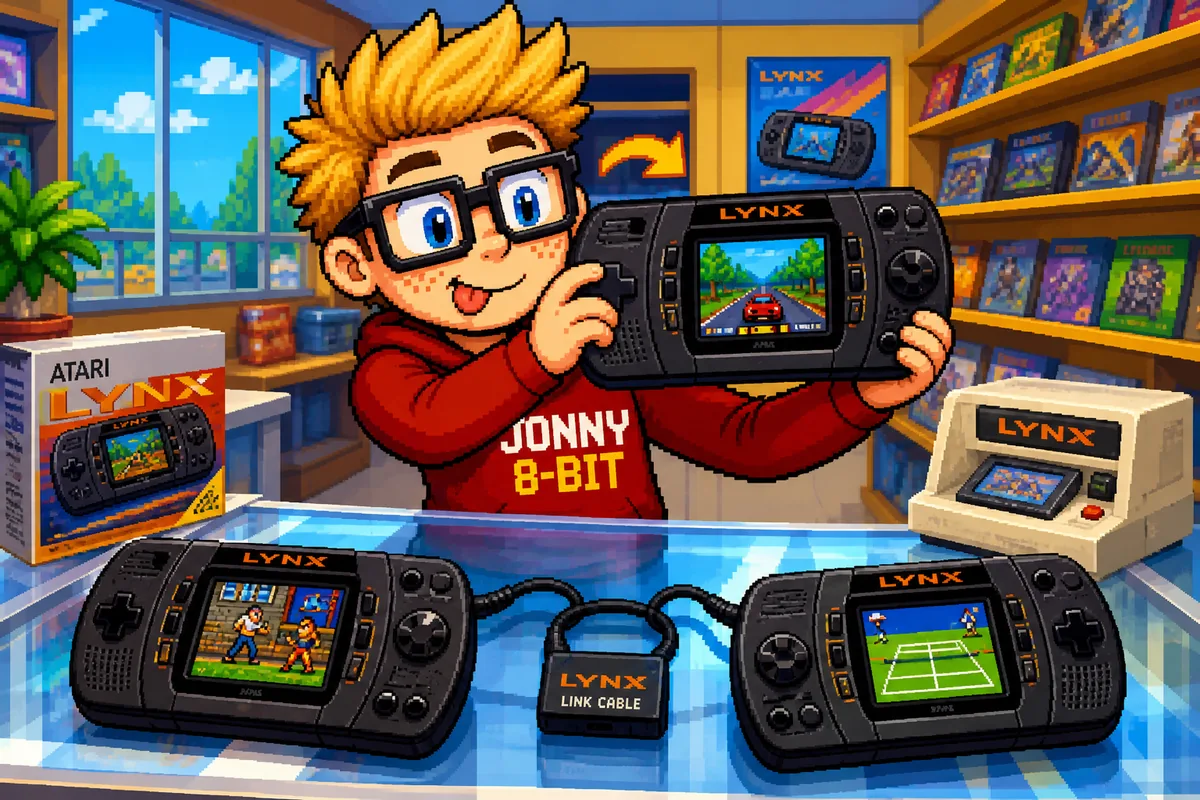
Turn an original Atari Lynx upside down and it can still make sense. The wide handheld has controls on both sides of its screen, and supported games can rotate the picture so a left-handed player can place the directional pad under the preferred hand. In 1989, when most portable systems treated one control layout as universal, that simple option felt unusually thoughtful.
The reversible design was only one ambitious feature. Lynx displayed color graphics, enlarged and rotated images in hardware, and connected multiple systems for group play. It was far more technically adventurous than Nintendo’s monochrome Game Boy. Yet the smaller, less technically impressive Game Boy became the historic winner. The Lynx story is not just about a powerful machine losing a sales contest. It shows how industrial design, accessibility, battery life, price, software, and business support all meet in the player’s hands.
The Lynx began as Epyx’s “Handy”
The machine did not begin at Atari. In 1987, former Amiga colleagues Dave Morse, Dave Needle, and RJ Mical met to discuss a portable game system. WIRED later reported that they sketched the basic idea in about an hour and a half. Needle specialized in hardware, while Mical’s background included software and the Amiga’s Intuition user interface. Their combined approach treated the chips, programming tools, and player experience as connected parts of one design.
Development moved to Epyx, the software company known for games such as Summer Games and California Games. The project’s internal name was Handy. Epyx could develop hardware and games, but producing and marketing a new console required far more money. The company looked for a partner, and Atari eventually obtained the system. Atari renamed it Lynx and prepared it for a market that was suddenly crowded with portable competitors.
Color was only the most visible trick
The 3.5-inch backlit LCD was the feature buyers could understand at a glance. Game Boy offered four gray-green shades; Lynx games could build colorful arcade-like scenes. Behind the display, custom hardware handled scaling, rotation, and distortion. A racing game could make roadside objects grow as the player approached. Blue Lightning could send aircraft and ground scenery toward the screen. These effects created a sense of speed and depth without requiring the machine to draw a modern 3D world.
Lynx also supported ComLynx networking. WIRED described a system able to connect as many as 16 units on one wire, with the hardware managing identification and communication. The practical player count depended on the game, the number of systems, cartridges, and cables available. Even so, portable linked multiplayer was a serious idea rather than an afterthought. The Lynx paired that ambition with stereo sound and a software-development environment built around the Amiga.
Reversible controls treated handedness as a design problem
The original machine placed a directional pad on one side of the screen and two sets of A and B fire buttons on the other. A player could rotate the entire Lynx 180 degrees. When a game supported the flip option, its picture and controls reversed with the hardware. The directional pad could therefore sit under either the left or right hand. IEEE Spectrum described the system as ambidextrous, and a period Lynx technical FAQ documented both its reversible controls and duplicated fire buttons.
The feature did not make every game equally comfortable for every person, and software had to cooperate with it. Still, it challenged an assumption built into most game controllers: movement belongs under the left thumb and action belongs under the right. The solution required no separate “left-handed edition.” Needle and Mical designed flexibility into the same object. Decades later, when games offer extensive control remapping, the Lynx remains a striking early example of hardware acknowledging different players.
The price of portable power
All that technology had physical costs. The original Lynx measured more than ten inches across and weighed substantially more than a Game Boy. Its backlight and color display drew power from six AA batteries and generally delivered only a few hours of play. Atari’s initial U.S. price was about $180—roughly $470 in 2025 dollars—while Nintendo launched the Game Boy in the United States for about half as much. A color screen looked exciting in a store, but parents also had to consider the batteries it would consume afterward.
Nintendo made the opposite set of compromises. Game Boy was smaller, lighter, less expensive, and could run around 10 to 14 hours on four AA batteries, according to Smithsonian’s museum history. It also arrived with Tetris, a game that worked for quick sessions and reached well beyond the usual action-game audience. Read beside Stangmedia’s explanation of Gunpei Yokoi’s “lateral thinking with withered technology”, the two handhelds become a near-perfect design comparison: Lynx pursued what portable hardware could display, while Game Boy concentrated on how long and how cheaply people could play.
Strong engineering could not build the market alone
The Lynx reached the public while Epyx was in serious financial trouble. That weakened the software partner just as a new platform needed a steady flow of games. Atari brought manufacturing and distribution, but it could not match Nintendo’s growing developer network, recognizable characters, or retail momentum. A handheld’s value increases when friends own compatible systems and stores keep stocking new cartridges. Nintendo’s lead therefore reinforced itself.
Atari released a smaller Lynx II redesign in 1991 with a backlight shutoff option, but the basic market problem remained. Lynx earned devoted fans and memorable versions of California Games, Chip’s Challenge, Klax, Todd’s Adventures in Slime World, and other titles. It never gained the broad library or installed base of Game Boy. That outcome does not make its engineering meaningless. It demonstrates that the best technology is only one part of a successful platform.
A handheld remembered for asking better questions
Lynx’s color and visual effects predicted the direction portable games would eventually take. Its linked play anticipated a future in which handheld gaming was social. Most distinctive of all, its reversible layout asked who might be excluded by a supposedly standard arrangement. The implementation was not perfect, but the question remains current.
The machine also offers a useful correction to winner-only history. Game Boy deserved its success, yet it was not the only creative answer to portable play in 1989. Lynx designers made different priorities visible, and later handhelds benefited from a market that had tested both approaches. Sometimes the product that loses the largest contest still leaves ideas worth picking up.
Videos and further viewing
These videos add demonstrations, interviews, or visual context to the story. A privacy-enhanced YouTube player loads only after you choose a video. Review YouTube’s privacy policy.
A Look At: The ATARI LYNX -The World's First Color LCD Handheld Designed by AMIGA Engineers
Video by Retrogamer Gen XA hardware tour of the Lynx, including its color screen, wide design, and unusual handheld features.