The Gulf War Game Boy That Survived a Bombing
Nintendo’s scorched handheld really did power on after a Gulf War deployment—but its owner says the famous bombing story is wrong.
 Narrated by Jonny 8-Bit6 min read · Published 8/15/2026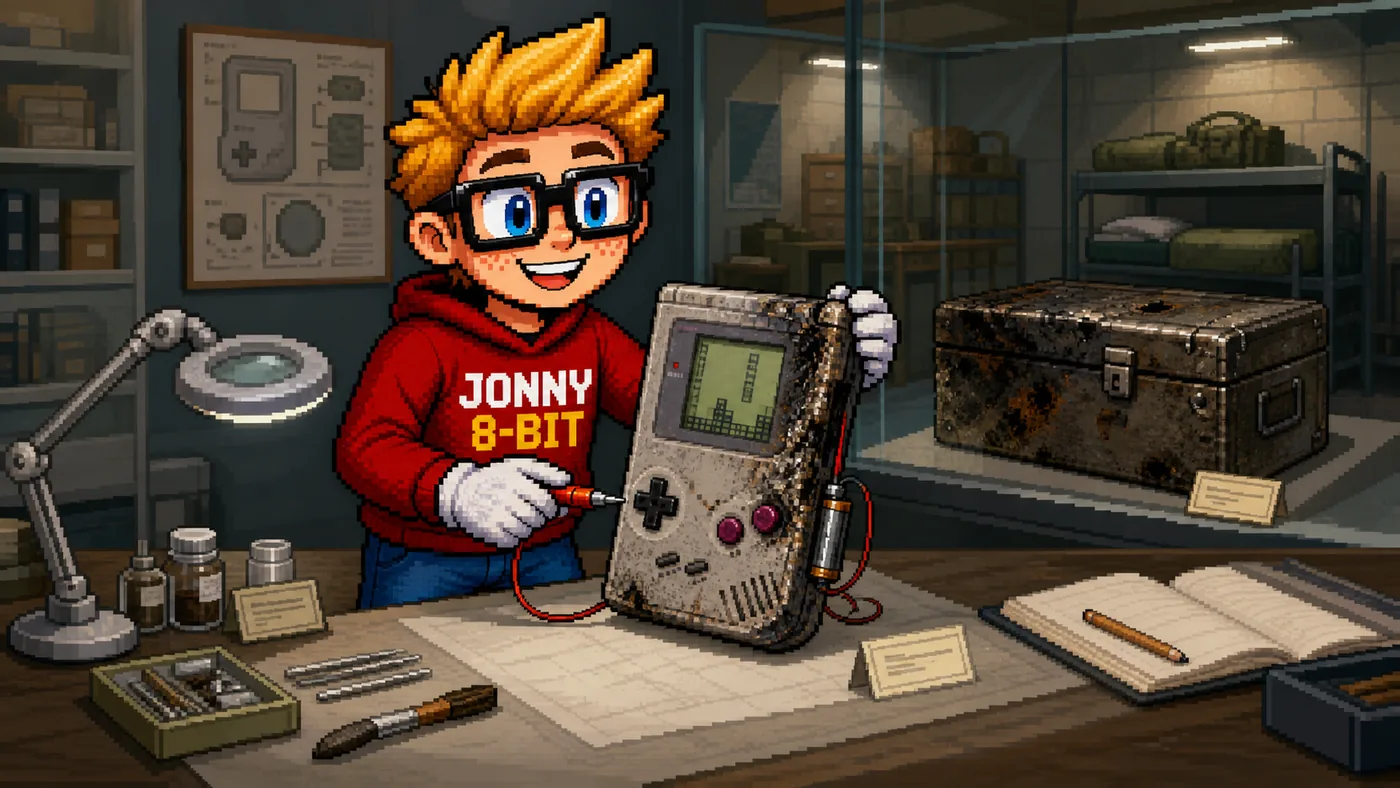
For years, visitors to Nintendo’s New York City store could see one of gaming’s strangest survivors. An original gray Game Boy sat inside a display case with its front badly burned, its plastic shell melted, and a copy of Tetris running on its screen. A nearby sign said the handheld had been damaged when barracks were bombed during the 1990–1991 Gulf War.
The Game Boy was real, and its ability to power on was real. The bombing story was not. Its original owner, Stephan Scoggins, told The Verge in 2023 that his tent burned down while he was serving in the Middle East. A bombing happened at the location in a separate incident, he said, but his Game Boy was not caught in it. The correction makes this less of a war legend and more of a remarkable story about fire, durable hardware, and how a short museum label can change history.
The famous plaque told the wrong story
The display at Nintendo New York turned the damaged Game Boy into a company legend. Its twisted shell looked like physical proof that Nintendo’s handheld could survive almost anything. Photographs spread across gaming websites and social media, often under headlines claiming it had lived through a bombing. Because the artifact was inside Nintendo’s own store, most people had little reason to question the explanation beside it.
Scoggins eventually cleared up what happened. He had been a registered nurse serving during Operation Desert Storm when a fire destroyed his tent and damaged his belongings. He believed the bombing claim grew from two real events being mixed together over time. That difference matters. The handheld survived a severe fire during a Gulf War deployment, but it did not take a direct blast or emerge from bombed barracks. The truth is still impressive without adding an event that its owner says never happened.
Nintendo Power tested it in 1991
The earliest public version of the story appeared in the July 1991 issue of Nintendo Power. Scoggins had sent the burned Game Boy to the Nintendo-owned magazine and asked whether the company might exchange it for a working one. His own description said the system had been claimed by a fire while he was stationed in the Middle East. It did not mention a bombing.
The magazine’s staff expected the handheld to be dead. Its back was in much better condition than its front, which had been charred and blistered by heat. The editors inserted a Tetris cartridge, connected a Battery Pak, and turned on the power. They heard the Game Boy’s familiar startup sound. According to their report, the directional pad and the A and B buttons had melted, while Start and Select still worked. Nintendo gave Scoggins a replacement Game Boy as a special courtesy and kept the damaged machine.
“Still working” did not mean fully playable
Retellings often say the burned Game Boy worked perfectly, but that goes beyond the original report. With its main controls melted, no one could comfortably play a normal game on it. What the test proved was that important parts inside the system could still communicate: the machine accepted power, read the cartridge, produced sound, and displayed Tetris on the screen.
That is already an extraordinary result. The 1991 account does not describe Nintendo repairing the motherboard or replacing the display before the test. Staff simply connected power, inserted a cartridge, and tried the switch. Later store displays could let Tetris run without anyone using the damaged controls. Calling the Game Boy “operational” is fair; calling it completely functional is not.
Why any of the hardware survived
Nintendo introduced the Game Boy in Japan in 1989 with Tetris. The handheld was small—an example preserved by The Henry Ford measures about 5.75 inches tall, 3.5 inches wide, and 1.25 inches deep—and it used solid game cartridges instead of tapes or spinning discs. Its simple, low-power design had fewer moving parts than many portable electronics. Those choices helped make the system practical to carry, but Nintendo never designed it to resist a building fire.
The damage was also uneven. Photos show that the front took the worst heat while much of the back kept its original shape. If the circuit board and cartridge connector avoided the hottest temperatures, the electronics could survive even while the outer plastic softened and burned. That was a lucky exception, not a safety feature. Batteries, screens, solder joints, and circuit boards can all fail dangerously when exposed to fire. No one should try to repeat this test at home.
A personal object became a public legend
Nintendo kept the scorched system and eventually displayed it in New York, where it spent years showing Tetris behind glass. The contrast made it unforgettable: the shell looked ruined, yet the screen still showed a game recognized around the world. Visitors photographed it, writers repeated its story, and the damaged handheld became an unofficial advertisement for the Game Boy’s toughness.
That fame also shows why labels need careful sourcing. A few words about a bombing changed a tent-fire story into something more dramatic, and the altered version spread for years. In 2023, Nintendo New York confirmed that the Game Boy was no longer on display. Store staff reportedly said it had been returned to Nintendo’s United States headquarters in Washington for safekeeping. Wherever it is stored now, its future label should preserve both the artifact and Scoggins’s correction.
What the corrected story tells us
The Game Boy did not become successful because it had the most advanced screen or the most powerful processor. It offered portable games, long battery life, interchangeable cartridges, and hardware simple enough to use almost anywhere. Those priorities fit the design thinking associated with Gunpei Yokoi’s practical approach to mature technology. By 2000, Nintendo reported that worldwide Game Boy sales had passed 100 million units.
Scoggins’s damaged unit adds a human story to those numbers. It was a personal entertainment device carried by a nurse during a dangerous military deployment, then a piece of reader mail, a magazine experiment, and finally a famous store exhibit. Correcting the bombing claim does not weaken that history. It respects the person who owned the machine and reminds us that a true story should not need extra destruction to hold our attention.
Videos and further viewing
These videos add demonstrations, interviews, or visual context to the story. A privacy-enhanced YouTube player loads only after you choose a video. Review YouTube’s privacy policy.
The Game Boy That Survived a Bombing
Video by FyenYTSee the damaged Nintendo Game Boy and the remarkable museum story surrounding its continued operation.