How Nintendo Rebuilt Consumer Trust With the NES
Nintendo did not merely bring a Japanese console to America; it redesigned how the machine, its games, and the entire business were presented.
 Narrated by Jonny 8-Bit6 min read · Published 8/20/2026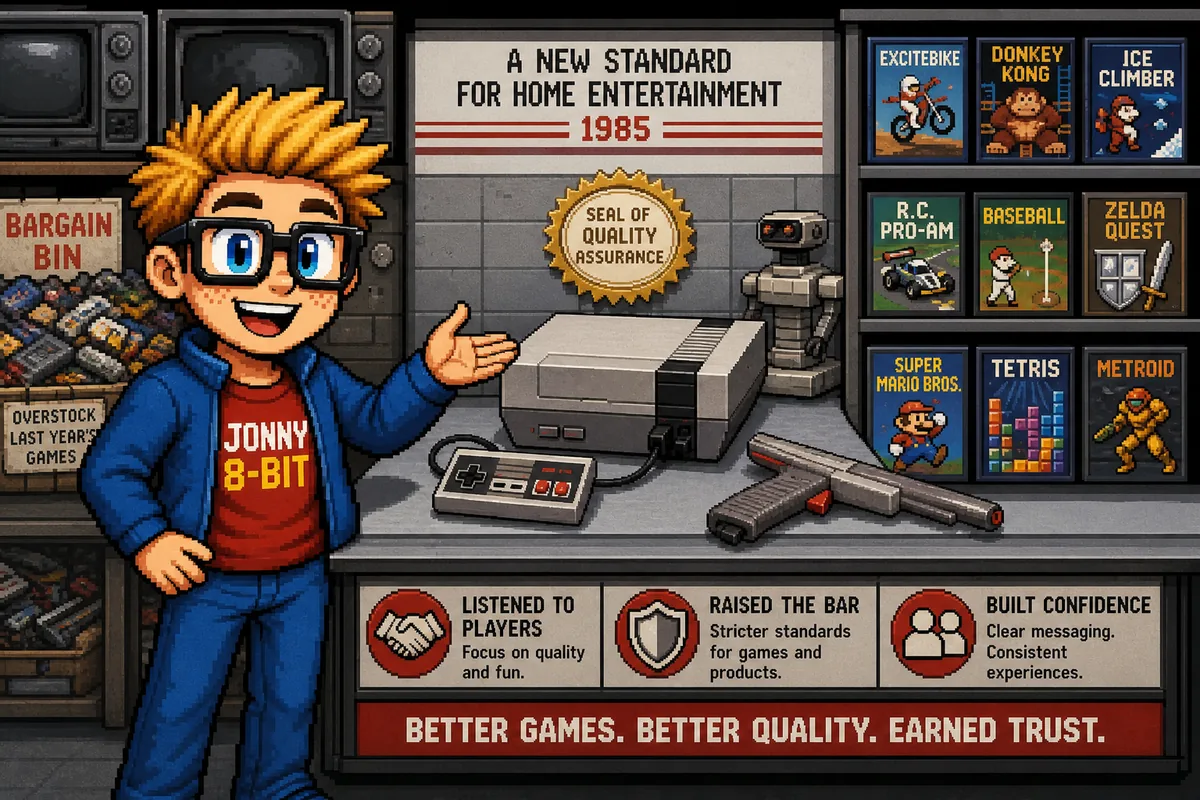
In 1985, Nintendo had a successful game console and a market that did not want another game console. The Family Computer, or Famicom, had become a major hit in Japan, but American retailers remembered shelves crowded with discounted cartridges, failed publishers, and expensive returns. To them, a new system could look less like an opportunity and more like the start of the same problem again.
Nintendo changed the machine’s appearance, tested it city by city, presented it as a family toy, used packaging that showed what games looked like, marked authorized products with a recognizable seal, and controlled which cartridges could run. Then it backed those promises with games people wanted to keep playing. Trust returned one purchase and one convincing game at a time.
A Japanese success met an American wall
Nintendo released the red-and-white Famicom in Japan in July 1983, during the North American console market’s collapse. The machine succeeded quickly at home. The Video Game History Foundation reports that Nintendo had sold 2.5 million Famicom systems during its first 18 months and controlled about 90 percent of Japan’s home-game market by January 1985.
Those numbers did not erase American memories. Retailers had watched demand forecasts fail, publishers close, and cartridges fall into clearance bins. Gail Tilden, one of Nintendo of America’s first marketing employees, later recalled that the company initially saw little U.S. opportunity for the Famicom. Even research with children produced a grim verdict from one moderator, who recommended that Nintendo not introduce it.
Nintendo therefore had two customers to convince. Children needed to want the games, but retailers had to provide shelf space and parents had to risk the money. Tilden remembered the launch price as $149 and described parents as the gatekeepers. Nintendo wanted adults to believe the product offered lasting family value instead of becoming another electronic toy left in a closet.
Nintendo stopped calling it just another console
Nintendo’s first American proposal was the Advanced Video System, shown at the Winter Consumer Electronics Show in January 1985. The AVS resembled higher-end electronics and included ambitious ideas such as wireless controllers, a keyboard, and a tape drive. It tried to place distance between Nintendo’s product and the game consoles that stores associated with the crash.
That design did not reach stores. Some features were impractical for mass production, and Nintendo shifted toward a simpler machine that its American staff nicknamed the “lunchbox.” The final gray-and-red hardware loaded cartridges through a front door. Marketing called the main unit a Control Deck, cartridges Game Paks, and the complete product the Nintendo Entertainment System. The language invited buyers to see a new category rather than another Atari-style console.
The strategy was not to hide that the NES played games. It was to make the whole package feel fresh, complete, and supportable. A Zapper light gun and R.O.B., the Robotic Operating Buddy, provided objects a salesperson could demonstrate. R.O.B. was slow and supported only two games, but a moving robot made the system look unlike anything that had filled bargain bins two years earlier.
The New York launch kept the risk contained
Instead of attempting an immediate nationwide release, Nintendo launched the final NES in the New York test market in October 1985. The limited area let the company learn how families and stores responded without betting its entire U.S. future on one holiday. Nintendo employees demonstrated the system, built displays, and tried to explain an unfamiliar brand in person.
The first Deluxe Set put R.O.B. and the Zapper beside the console. Tilden rejected the later idea that Nintendo knowingly used a useless robot to trick shoppers. The team genuinely thought robots were exciting and that R.O.B. created a visible point of difference. Within four to six months, however, the Los Angeles test included a simpler set built around Mario. Nintendo adjusted when the games themselves became the stronger attraction.
Black-box packaging made a quieter promise
Early NES releases used the famous “black box” design. Instead of painted fantasy scenes that could promise more than old hardware delivered, the front showed blocky artwork resembling the game screen. Tilden said the point was not to oversell. The box also identified a category, helping shoppers tell an action game from sports, education, or another style.
This was a modest but important form of honesty. A parent could compare the picture on the package with what appeared on the television. The art did not prove a game would be fun, but it reduced the gap between expectation and reality. After the old market had trained shoppers to distrust exciting cover art, accuracy became part of the NES brand.
The seal and the lock gave Nintendo control
The Nintendo Seal of Quality turned authorization into a symbol shoppers could recognize. Tilden recalled that her boss, Ron Judy, wanted something like the Good Housekeeping seal. Nintendo placed it on official products and used accompanying material to describe standards for workmanship, operation, and acceptable content. The seal communicated that someone stood behind the box.
The name needs a warning: it did not guarantee brilliant design or a fun evening. Plenty of licensed NES games disappointed players. The seal mainly told buyers that Nintendo had authorized the product and that it was made to work with the system. Its value came from accountability and consistency, not from a promise that every cartridge was a masterpiece.
Nintendo gave that policy technical force through the 10NES lockout system. A program in the console checked for a matching “key” in an authorized cartridge. According to the U.S. Copyright Office’s summary of Atari Games v. Nintendo, the system prevented the NES from running cartridges Nintendo had not approved and let Nintendo collect licensing fees from publishers.
That control addressed the uncontrolled supply that had hurt the earlier market, but it also concentrated power in Nintendo’s hands. Publishers had to accept Nintendo’s terms, and companies later challenged the lockout system and licensing restrictions. Rebuilding trust for buyers and retailers came with a less comfortable tradeoff: Nintendo became the gatekeeper to a highly valuable audience.
Software turned the promise into trust
Packaging could win a first look, but only games could justify a second purchase. Super Mario Bros. gave players responsive movement, colorful scrolling worlds, secrets, shortcuts, and a difficulty curve that encouraged another try. It was easy to understand and deep enough to discuss on playgrounds. The Warp Zones rewarded exploration and made players feel that the cartridge contained more than its straight path revealed.
Other releases widened the promise. Duck Hunt made the Zapper useful, Excitebike offered racing and track design, and The Legend of Zelda later delivered a large adventure with saved progress. Nintendo and licensed publishers gave families reasons to return to the same hardware instead of treating it as a one-season novelty.
The NES did not restore the market through branding alone, and Nintendo did not act only out of kindness toward consumers. Its controls generated licensing revenue and protected its business. Yet the strategy worked because its pieces supported one another: cautious distribution reassured stores, honest packaging set expectations, authorization identified accountability, and strong software rewarded the purchase. Trust was not printed on the gold seal. It was earned when the next Game Pak worked and the next game felt worth bringing home.
R.O.B. may have helped the NES enter the room, but he did not carry the industry on those little plastic arms. The real rebuild happened when a cautious first purchase became a request for one more game.
Videos and further viewing
These videos add demonstrations, interviews, or visual context to the story. A privacy-enhanced YouTube player loads only after you choose a video. Review YouTube’s privacy policy.
The Video Game Years 1983 - Full Gaming History Documentary
Video by Pat the NES PunkA year-by-year documentary placing the market crash and Nintendo’s approaching U.S. launch in their wider 1983 context.