Red Annihilation: The Quake Tournament With a Ferrari Prize
An online Quake competition ended at E3 with a one-on-one final, a dominant champion, and the most famous set of car keys in esports history.
 Narrated by Jonny 8-Bit6 min read · Published 8/20/2026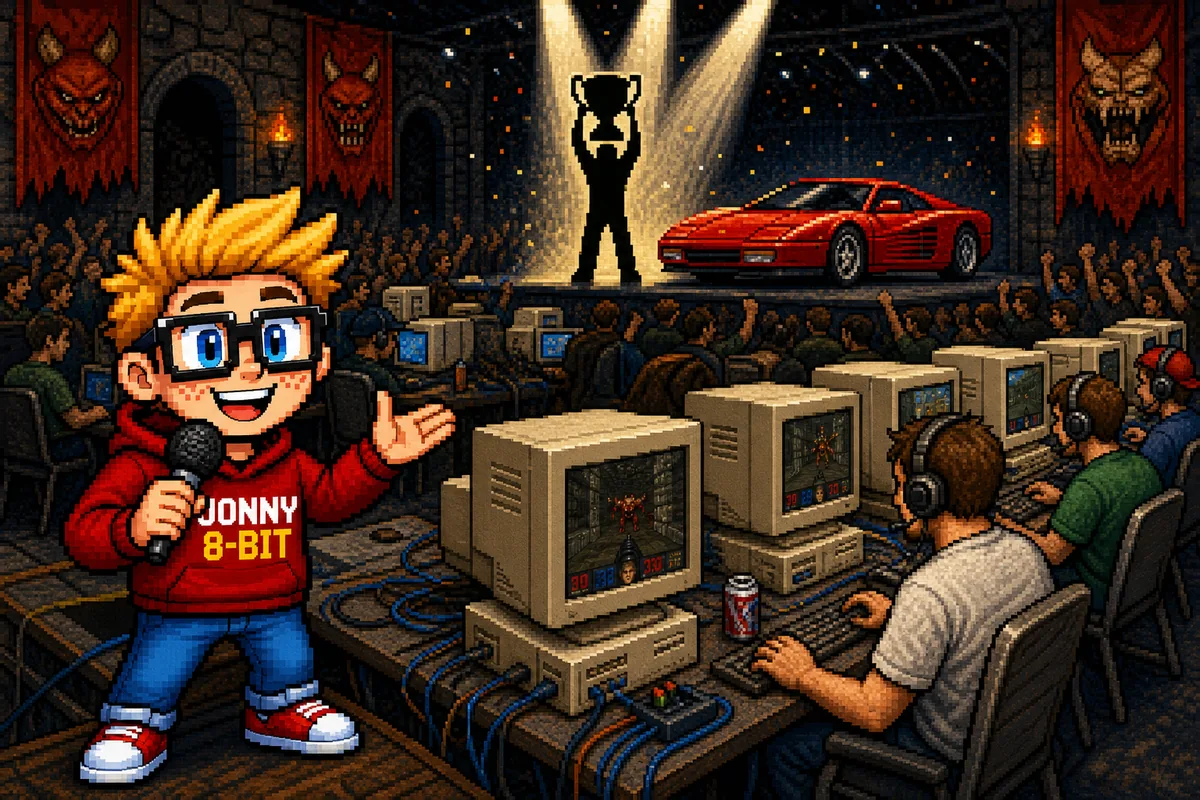
With ten seconds left in the final match, Dennis “Thresh” Fong knew the Ferrari was his. He was far enough ahead that his opponent could not catch him. Then he noticed the red sports car reflected in his computer monitor. It had been parked behind him throughout the match, waiting for a winner.
Fong was 20 years old. The car was John Carmack’s modified 1987 Ferrari 328 GTS, and the game was Quake. When the timer expired at the Electronic Entertainment Expo in Atlanta in June 1997, Carmack walked over and handed Fong the keys. Fong had one immediate problem: he did not know how to drive a stick shift.
That funny detail helps make Red Annihilation memorable, but the tournament mattered for a larger reason. It joined online qualifying, a live network final, recognizable player names, major technology sponsors, and an extraordinary prize. Competitive gaming had existed for years, yet this event looked surprisingly close to the esports system that would grow around it.
Quake turned the Internet into an arena
Id Software released Quake in 1996. Its dark castles, monsters, and rocket launchers made it a strong single-player game, but its network deathmatches created a different kind of excitement. Players could face human opponents whose choices were less predictable than any computer-controlled enemy. They learned maps, timed item pickups, guarded powerful weapons, and listened for footsteps or elevators that revealed an opponent’s position.
Online play was still rough. Many homes connected through dial-up modems, and a slow or unstable connection could decide a fight. Carmack and id worked on QuakeWorld, a version designed to make Internet play more responsive. Players gathered on servers, formed clans, and became known by handles instead of their legal names. Long before social media, a name such as Thresh could carry a national reputation inside a game community.
Red Annihilation used the Internet to find its competitors. Mplayer, an online gaming service, ran open Quake qualifiers that drew roughly 2,000 entrants according to widely repeated contemporary accounts. The field was narrowed before a smaller group traveled to Atlanta. The exact number of finalists varies between later reports, but the structure is clear: players first proved themselves online, then the decisive matches moved to computers connected over a local-area network.
John Carmack offered a very unusual trophy
The prize began with a blunt message from Carmack. In a January 31, 1997, entry in his public `.plan` file, he wrote that he had “too many ferraris” and intended to give away his first one as the grand prize in a Quake tournament. Carmack had bought that car after the success of Wolfenstein 3-D. Later hits, including Doom and Quake, allowed him to buy three more.
This was not a brand-new showroom car. It was a red 1987 Ferrari 328 GTS with a Norwood Autocraft turbo conversion. Carmack reported that it produced 360 horsepower at the rear wheels. It had new paint and a replacement engine because, in his own words, he had melted the first one. He also admitted that the interior “could use a little work.” Even with those quirks, it was an astonishing tournament prize.
Carmack originally planned to include money to cover taxes and insurance. As tournament planning continued, he proposed one-on-one deathmatch finals over a LAN, probably using double elimination. Intergraph already had a clan competition scheduled for E3, with ClanRing managing it, so the Ferrari contest was added to that larger event. Intergraph offered to pay travel and lodging for a limited group of contestants. Mplayer handled the online side, while Microsoft was also associated with the sponsored event.
The online road ended on a local network
Holding qualifiers online made the tournament open to players far beyond one city, but placing the final on a LAN was important. On a local network, the computers communicated without crossing the wider Internet. That greatly reduced the connection delay that frustrated modem players. The championship could be decided by movement, aim, and strategy instead of by whose phone line behaved better that afternoon.
The finals took place during E3 1997 in Atlanta. E3 was an industry trade show rather than a public esports arena, but it supplied the kind of stage competitive gaming rarely received at the time. Computer companies could display powerful systems, game publishers could attract press attention, and spectators could see skilled players turn a familiar shooter into a serious contest.
Fong entered as the favorite from the West Coast. He had become well known through earlier Doom and Quake competition, and sponsors were already paying for his skill and public profile. His expected rival was Tom “Entropy” Kimzey, who had a similar reputation on the East Coast. The final gave the event an easy story: two leading players from opposite sides of the country meeting for the first time with a Ferrari waiting nearby.
Thresh controlled the final
Fong and Kimzey could not agree on one of the most popular maps, so they settled on another choice. Fong later remembered winning 13 to negative one. A player could fall below zero by causing his own death, such as being caught in his own explosion. The number has been reported differently in some later summaries, but every version agrees on the important point: Fong won by a huge margin.
That result was not simply a demonstration of quick aiming. Elite Quake play required control of the battlefield. A player who knew when armor, health, and weapons would return could arrive first and deny them to an opponent. Once ahead, that player could use sound, timing, and likely spawn locations to keep the advantage. Fong’s disciplined approach helped show an audience that a first-person shooter could reward planning as much as reflexes.
When the countdown began, Fong finally became nervous. He had been focused on the match until he saw the Ferrari in the monitor. Carmack presented the keys, then asked how Fong planned to get the car back to California. After learning that the winner could not drive it, Carmack returned with cash to help have it shipped home.
A bright red symbol of professional gaming
Red Annihilation was not the first video game competition. Arcades had held score contests for years, and nationwide events such as the Nintendo World Championships of 1990 had already placed talented players on large stages. It also was not a modern global broadcast with a permanent league, a large production crew, and millions of viewers.
What it offered was a powerful preview. An unknown player could enter through an online service, advance to an in-person final, compete under a gaming handle, attract sponsors, and win a prize that made people outside the hobby pay attention. Guinness World Records now regards Fong as the first professional videogamer, although that label depends on how “professional” is defined. Earlier champions earned prizes, and some players made money from games before him. Fong stood out because tournament results, sponsorship income, and public recognition came together around one career.
Later esports scenes would build more stable leagues, broadcasts, teams, and training systems. South Korea’s professional StarCraft culture showed how much larger that model could become. Red Annihilation came before those systems were mature. Its organizers were still solving basic questions about Internet delay, fair qualification, travel, hardware, and even how to deliver the prize.
The Ferrari did not create esports by itself. It gave an emerging culture a photograph nobody could ignore: a young champion, a famous game programmer, and a red sports car earned through a computer match.
Videos and further viewing
These videos add demonstrations, interviews, or visual context to the story. A privacy-enhanced YouTube player loads only after you choose a video. Review YouTube’s privacy policy.
Thresh wins Ferrari in 1997 Red Annihilation Quake 1 Tournament! HD2
Video by TheAGPTourWatch surviving footage from the Red Annihilation final where Thresh won John Carmack’s Ferrari.