Street Fighter II Combos Began as an Unexpected System Behavior
Capcom tried to make special moves easier to perform and accidentally opened a path from one attack into another before an opponent could block.
 Narrated by Jonny 8-Bit6 min read · Published 8/20/2026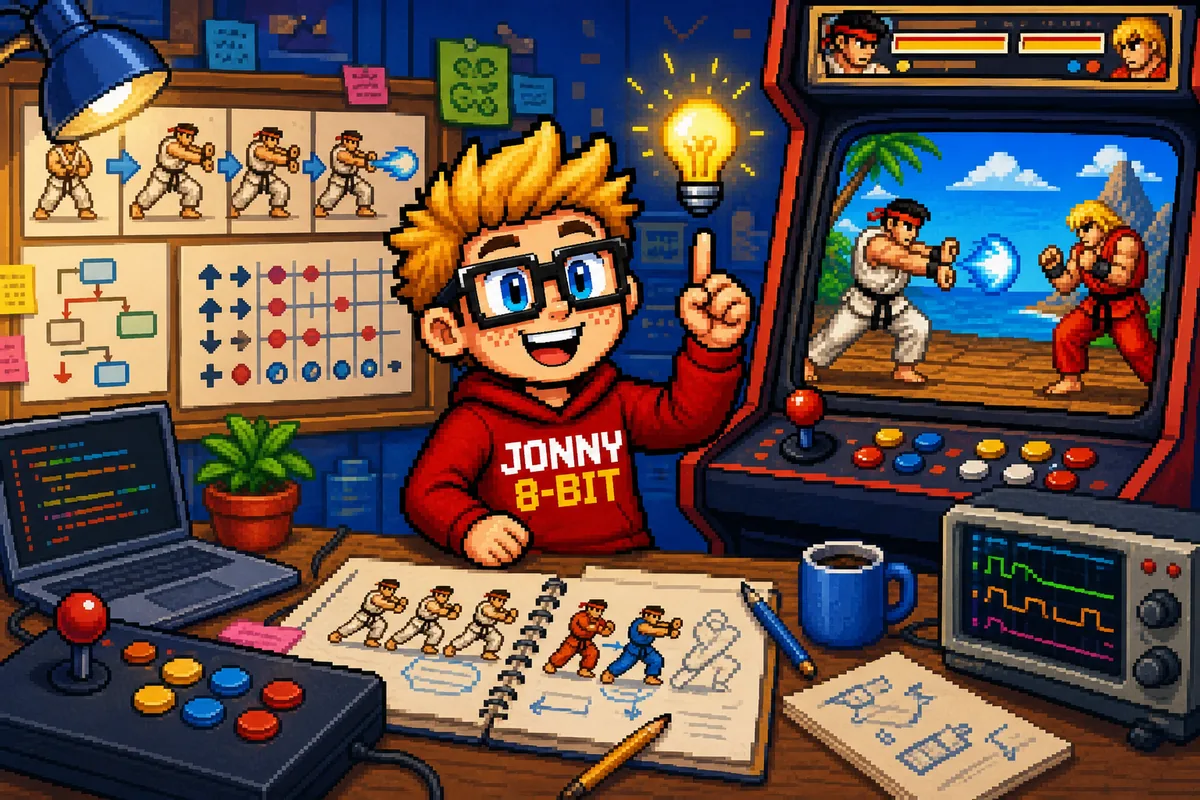
An opponent in Street Fighter II is knocked backward by Ryu’s punch. Before Ryu finishes pulling his arm into its resting position, a Shoryuken erupts underneath the opponent and hits again. There is no time to block between the attacks. What looks like a planned two-part martial arts technique began as a side effect of a system created for another reason.
The simplified legend says that combos were a bug Capcom missed and arcade players discovered after release. The real history is more interesting. Lead designer Akira Nishitani explained that the behavior was unexpected, but the development team found it before the game shipped. They recognized its potential and decided to keep it. An accident became a feature through judgment, then became a language through play.
Street Fighter II did not invent every form of consecutive attack. It popularized reliable, character-specific sequences that an opponent could not interrupt after the first hit. A combo became a reward for knowledge, timing, positioning, and nerve.
Capcom was trying to make special moves more forgiving
The original Street Fighter asked players to perform joystick motions followed by an attack button. These commands gave fireballs and rising uppercuts a physical rhythm, but were difficult to execute. Pressing a button too early might produce an ordinary punch instead of the intended special.
For Street Fighter II, Capcom added input leniency. The program kept enough command information to recognize a special even when button timing was not exact. Nishitani said the goal was to prevent a special from failing because its button was pressed too quickly.
The helpful rule produced an unexpected result. If the early press started a normal attack, the game could still recognize the special command. The special could interrupt the normal attack’s remaining animation, creating a path from a punch or kick into a Hadouken or Shoryuken.
Canceling an animation can create a combo
A fighting-game attack has several stages. It starts, becomes capable of hitting, and then recovers as the character returns to a neutral stance. The defender who is struck also spends a short period in “hit stun,” during which blocking and counterattacking are unavailable. Normally, the attacker must finish recovering before beginning another move.
A cancel changes that schedule. The game cuts off the recovery portion of the first attack and begins the special move immediately. If the special arrives before the opponent’s hit stun ends, the two attacks form a true combo. After the opening hit connects, the defender has no usable gap in which to escape or block.
Not every multi-hit sequence is a cancel. In a “link,” the first attack completes normally, but the attacker recovers soon enough to land another move before the defender becomes active. Some special moves also contain several hits by themselves. Street Fighter’s accidental discovery was specifically the ability to interrupt certain normal attacks with special moves, although players combined canceling with these other timing relationships as their knowledge grew.
Distance mattered as much as speed. An attack might cancel correctly but push the opponent beyond the special’s reach. A corner sequence might fail near center screen, while a stronger attack could offer more damage but slower timing. Animation and position became resources to study.
The developers discovered it and chose not to remove it
Nishitani’s 1991 account describes the familiar uppercut-to-Shoryuken sequence as an unplanned result of adjusted game settings. He remembered being astonished the first time he saw it. Decades later, he clarified that input leniency created the behavior and that the team found it interesting enough to retain.
For that reason, Nishitani resisted calling it a bug. The cancel was not part of the original plan, but once Capcom understood it, the team decided it could expand the game. This places it between accident and invention: the cause was unintended, while the choice to ship it was deliberate.
That choice required judgment because the team was already fixing freezes, misplaced characters, stalled computer opponents, and other genuine bugs. The cancel did not crash the game or make its rules random. It created a difficult but repeatable opportunity, so Capcom allowed players to explore it.
Arcade players turned a possibility into strategy
The original game did not pause to teach cancel timing or print a recipe for every sequence. Players learned by watching the screen, testing attacks, and challenging other people. A successful combination was immediately visible: two or more hits landed while the opponent remained helpless. That made discoveries easy to demonstrate at an arcade cabinet even when the underlying timing was hard to explain.
Communities began mapping which normal attacks could flow into which specials. Players compared damage, range, reliability, and the situations that created an opening. A combo that worked against the computer became more valuable when it could punish a human opponent’s mistake. Execution practice also gained a purpose: one clean opening could now produce several attacks instead of one.
The system deepened character identity. Ryu and Ken could turn a normal strike into a fireball or uppercut. Charge characters such as Guile required prepared directional input. Learning a fighter meant learning not only individual moves, but the connections among them.
Combos changed both offense and defense
Without combos, the reward for landing a difficult opening might be one attack. With combos, that opening could lead to major damage or a knockout. Players therefore had to judge risk differently. A missed sweep or poorly placed jump was dangerous not only because it could be hit, but because the opponent might convert that hit into a full sequence.
The first hit became a question as well as an impact: can the attacker recognize that it connected and complete the combo? This skill became known as hit confirming. Players also learned safer opening attacks, reliable punishments, corner routes, and character-specific responses. The accidental cancel did not replace the game’s footwork and prediction; it increased the value of winning those smaller battles.
Later games made combos visible and intentional. Hit counters confirmed uninterrupted sequences, and training modes supported practice. Designers created launchers, air combos, super cancels, wall bounces, and damage scaling knowing that players would optimize routes. Street Fighter’s surprise became standard design vocabulary.
A productive accident needs both makers and players
Not every unexpected behavior deserves celebration. Some bugs erase progress, freeze a match, or give one player an unavoidable advantage. A useful emergent feature must be repeatable enough to learn, understandable enough to plan around, and balanced enough to leave meaningful decisions on both sides.
Street Fighter’s cancel passed that test. Capcom supplied the rule and chose to preserve it; arcade players revealed its depth through thousands of matches. Years later, advanced descendants of that same design helped make moments such as Daigo Umehara’s Evo Moment 37 comeback readable as more than one lucky hit. The parry created an opening, but practiced combo knowledge converted it into victory.
The story is not “a bug created an entire genre.” Street Fighter II already had strong characters, special moves, competitive play, and careful animation. The cancel connected those parts. Developers recognized it, players expanded it, and later designers made it expected.
Videos and further viewing
These videos add demonstrations, interviews, or visual context to the story. A privacy-enhanced YouTube player loads only after you choose a video. Review YouTube’s privacy policy.
Street Fighter II’s Legendary Combos Were an Accident 😳 #streetfighter #gaminghistory #retrogaming
Video by Side-Scrolling StoriesA quick demonstration of how Street Fighter II’s unexpected cancel behavior became the foundation of combos.