GoldenEye’s Multiplayer Mode Was Added Late in Development
Months before release, GoldenEye still had no working multiplayer. A trusted team quietly turned the campaign’s systems into a four-player classic.
 Narrated by Jonny 8-Bit6 min read · Published 8/20/2026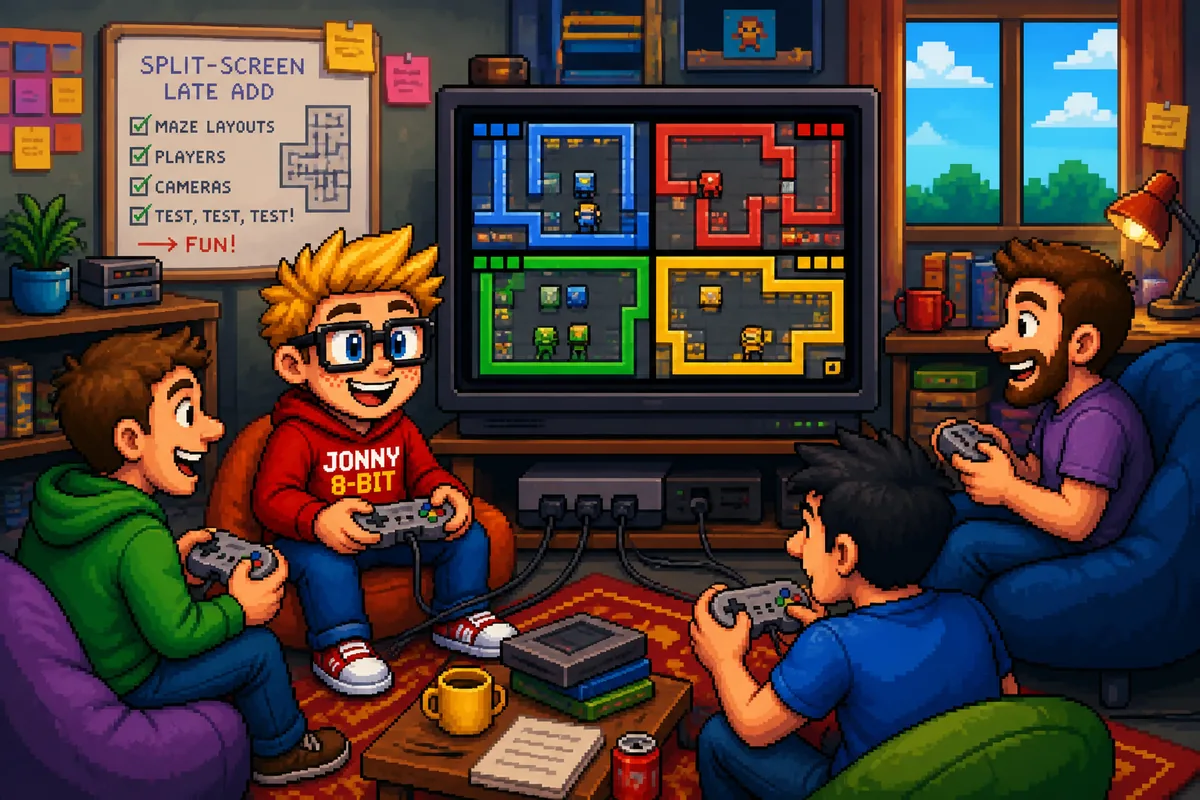
Four friends crowd around a Nintendo 64. Each person gets one quarter of the television, a controller, and a few seconds to choose a Bond villain. Someone demands proximity mines. Someone else reaches for Oddjob and is immediately told to pick anybody taller. The match begins, and a quiet living room turns into a shouting contest.
For many players, this was the heart of GoldenEye 007. Rare’s 1997 first-person shooter had a creative single-player campaign based on the 1995 James Bond film, but its split-screen mode kept the cartridge in consoles long after the missions had been completed. The surprising part is how close that mode came to missing the game.
Multiplayer had appeared as a small idea in an early design document, but there was no working version until the project was already badly behind schedule. Around March or April 1997, only months before the August release, programmer Steve Ellis began turning that idea into a real four-player game. A working prototype appeared within weeks, and the full mode took roughly one month to build.
The idea was early, but the playable mode was late
Director Martin Hollis began GoldenEye with a design document of about ten pages. Multiplayer occupied only a paragraph. That early proposal imagined connecting two consoles so two players could duel. The team did not yet know the Nintendo 64’s final name, controller, power, or unusual hardware features, so Hollis could not be sure that one machine could draw several viewpoints at once.
The main game also kept changing. It began as something closer to Sega’s on-rails arcade shooter Virtua Cop, then became a free-moving first-person game with stealth, mission objectives, gadgets, and enemies who reacted when shot in different places. Rare’s mostly inexperienced team spent nearly three years building and revising that campaign.
The original multiplayer paragraph therefore did not grow into code right away. It was more like a note saying, “This might be interesting someday.” Late in development, the team played Mario Kart 64. Its four-player split screen proved that Nintendo’s new console could put four competitors on one television and still be fun. Hollis decided that GoldenEye should try it too.
Steve Ellis built the first version in weeks
By early 1997, asking management for another major feature would have been difficult. GoldenEye was already over schedule, and multiplayer was not required to finish the licensed campaign. Hollis instead asked programmer Steve Ellis to add four-player split screen. Ellis was the last programmer to join the project, but Hollis described him as exceptionally talented.
Ellis produced a working prototype within a couple of weeks. Reports from Hollis’s 2012 Game Developers Conference postmortem describe the wider mode as taking about one month. Most important, Rare and Nintendo management were not asked for formal permission first. The developers showed the feature after it was already working.
That does not mean the team had been ordered never to make multiplayer and openly disobeyed. Rare and Nintendo gave the developers unusual freedom, and long stretches could pass without managers entering their work area. Hollis believed that asking in advance would probably have brought a “no” because of the late schedule. A playable build made the value much easier to see than a proposal promising even more work.
The campaign had already built the toy box
One month sounds almost impossible until the work already inside GoldenEye is considered. The campaign had weapons, character models, movement, collision detection, sound, damage rules, and finished environments. Multiplayer could reuse that large toy box. The new mode did not need a separate story, enemy intelligence, or mission briefings. It needed to place human-controlled characters inside spaces and systems that already worked.
The Nintendo 64 also helped. Four controller ports were built into the front of every console. Families did not need a network connection or a separate multitap accessory. If four controllers were available, four people could play in the same room. That hardware choice made local competition easy to understand and easy to start.
Reuse did not make the feature effortless. In the campaign, the player never saw James Bond crouch from the outside, so a complete crouching animation was unnecessary. Multiplayer suddenly made every player visible to the others. With little time left, crouching characters appeared to slide around on one knee. Explosive weapons created another problem: human players fired grenades and rockets much more recklessly than a careful campaign player, filling four viewpoints with effects the game had to process.
Four-way split screen was especially demanding. Each view could show the other three characters, meaning the console might need to draw as many as twelve character images across four different camera views. Programmer Mark Edmond and the art team helped adjust animation and performance. The final result carried rough edges because the team had to make it run, not rebuild the entire engine around a feature planned from day one.
Simple options created hundreds of arguments
The finished game supported as many as four players and offered eight scenarios. Normal was a standard contest. You Only Live Twice gave each player two lives. The Living Daylights worked like flag tag, while The Man With the Golden Gun gave one player a weapon capable of defeating an opponent with a single shot. Licence to Kill made every successful hit fatal, and three team arrangements completed the list.
Players could also choose arenas, characters, weapon sets, and match lengths. Those combinations gave a quickly built mode enormous replay value. A match with pistols felt careful and tense. A match with rockets became chaos. Proximity mines turned familiar hallways into traps, especially after everyone forgot where the mines had been placed.
The character list created its own social rules. Oddjob was much shorter than most opponents and therefore harder to aim at with the game’s controls. Hollis later called that a “social dynamics problem”: friends were expected to pressure one another not to use him. “No Oddjob” became an unofficial rule in countless homes, even though the cartridge itself allowed the choice.
The late addition changed console multiplayer
PC shooters already supported competition, and GoldenEye did not invent first-person multiplayer. Its special achievement was bringing an easy, social version of that experience to a popular console. Four people could sit on one couch, see every victory and mistake, and start another match without configuring computers or connecting a network.
The shared screen had a supposed weakness: everyone could look at everyone else’s location. Players called this screen-peeking, but it also added another layer of awareness and friendly accusation. The technology kept the competitors physically together. Reactions, negotiations, house rules, and rematches became part of the game.
GoldenEye also helped show that a console controller could support a first-person shooter, a genre strongly associated with computer keyboards and mice. Earlier games such as Doom had already created a huge shooter culture—and even made secret commands such as IDDQD and IDKFA common gaming knowledge. GoldenEye added a different memory: four controller cables stretching toward one television while friends argued about mines, maps, and Oddjob.
The multiplayer story is not proof that every project should ignore schedules or hide work from managers. The mode arrived quickly because years of campaign development had already created its parts, and because a skilled team knew those parts well. The important lesson is that a small playable experiment can reveal value that a document cannot. Rare did not merely describe why four-player GoldenEye might be fun. The team put controllers in people’s hands and let the room answer.
Videos and further viewing
These videos add demonstrations, interviews, or visual context to the story. A privacy-enhanced YouTube player loads only after you choose a video. Review YouTube’s privacy policy.
The Making of GoldenEye 007 (N64) | Documentary
Video by onaretrotipA making-of documentary covering Rare’s development process and GoldenEye’s unexpectedly important multiplayer mode.