The Pac-Man Level 256 Kill Screen Explained
After 255 cleared mazes, one overflowing number makes Pac-Man draw 256 bonus symbols and tears apart the right half of its own screen.
 Narrated by Jonny 8-Bit6 min read · Published 8/20/2026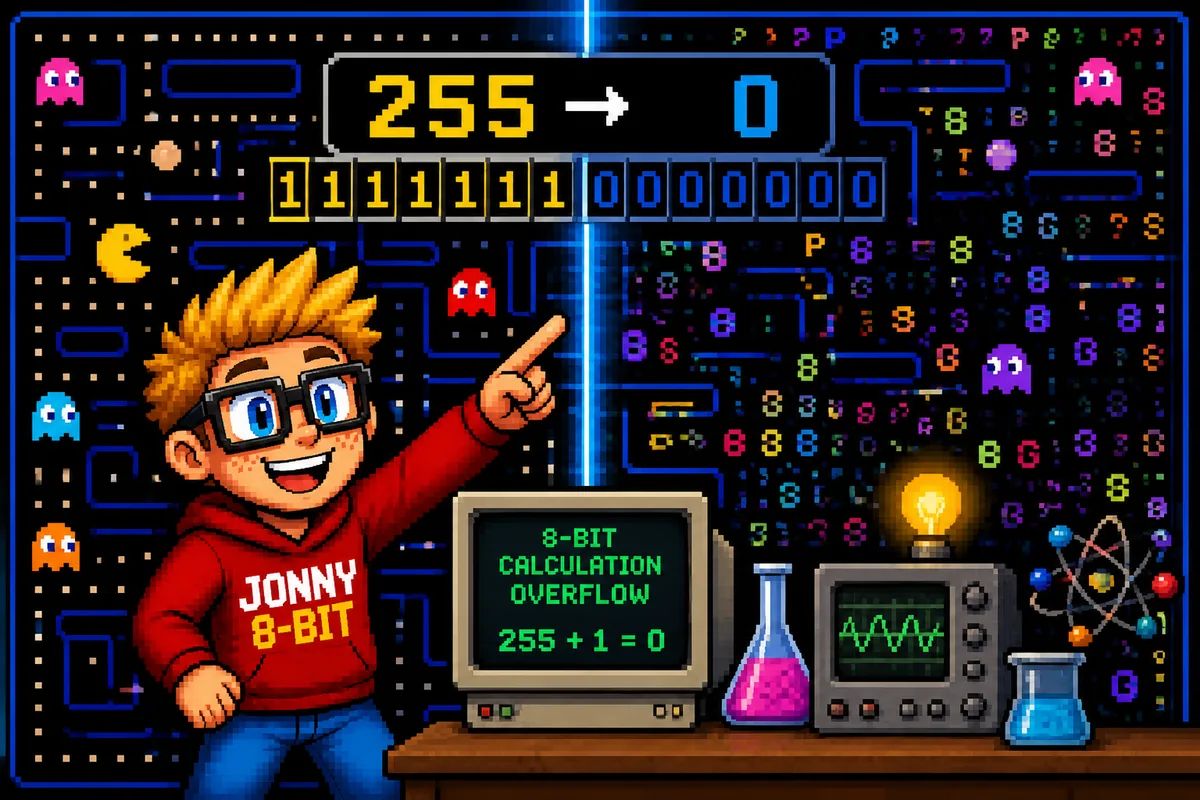
Imagine clearing a Pac-Man maze, then another, and then hundreds more without losing your final life. Several hours after the opening cherry, you finish board 255. The next maze appears—but only its left half looks normal. The right half has become a wall of colored letters, numbers, fruit pieces, maze fragments, and meaningless shapes.
This is level 256, commonly called the split screen or kill screen. Pac-Man and the ghosts still move, but the board cannot be finished through ordinary play. A display error has turned an apparently endless arcade game into one with a mathematical endpoint.
The failure is often summarized as “Pac-Man ran out of levels.” The stranger truth is that the game tries to draw 256 bonus symbols along the bottom. A routine meant to show a few cherries, strawberries, and keys starts reading unrelated data and painting it across the maze.
Pac-Man seemed as though it could run forever
Namco released Pac-Man in 1980, and its single joystick made the basic goal easy to understand: eat every dot while avoiding four ghosts. Its colorful characters and food theme stood apart from the space shooters filling many arcades. The story of how Toru Iwatani shaped that friendlier idea goes well beyond the familiar missing-pizza-slice explanation.
The simple controls hid a game that rewarded careful routes. Ghost behavior followed rules, and players learned patterns through the maze. After level 21, the difficulty settings repeat. A player with a dependable pattern could continue as long as concentration and spare lives allowed.
Early strategy books therefore described Pac-Man as endless. Almost nobody would clear 255 mazes during normal arcade play; doing so required more than three million points and hours of accurate movement. Only extraordinary players could make the hidden limit visible.
One byte can count only so far
The arcade hardware uses a Zilog Z80 processor and handles many small values in eight-bit units called bytes. Eight bits can represent 256 unsigned values: zero through 255. Add one to 255 and the result wraps to zero, like a mechanical odometer returning to all zeroes.
Inside Pac-Man, the board counter starts at zero. Level 1 is represented as 0, level 2 as 1, and so on. On level 256, the counter holds 255, or FF in hexadecimal. Trouble begins when the game prepares the bonus-symbol row at the bottom.
The fruit routine copies that counter into a one-byte register and adds one. It expects an answer from 1 through 255, but 255 plus one wraps to zero. The routine now holds a value its designer never expected.
The fruit loop runs 256 times
For early boards, the routine draws one fruit symbol for each level. Later, it displays only the most recent seven symbols. Either way, the loop expects a count from one through seven. It draws a symbol, subtracts one from the count, and stops when the result reaches zero.
Starting at zero turns that sensible loop into a disaster. The program draws one symbol before performing its stop check. It then subtracts one from zero, which wraps backward to 255. The result is not zero, so the loop continues. It must count all the way down from 255 before it finally reaches zero again. Including the first accidental pass, the drawing routine runs 256 times.
The game has no table of 256 valid bonus pictures. After the routine passes the real fruit data, it treats nearby bytes as graphics and advances through memory controlling visible tiles. The display layout directs much of that writing through the maze’s right side. The result looks random, but the same misplaced data produces it every time.
That is why original, unmodified machines produce the same recognizable split screen. It is not worn hardware or a secret final maze. The strange symbols come from a loop following its instructions with an unplanned starting value.
The damaged maze cannot supply enough dots
The kill screen does not immediately end the game. The left side contains 114 normal dots. Nine more survive on the corrupted right side, although four are invisible. A bonus key can also be collected. Players mapped the broken collision paths and learned to trap ghosts along the edge.
Clearing a normal board requires Pac-Man to eat 244 dots. Level 256 contains only 123 unique edible dot positions. Eating every one of them therefore does not trigger the next board. The game keeps waiting for dots that no longer exist because the fruit-drawing error overwrote the screen data that should have created them.
The nine damaged-side dots return whenever Pac-Man loses a life. With five extra lives, the largest possible harvest is 168 dots—still 76 short. The split screen offers at most 6,760 points. Eventually nothing productive remains, and the player must let the remaining Pac-Men be caught.
A software bug created a perfect score
The kill screen changed the meaning of mastery. An endless game could have no final best score. Once players understood level 256, they calculated a maximum of 3,333,360 points. A perfect game collects every possible dot, energizer, fruit, and blue ghost through 255 boards, then every available point on the split screen.
That goal connected code analysis with the high-score culture described in our story about Twin Galaxies’ national arcade scoreboard. Players needed more than a safe pattern. They had to understand invisible dots, extra-life rules, and the program’s exact boundary. An obscure defect became the finish line for a demanding arcade performance.
Rumors describe a secret path beyond level 256, but normal play cannot provide one. Some program versions include a “rack test” service switch that forces an advance; using a test feature is not clearing the board. Researchers can also patch the loop. On an original machine under normal rules, the missing dots make advancement impossible.
The glitch outlived the hardware limit
Level 256 became a useful lesson in how small assumptions can survive for years inside software. The programmer expected a fruit count greater than zero because no normal customer was expected to reach the one board that produced zero. The loop itself worked. The input was valid everywhere except at the distant edge of an eight-bit number.
The broken maze also became part of Pac-Man history rather than an embarrassment to erase. Later games and artwork reused its colorful digital debris, most directly in Pac-Man 256, where an advancing wall of glitches chases the player through an endless maze. A 1980 programming accident became a visual monster of its own.
Videos and further viewing
These videos add demonstrations, interviews, or visual context to the story. A privacy-enhanced YouTube player loads only after you choose a video. Review YouTube’s privacy policy.
Pac-Man Kill Screen Explained
Video by Retro Game Mechanics ExplainedA visual breakdown of the byte overflow and drawing routine that corrupt the right half of Pac-Man’s level 256.