Steve Wozniak’s Secret Tetris Name Fooled Nintendo
Evets Kainzow looked like a mysterious new Tetris master. The name was really Steve Wozniak spelled backward—and even Woz briefly forgot the joke.
 Narrated by Jonny 8-Bit6 min read · Published 8/15/2026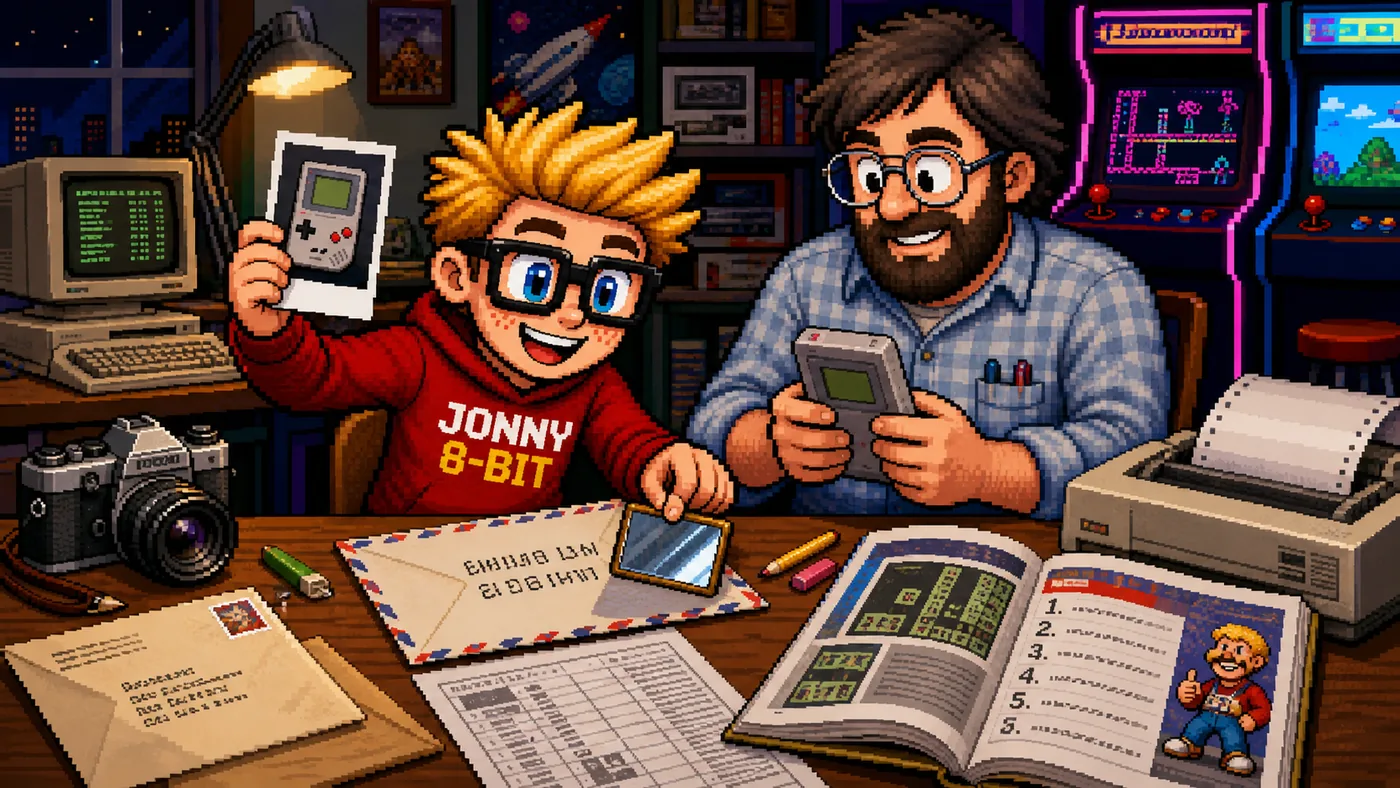
Open the July 1991 issue of Nintendo Power and turn to the high-score pages. Among the best Game Boy Tetris players is someone named Evets Kainzow of Saratoga, California, with 546,145 points. Read the name backward and the mystery disappears: “Evets Kainzow” becomes “Steve Wozniak.”
The Apple co-founder had already appeared in the magazine under his real name. When the editors decided they had printed him enough times and wanted to feature newcomers, Wozniak created one. He reversed both his names, changed his listed city, and mailed another score. The prank worked so well that Woz forgot about it and briefly worried when he saw the “new” local player. The basic story is true, but popular versions often inflate it into a Nintendo ban or an official world-championship scandal. The real event was smaller, funnier, and well documented.
Wozniak was a game player before he was an Apple legend
Steve Wozniak is best known as the engineer who designed the early Apple computers. Games, however, were part of his work long before the Macintosh or iPhone existed. In the 1970s, he designed a compact hardware version of Atari’s Breakout for Steve Jobs. He later explained that color graphics and game programming shaped important parts of the Apple II. Playing was not a random celebrity hobby added after he became famous; it was tied to the way he learned and built electronics.
The original Game Boy version of Tetris fit Wozniak’s taste for elegant systems. Seven shapes fall into a narrow well. Completing a horizontal line makes it disappear, while mistakes pile toward the top. The rules can be explained in a minute, but controlling the board at high speed demands planning and calm. The portable Game Boy also let him practice while traveling. That same humble handheld became a lasting symbol of Nintendo’s reach, as shown by the famous Gulf War Game Boy.
A high score had to travel through the mail
There was no online leaderboard in 1990. Nintendo Power, Nintendo of America’s official magazine, invited players to prove their achievements by taking photographs of game screens. A Game Boy player had to finish the run, photograph the score while it remained visible, develop the film, and mail the print with identifying information. Editors then chose which results to publish in a later issue.
That system was slow and partly based on trust. A photograph showed that a score had appeared on a screen, but it did not provide a recording of the entire run. The published list was also curated rather than complete. It represented the strongest submissions the magazine received and selected, not every player in the world. Even so, seeing a name in a national Nintendo magazine carried real weight. For many readers, it was the closest thing available to a shared leaderboard.
His first scores were already unusual
Wozniak’s original letter to Nintendo Power described two games played in July 1990. On July 8, he scored 404,599 points with 200 completed lines while aboard a Concorde flying between London and New York. He reported that the aircraft was moving at Mach 2 at an altitude of 53,000 feet, allowing him to joke that it would always be one of the “higher” Tetris scores.
On July 26, he improved to 507,110 points with only 167 lines. That lower line count was not a contradiction. Tetris rewards players more generously for clearing several lines at once, especially at higher levels. Building a clean stack and dropping a long piece into a four-line gap can produce far more points than repeatedly clearing single lines. The magazine printed Wozniak’s letter and photographs, then noted that his 507,110 total had topped its November high-score list.
Nintendo Power wanted a different name on the page
Wozniak has retold the next part in several interviews. According to him, Nintendo Power eventually said it would not print his name again because the magazine wanted newcomers. That wording matters. He was not banned from owning a Game Boy, playing Tetris, buying Nintendo products, or mailing the magazine. No governing body erased his earlier score. An editor simply wanted more variety in a limited section.
Headlines claiming that “Nintendo banned Woz from Tetris” turn an editorial decision into a punishment that did not happen. Even saying he was banned from Nintendo Power is too broad: the magazine had previously printed his scores and a reader letter. The best-supported version is that the high-score section stopped featuring his name after it had appeared repeatedly.
Wozniak responded in the spirit of a practical joke rather than a protest. He had spent much of his life finding clever paths through rules and systems. This time, the system was not a circuit board. It was a paper form with spaces for a player’s name and hometown.
Evets Kainzow entered from the next city over
For his next submission, Wozniak wrote “Evets Kainzow,” reversing Steve and Wozniak. He also changed the city from Los Gatos to neighboring Saratoga so the entry would not look identical to his earlier ones. He photographed the new score, mailed it in a real envelope, and then forgot what he had done.
When a later issue arrived, Wozniak turned to the rankings to see whether anyone had approached his score. He saw the unfamiliar name near the top and noticed that the player lived nearby. In his retelling, he felt a chill: Who was this mysterious local rival? Only then did he remember that the rival was himself. The prank had passed through the magazine’s process and then fooled its creator a second time.
The printed result was 546,145 points under the reversed name. Magazine researchers have identified it in Nintendo Power Volume 26, published in July 1991. This was not a made-up score attached to an empty alias; the magazine displayed a real improvement over Wozniak’s previously published 507,110 total. The disguise hid the player, not the achievement.
A magazine champion is not automatically a world champion
Wozniak has playfully called himself the Game Boy Tetris world champion. His scores were excellent, but the title needs a qualifier. Nintendo Power did not run an open, complete world ranking, and its photograph-based system was different from the rules used by a dedicated record keeper. Nintendo Life’s review of the old magazine pages found that the 546,145 “Evets” entry was never beaten in that particular feature, but it also noted that Twin Galaxies recognized Wozniak’s 507,110 score under his real name rather than the alias result.
The difference is a useful piece of competitive-gaming history. Early scoreboards such as Twin Galaxies’ national arcade rankings tried to compare distant players through referees, phone calls, photographs, and later video. Modern record attempts may be streamed from beginning to end and checked frame by frame. Wozniak’s submission came from an era when a developed photograph, a return address, and an editor’s judgment could place someone before millions of readers.
Another repeated error gives the alias to Vladimir Pokhilko, a psychologist and friend of Tetris creator Alexey Pajitnov. Pokhilko played an important role in the game’s wider story, but no reliable evidence ties him to Evets Kainzow. Wozniak has described the trick in first-person interviews, and the reversed spelling points directly to him. The joke does not need a substitute hero or a larger conspiracy.
Videos and further viewing
These videos add demonstrations, interviews, or visual context to the story. A privacy-enhanced YouTube player loads only after you choose a video. Review YouTube’s privacy policy.
Steve Wozniak: The Secret Tetris Champion Revealed
Video by GoatlandA concise retelling of Woz’s high-score run and the backward name that returned him to Nintendo Power’s rankings.