
Why Centipede Reached a Wider Arcade Audience
Fast trackball movement and a colorful organic battlefield helped the 1981 cabinet stand apart from rows of spaceships.
 Narrated by Jonny 8-Bit6 min read · Published 8/20/2026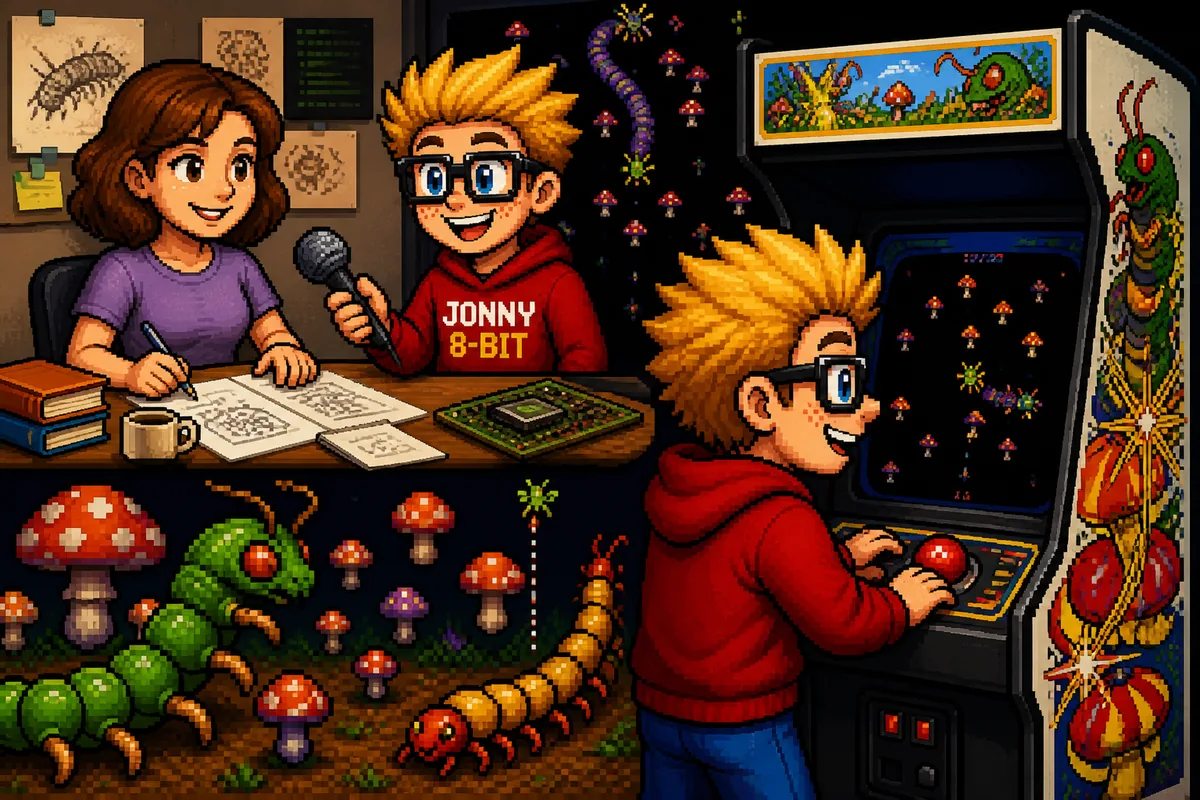
Walk into a crowded arcade in 1981 and many games told a similar story. The screen was dark. The setting was outer space or a battlefield. The player fired at waves of mechanical enemies. Then Centipede appeared with a glowing garden, pastel mushrooms, insects, and a trackball that begged to be spun.
Atari’s new game was still a fast shooter, but it did not feel like another copy of Space Invaders. Co-designers Dona Bailey and Ed Logg built something that was easy to understand, exciting within seconds, and deep enough to reward practice. That combination helped Centipede reach people who did not always feel invited by the usual arcade cabinet.
A different idea in a room full of spaceships
Bailey joined Atari’s coin-operated game division in June 1980 after programming microprocessors for Cadillac climate-control systems at a General Motors-Delco plant. She had only recently discovered arcade games. In a later interview, she remembered being confused during her first attempt at Space Invaders, but she also noticed that its display looked like the hardware she programmed at work. That connection helped convince her that she could make games too.
At Atari, Bailey worked with the more experienced Logg, who had already helped create Asteroids. The starting idea was written in an Atari brainstorming notebook: a multi-segmented insect crawls onto the screen and is shot one segment at a time. Development ran from July 1980 until the game entered production in May 1981. A focus group and several weeks of testing in an actual arcade helped the team tune the finished game before it shipped.
A trackball made the first move feel natural
The controls were unusually direct. Rolling the trackball moved the player’s shooter in the same direction, while one button fired. A newcomer did not have to study a control panel or remember several commands. A quick push, a sudden stop, and a tap of the button were enough to understand the basic relationship between hand and screen.
The controls still left plenty of room for skill. Unlike shooters that kept the player on one horizontal line, Centipede allowed movement throughout the lower part of the field. A player could dodge sideways, move forward, retreat, or make a desperate sweep around an attacking spider. The trackball responded to both direction and force, so an experienced player could move with speed and precision that a simple on-off joystick did not provide.
Every shot rewrote the battlefield
The descending centipede was not moving through an empty screen. It bounced off mushrooms, dropped to the next row, and reversed direction. When the player destroyed one of its body segments, that segment became another mushroom. A shot could therefore solve an immediate problem while making the next attack more complicated. The battlefield slowly became a record of the player’s own decisions.
Other insects kept that system from settling into a safe pattern. Fleas dropped down the screen and left new mushrooms behind. Scorpions crossed the field and poisoned mushrooms, causing a centipede that touched them to plunge toward the player. The spider moved through the player’s territory in a less predictable way. Bailey later said the spider was her favorite enemy because it was “bratty and unpredictable”—and because battling a digital spider was satisfying to someone who feared real ones.
Color and familiar creatures changed the invitation
Bailey wanted the game to shimmer in a dark arcade. Its pinks, blues, greens, and violets stood out against rows of black star fields. The enemies were also recognizable without explanation. A centipede crawled. A flea dropped. A spider darted around. The game did not need a detailed science-fiction story before the action made sense.
That presentation mattered because arcade play often began with a glance. A person walking past a cabinet decided in seconds whether to stop, watch, and spend a quarter. Centipede offered strong colors, readable motion, familiar creatures, and a large physical control. It looked approachable without looking slow or childish. Once a player began, the rising speed and constantly changing mushroom field supplied the pressure.
What “a wider audience” really means
Centipede is often described as a game that attracted far more women than other arcade hits of its time. Atari also promoted it as part of an effort to reach female players. Logg told Video Games magazine in 1983 that the game had been aimed at the women’s market and that Bailey’s viewpoint was important. The Strong National Museum of Play says the finished game appealed to male and female players, young and old.
Still, the story should not be reduced to the claim that women simply preferred pastel colors or garden insects. Reliable public records do not provide a complete, carefully measured breakdown of every Centipede player. Bailey herself later said she hoped everyone would like the game and did not really know who would. The safer lesson is more useful: changing the theme, controls, visual language, and first few seconds of play can change who feels comfortable stepping up to a machine.
Commercial success backed up the idea
The game was not merely admired; it was produced on a major scale. Atari production figures preserved by Atari Museum list 46,062 full-size upright cabinets, plus 5,977 small cocktail-table units, 3,942 cabaret cabinets, and 25 larger cocktail versions. That puts the recorded total above 55,000 machines before counting the many home versions that followed.
Atari converted Centipede for the 2600 and other home systems, and later publishers brought it to computers, handheld devices, and modern collections. The Strong inducted it into the World Video Game Hall of Fame in 2020. Its long life shows that its broader reach was not a short marketing trick. The basic design remained readable and exciting even when the original cabinet was no longer nearby.
The bigger takeaway is just as memorable. Centipede widened its audience because every part of it worked together: an inviting cabinet, an easy first move, a colorful world, and a system that became more interesting with every shot. Accessibility did not mean removing challenge. It meant making the challenge easier to enter.
Videos and further viewing
These videos add demonstrations, interviews, or visual context to the story. A privacy-enhanced YouTube player loads only after you choose a video. Review YouTube’s privacy policy.
Why Centipede Became Atari’s Most Addictive Game
Video by Bygone BitsA focused look at Centipede’s trackball action, colorful playfield, and distinct arcade appeal.