Did a Missing Pizza Slice Really Create Pac-Man?
The pizza story is real, but a missing slice was only one ingredient in the careful design that turned Pac-Man into a worldwide icon.
 Narrated by Jonny 8-Bit6 min read · Published 8/15/2026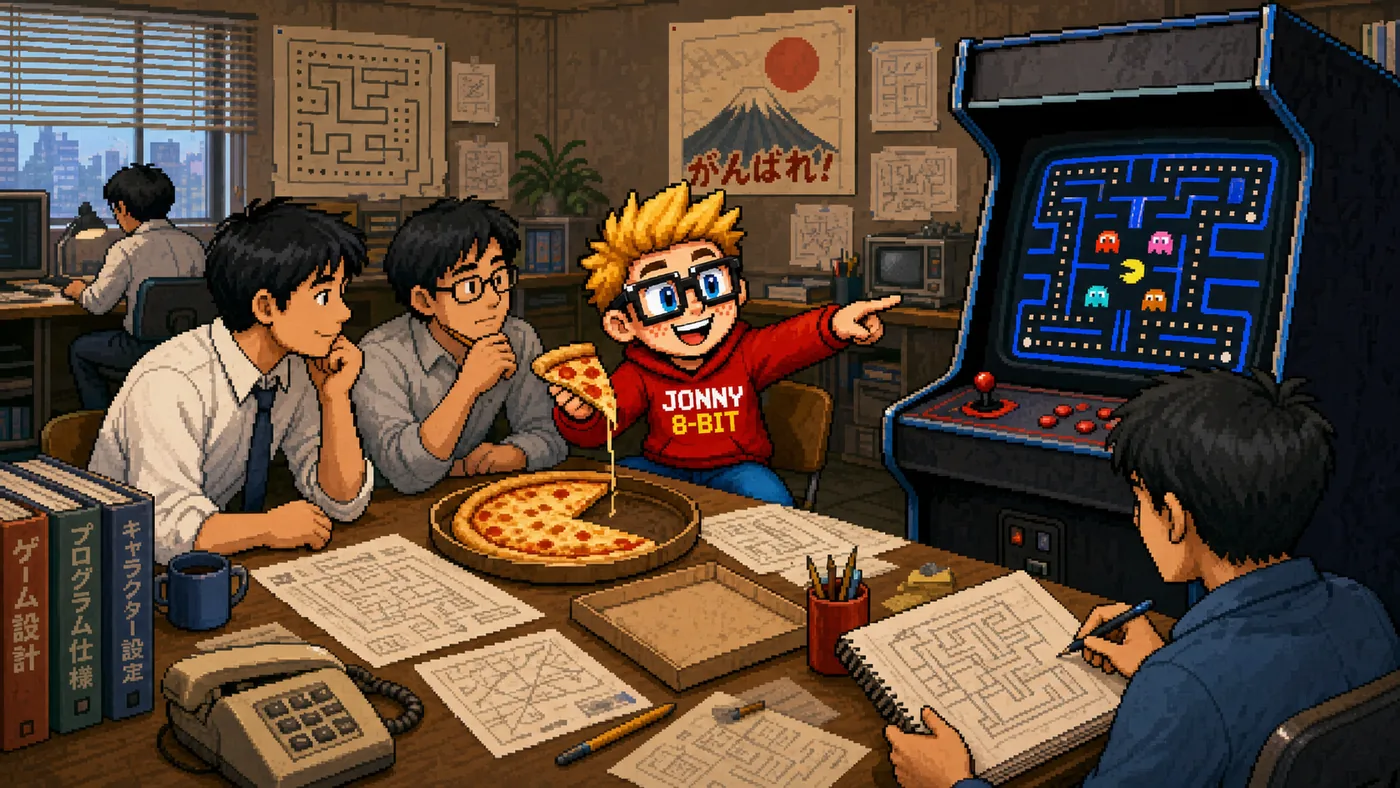
It is one of the most famous origin stories in video game history. Japanese designer Toru Iwatani was eating pizza, removed one slice, and suddenly saw a round character with an open mouth. That simple image became Pac-Man.
Did it really happen? According to Iwatani, yes. He has told the story himself more than once. However, the pizza did not magically produce a finished arcade game. It provided a memorable shape for a project already built around eating. Japanese wordplay, a plan to reach a wider audience, and 15 months of work by a five-person Namco team did the rest.
The project started with eating, not pizza
Iwatani joined Namco in 1977 and worked on several games before leading the game and visual design of Pac-Man. In a 2005 account published by Game Developer magazine, he explained that his original goal was to make a game everyone could enjoy. Many popular arcade games of the late 1970s centered on spaceships, aliens, shooting, or war. Space Invaders helped launch Japan’s arcade boom, but its success also inspired many companies to fill game centers with similar action.
Iwatani wanted to try something brighter and less aggressive. He decided that the new game’s central action would be eating. At the time, he described women and couples as important parts of the audience he hoped to bring into arcades. Some of his comments about what women liked sound dated now, but the design result was important: a colorful, easy-to-understand game that did not depend on shooting anything.
So where does the pizza fit?
Once the team had an eating theme, it needed a character that could express that action. Iwatani recalled sitting in a restaurant and noticing a pizza after one slice had been removed. The remaining circle looked like a head with its mouth open. In a 2010 interview, WIRED directly asked whether that story was true. Iwatani answered that it was.
That does not mean every part of Pac-Man appeared at the table. The pizza solved one visual problem: how to show a mouth with the smallest possible number of shapes. On a 1980 arcade screen, a circle with a wedge missing was bold, readable, and easy to animate. Point the opening left or right, alternate it between open and closed, and the player instantly sees a creature chomping its way through the maze.
A Japanese word also shaped Pac-Man
The pizza is not the only explanation Iwatani has given for the design. The Strong National Museum of Play notes that he also described rounding out the Japanese character for mouth, kuchi, written as 口. That square symbol and the round pizza are not competing stories. Both connect a simple shape to the same idea: a mouth that eats.
Language influenced the name as well. The Japanese expression paku-paku describes a mouth repeatedly opening and closing while eating. Namco’s original Japanese title was Puck Man. When the game came to the United States, the name was changed to Pac-Man. Iwatani later confirmed that the American side worried vandals might alter the letter P on a cabinet. The new spelling soon became the name used around the world.
The whole game learned how to eat
A good character design does more than look clever. Pac-Man’s shape explains what the player does. He eats dots to clear the maze, grabs fruit for bonus points, and swallows power pellets that briefly turn the ghosts blue. During those few seconds, the chase reverses and Pac-Man can eat the creatures that were hunting him. Iwatani said that reversal was inspired by Popeye eating spinach and suddenly becoming strong enough to defeat Bluto.
The four colorful ghosts added another layer. They were not just identical enemies with different paint. Each used its own targeting behavior, which made the group feel less predictable and gave the ghosts a hint of personality. According to Iwatani’s postmortem, Namco’s president once suggested making every ghost red. The team kept the individual colors because the ghosts were meant to be recognizable characters, not a matching wall of danger.
Five people turned the idea into a classic
The finished game was not a one-person project or a quick sketch copied into a cabinet. Game Developer reported that the Namco team had five members and spent about 15 months building it. They tested the maze, adjusted the difficulty, and worked to keep the rules simple without making the action boring. Iwatani later said that the team used trial and error to balance the ghost attacks and other settings for beginners and experienced players.
Pac-Man reached the public for a location test in Tokyo’s Shibuya district on May 22, 1980. It was placed in a building with several movie theaters, where couples and other people who were not regular arcade players could encounter it. The team watched how people reacted, then revised the balance before the wider Japanese release in July. That process is much less tidy than the pizza tale, but it is closer to how successful games are actually made.
Why the pizza story became so powerful
Origin stories survive when they are easy to picture. Anyone can look at a pizza with one slice missing and recognize Pac-Man. The tale also explains why his silhouette works on an arcade screen, a lunchbox, a television cartoon, or an icon smaller than a coin. The Strong credits Pac-Man with becoming a mass-culture symbol and helping launch a huge wave of game merchandise and licensing.
The pizza story is therefore true, but incomplete. It describes the instant when Iwatani connected an eating theme to a brilliant shape. The game’s lasting appeal came from what happened around that moment: the language behind the name, a team that refined the rules, enemies with recognizable personalities, and a design meant to welcome people who did not already live in arcades. Even the famous Pac-Man level 256 kill screen became part of the history because players kept pushing that simple design far beyond an ordinary game.
Videos and further viewing
These videos add demonstrations, interviews, or visual context to the story. A privacy-enhanced YouTube player loads only after you choose a video. Review YouTube’s privacy policy.
How a Pizza Slice Created a $1 Billion Game
Video by UluzaA compact retelling of the pizza inspiration and the design choices behind Pac-Man’s recognizable shape.