
How Silent Hill Turned Draw Distance Into Atmosphere
The PlayStation could not show an entire town at once, so Team Silent made the unseen distance more frightening than anything it could have drawn.
 Narrated by Jonny 8-Bit6 min read · Published 8/20/2026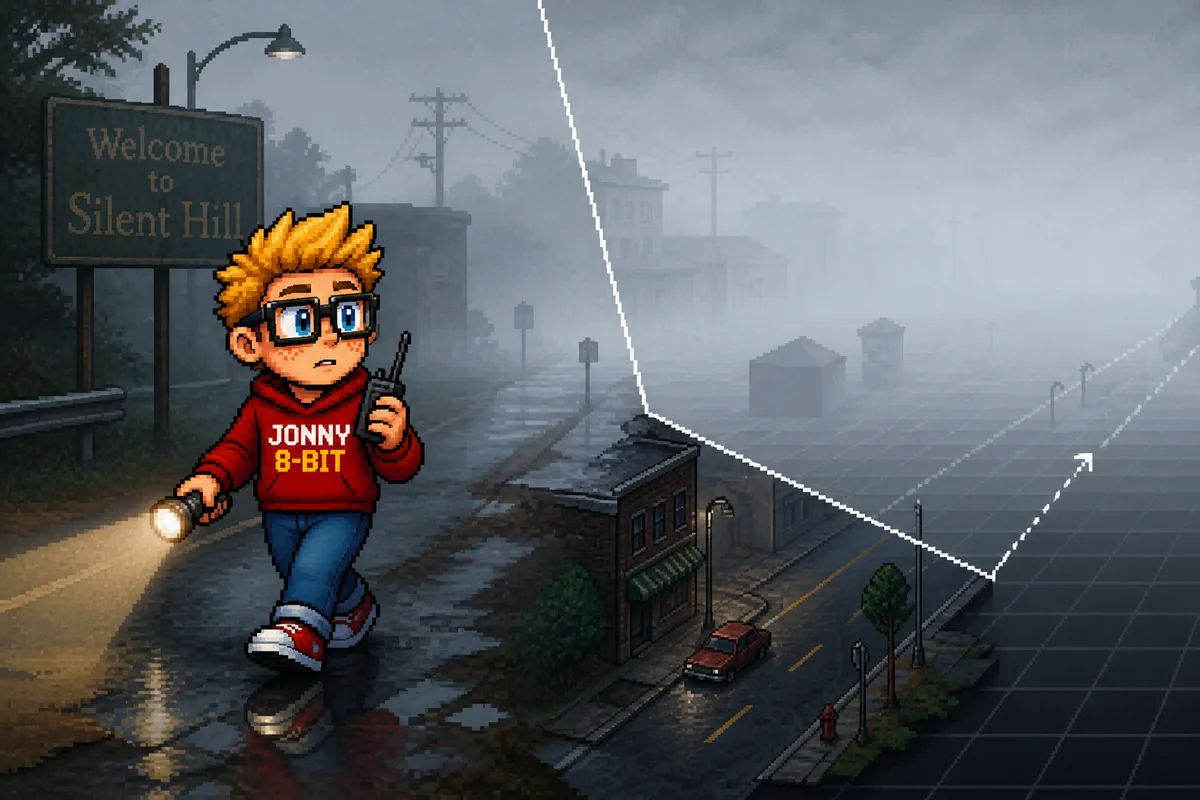
Harry Mason steps onto a street that seems to end a few yards ahead. Buildings fade into white fog. Snow falls even though it is not winter, and the daughter he is searching for has vanished. Then a pocket radio begins spitting static. Something is nearby, but the player cannot see it yet.
That opening made Silent Hill feel unlike other PlayStation horror games when Konami released it in 1999. The fog was partly a solution to a technical problem: the console could not efficiently draw a detailed three-dimensional town far into the distance. Hiding that boundary prevented distant scenery and enemies from suddenly appearing in clear view.
The famous version of the story often stops there, as if an underpowered machine accidentally invented the game’s atmosphere. Team Silent did something more interesting. Its developers built the camera, lighting, sound, enemy warnings, map reading, and story around limited vision. A short draw distance became a source of dread because every other part of the game supported it.
A fully 3D town was an ambitious choice
Many PlayStation games combined polygon characters with pre-rendered backgrounds. A background could look detailed because it was stored as a finished picture, but the camera and player usually had to remain within carefully chosen positions. Silent Hill instead built its streets and many interiors from real-time polygons. The player could move through the town while the camera changed position around Harry.
Director Keiichiro Toyama said this approach was one of the project’s biggest challenges. The team wanted a familiar American town that felt ordinary enough to become disturbing when reality began to bend. Full 3D spaces allowed fog to move across the view, a flashlight to illuminate nearby surfaces, and camera angles to follow the player through streets. Toyama believed those effects helped distinguish the game from competitors that relied more heavily on fixed backgrounds.
The choice also created extra work. Streets, buildings, intersections, alleys, and rooms all needed geometry, textures, and connections. Toyama recalled that parts of the planned map were cut because of the schedule. Team Silent was building a navigable town on hardware with strict limits, not merely decorating a series of separate scenes.
Draw distance defined what the player could see
Draw distance is the range within which a game displays its three-dimensional world. The farther a camera can see, the more scenery the machine may need to process at once. On the original PlayStation, trying to render every wall, object, and creature down a long street could overwhelm the system or cause obvious visual pop-in as objects appeared.
Akihiro Imamura and Akira Yamaoka later explained the team’s solution in a Game Developer postmortem. The console could not render distant objects without too much strain, so the developers limited visibility with fog and darkness. Fog concealed the cutoff outdoors. Darkness performed a similar job inside buildings and during the town’s nightmarish transformations.
This did not mean the fog itself magically gave the PlayStation more power. It gave the artists a believable place to stop showing distant detail. The game only needed to present the part of the world immediately surrounding Harry, while the haze made the missing distance feel intentional.
The fog changed how people played
On a clear street, a player could study the road ahead, count enemies, and choose a safe route. In Silent Hill, the next intersection might contain a monster, a locked gate, or a broken road. Players had to move toward uncertain shapes before they could identify them. The town became larger in the imagination because its boundaries were rarely visible.
Navigation required attention to the paper-style maps Harry collected. The game marked useful details and blocked routes, encouraging players to compare the map with street signs and landmarks. Fog reduced the value of distant sight, so knowledge of the town became a survival tool. The player could not simply stand at one end of a road and understand everything ahead.
Limited vision also changed the rhythm of exploration. A building emerged gradually instead of appearing as a complete picture. An enemy could begin as a moving shadow. Empty fog created pauses in which players expected an attack that might never come. The game did not need to fill every street with monsters because uncertainty was already applying pressure.
Sound warned players without comforting them
Team Silent paired the missing view with information the player could hear. Harry finds a pocket radio that produces white noise when creatures are close. According to the original instruction manual, the static changes with the number and distance of nearby enemies. It is an early warning system, but not a precise radar screen. The sound tells the player to worry without clearly showing where to aim or whether running is safer.
Yamaoka’s audio avoided the comfort of a constant, traditional musical score. Mechanical scraping, industrial noise, distant impacts, and sudden silence made the environment feel unstable. The radio’s static could grow louder while the fog remained empty, forcing the player to imagine the shape closing in.
The flashlight created another tradeoff. It helped Harry search, fight, and read his map in dark areas, but its light could alert monsters. Turning it off made the player harder to detect while also making navigation and accurate shooting more difficult. Visibility was not merely a graphics setting; it became something the player managed.
The ordinary hero made uncertainty stronger
Harry was not presented as a trained soldier. Toyama described him as a normal person whose movements were deliberately less confident and heroic. He could stumble, tire while running, and handle guns with limited skill. The manual even warns that his shooting is questionable because he has no special training.
That vulnerability matched the visual design. A heavily armed action hero might treat the fog as cover, but Harry enters it because his daughter Cheryl is missing. He has a personal reason to continue even when the player would rather stay under a streetlight. The limited view becomes part of his confusion rather than a rule imposed only on the audience.
The story also refused to explain every image immediately. Toyama compared the experience to pieces of a dream that players assemble in their own minds. Fog supported that idea by making the physical town incomplete from moment to moment. Streets, memories, and threats all arrived as fragments.
The limitation became a lasting identity
It would be misleading to claim that the atmosphere appeared by accident. The hardware problem was real, but the team deliberately chose how players would experience the solution. Fog, darkness, radio static, awkward vulnerability, camera movement, and incomplete information worked together. Remove that coordination and a short draw distance is merely a technical weakness.
Later Silent Hill games ran on more powerful hardware, yet the series kept its fog and darkness. Better machines allowed developers to refine shadows, particles, and lighting instead of making the town perfectly clear. What began as a practical boundary had become part of the fiction and a visual promise: whatever waits in Silent Hill should never be completely visible.
This is a strong example of the design philosophy explored in Gunpei Yokoi’s “lateral thinking with withered technology”. A limitation does not automatically improve a game. Creative work begins when developers understand that limit, connect it to the player’s emotions, and make the restriction feel inseparable from the experience.
Videos and further viewing
These videos add demonstrations, interviews, or visual context to the story. A privacy-enhanced YouTube player loads only after you choose a video. Review YouTube’s privacy policy.
The Strange Atmosphere Of Silent Hill
Video by Internet PitstopA visual study of how fog, sound, empty streets, and limited visibility create Silent Hill’s distinctive unease.