Inside the Nintendo World Championships of 1990
Nintendo turned three familiar NES games, one unforgiving timer, and a traveling consumer show into America’s biggest console competition.
 Narrated by Jonny 8-Bit6 min read · Published 8/20/2026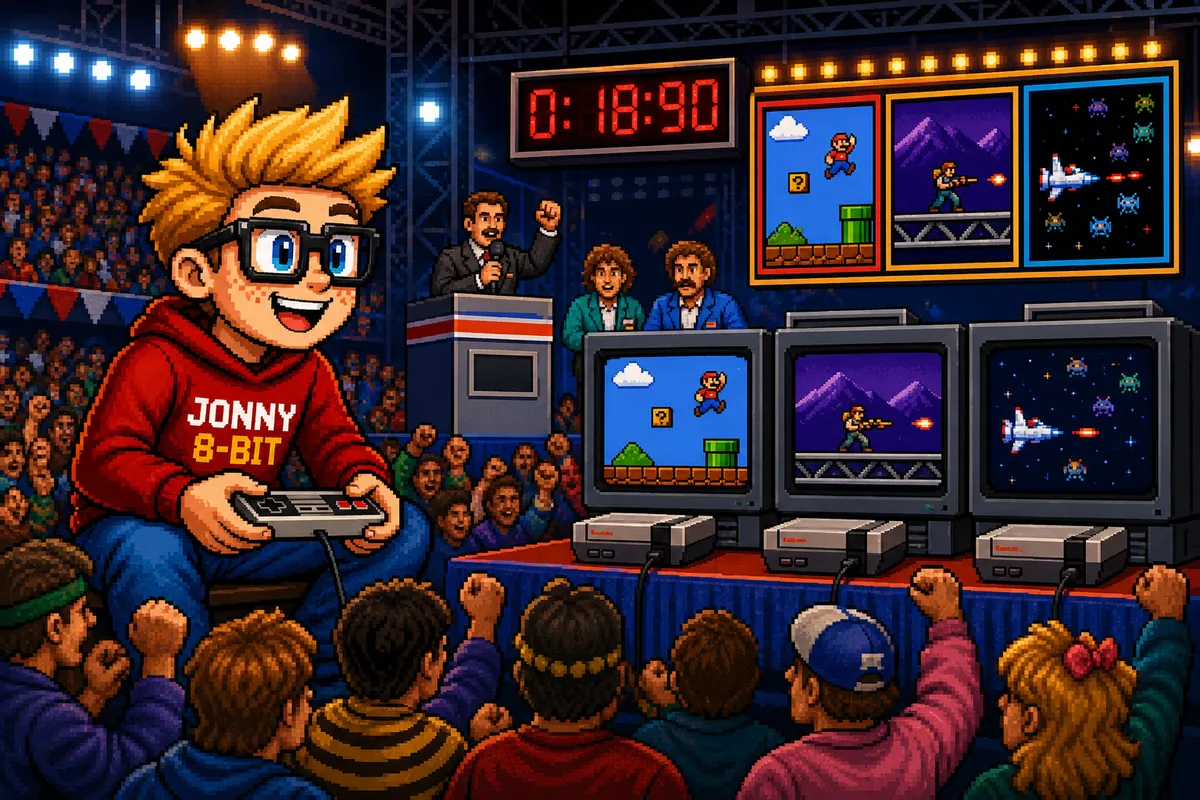
The lights flashed, music filled the room, and an announcer called out scores while rows of players gripped NES controllers. Each competitor had only minutes to collect coins with Mario, race a sports car, and build as many Tetris lines as possible. One mistake could end months of practice.
This was the Nintendo World Championships of 1990, a nationwide tour that made living-room skill feel like a televised sporting event—even though most of the finals were never broadcast nationally. It brought large crowds, elaborate staging, age divisions, corporate sponsors, and a purpose-built competition cartridge together years before streaming platforms made esports easy to watch.
The event is now often remembered because its cartridges became valuable collectibles. That afterlife can hide the better story: Nintendo built an enormous traveling celebration where players met one another, tested unreleased games, learned tournament strategy, and discovered that their private hobby could command a public stage.
PowerFest was much bigger than one contest
The championship traveled under the PowerFest ’90 banner. The tour began in Dallas in March and moved through convention centers around the United States. It reached 29 cities, but Los Angeles hosted two separate competition weekends. That produced 30 sets of local age-group champions and eventually 90 finalists.
Calling it a simple tournament undersells the production. Archival event materials describe a “Power Walk” filled with games from Nintendo and its licensed publishers, including upcoming releases people could try before finding them in stores. A “Super Stage” added characters and live entertainment. Behind the competition stood custom sets, banks of televisions, lights, music, and staff who kept thousands of visitors moving.
The structure served two goals at once. Players received a rare chance to gather around their favorite console, while Nintendo placed the NES at the center of a family entertainment spectacle. A 1989 movie, The Wizard, had already shown audiences a dramatic fictional Nintendo tournament. PowerFest let fans walk into something that felt surprisingly close to that fantasy.
One cartridge combined three different games
The heart of the competition was a custom NES cartridge containing modified sections of Super Mario Bros., Rad Racer, and Tetris. It was not three complete games. Instead, it linked three short objectives into a single timed challenge lasting 6 minutes and 21 seconds.
First, the player had to collect 50 coins in Super Mario Bros. Reaching that goal automatically moved the cartridge to Rad Racer, where the objective was to finish the first course. Completing the race opened Tetris, which continued until the master timer expired. A player who failed to clear an early objective never reached the later games.
The final score rewarded the three sections very differently. Mario points counted at their normal value, Rad Racer points were multiplied by 10, and Tetris points were multiplied by 25. That formula made speed in the first two games essential. A safe but slow Mario route left less time for the heavily weighted puzzle game.
Winning required strategy beyond raw reflexes
The cartridge tested several skills in quick succession. Mario rewarded a memorized coin route and clean movement. Rad Racer demanded controlled speed, because a crash cost precious seconds. Then Tetris required players to settle down after two frantic transitions and make valuable lines under pressure.
Strong competitors learned that the first section was not about finishing World 1-1. It was about reaching 50 coins as quickly as possible, even if that meant using unusual routes or taking a deliberate death when the reset position saved time. The cartridge turned a familiar platform game into a routing problem. Every second rescued from Mario or the race became another falling piece in Tetris.
Practice was not equally available. The cartridge was not sold in stores, so most entrants could use it only at a tour stop. Some serious competitors traveled to more than one city to gain experience. Future under-11 champion Jeff Hansen recalled first placing third in Salt Lake City, practicing Tetris intensely, then flying with his father to the final tour stop in Tampa to make another attempt. He won there and earned his trip to Hollywood.
Ninety finalists met in Hollywood
Competitors were divided into three groups: age 11 and under, ages 12 through 17, and age 18 or older. Each local event produced one champion from each group. In December, the 90 finalists and their guests gathered at Universal Studios Hollywood for the national finals.
The weekend mixed serious play with a carefully produced reward experience. Hansen later remembered studio attractions, Nintendo characters, group activities, and long practice sessions with other finalists. He also described a friendly atmosphere in which competitors shared strategies. Under the lights, though, the event narrowed through qualifying rounds until the best two players in each division met head-to-head.
Jeff Hansen won the youngest division. Thor Aackerlund won ages 12–17, and Robert Whiteman won the adult category. There was no official final that replaced those three titles with one overall champion, although an informal contest among them reportedly put Aackerlund first. Each division winner received major prizes that included a $10,000 savings bond, a Geo Metro convertible, a large-screen television, and a gold-colored Mario trophy.
The prize cartridges became collector legends
At a dinner during the finals, Nintendo told the competitors that each would receive a copy of the championship cartridge. Ninety gray cartridges were distributed to the finalists. Nintendo Power later awarded 26 gold-colored copies through a separate magazine contest. Those 90 gray and 26 gold prizes became some of the most famous artifacts in NES collecting.
The number 116 is sometimes treated as the exact production total, but it describes the best-known prize distribution, not necessarily every cartridge Nintendo built. The national tour required many competition stations, and surviving cartridges with other histories have complicated any simple count. Some tour hardware was reportedly reused or destroyed, while a few pieces may have escaped normal disposal.
Rarity, an instantly recognizable label, and a direct connection to real contestants gave the cartridges unusual appeal. The gray copies can be tied to finalists; the gold versions evoke the magazine contest and resemble the gold shell of The Legend of Zelda. For a collector, each is both playable software and a physical piece of a one-time national event.
A bridge between arcade records and modern esports
The 1990 championships did not invent competitive video gaming. Arcades had hosted contests for years, and organizations such as Twin Galaxies built national scoreboards during the early 1980s. Nor was Nintendo’s “World” championship a broad international tournament; its qualifying tour was centered in the United States.
What Nintendo achieved was still remarkable. It packaged console competition as a touring mass-media spectacle, gave different ages a path to the finals, and designed one ruleset that could compare players across the country. The scoring cartridge worked like an early standardized esport format: every contestant faced the same games, objectives, multipliers, and timer.
Later competitive scenes would grow through local networks, television, broadband, livestreaming, and professional teams. The scale and culture surrounding games such as StarCraft in South Korea were still years away. PowerFest ’90 nevertheless proved that a home console could support spectators, recognizable champions, serious practice, and a national story built around high-level play.
Videos and further viewing
These videos add demonstrations, interviews, or visual context to the story. A privacy-enhanced YouTube player loads only after you choose a video. Review YouTube’s privacy policy.
Nintendo World Championship 1990 - World's Worst Let's Players
Video by WULFF DENSee the timed championship cartridge in action and revisit the unusual competition built for Nintendo’s 1990 tour.