
How Pokémon Turned the Game Boy Link Cable Into a Social Tool
Pokémon made one player’s adventure deliberately incomplete—and made another person with a Game Boy part of the solution.
 Narrated by Jonny 8-Bit6 min read · Published 8/20/2026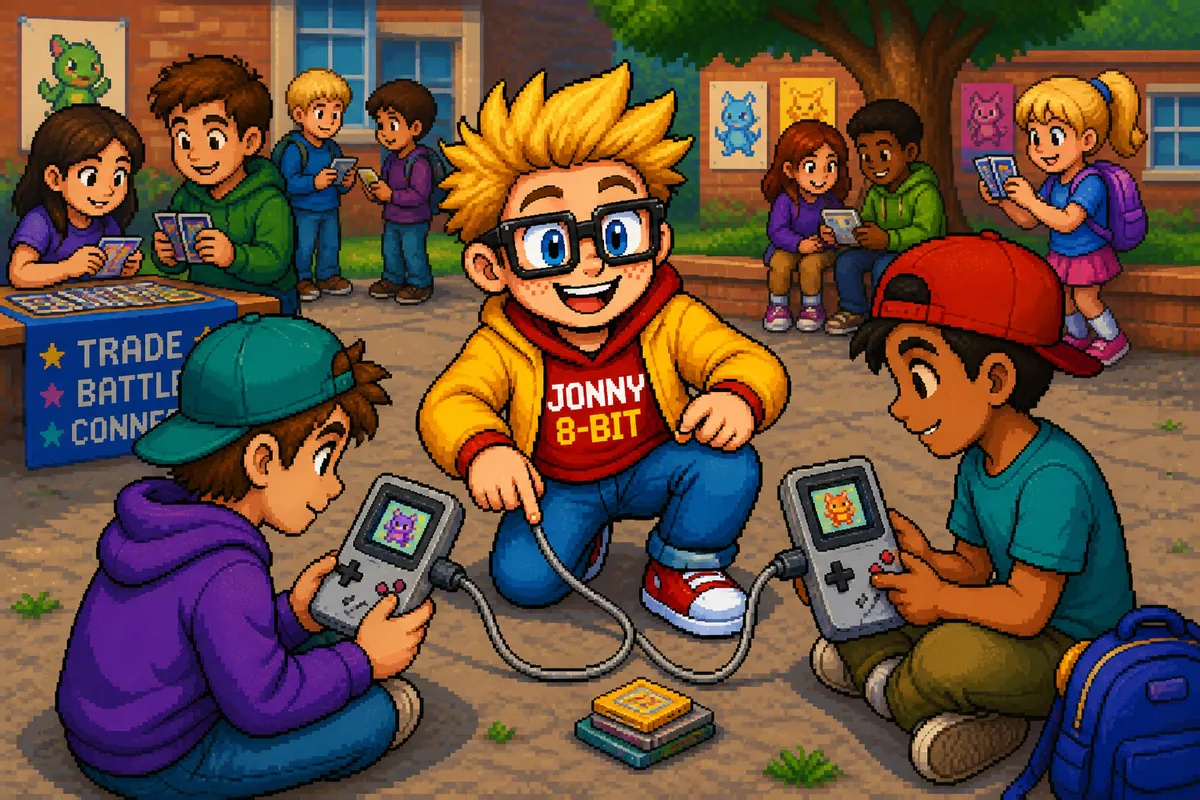
Picture two children sitting close enough for a short gray cable to reach between their Game Boys. Each has spent hours building a private collection of creatures. Then the screens flash, two Poké Balls travel past each other, and a Pokémon that belonged to one player becomes part of the other player’s saved game. The wire has transferred only a small amount of data, but the trade feels like handing over something real.
That feeling helped make the first Pokémon games different from an ordinary single-player role-playing game. The Game Boy Link Cable was not new, and Pokémon did not invent connected handheld play. What Game Freak changed was the purpose of the connection. Instead of using the cable only to compete, Pokémon used it for collecting, negotiating, cooperating, showing off, and trusting another person.
The Link Cable already knew how to create rivals
Nintendo released the Game Boy in 1989 with a port that allowed compatible systems to communicate through a cable. Two players could connect copies of Tetris and send penalty lines into each other’s screens. Other games supported races, battles, or shared play. Nintendo had already made a personal handheld briefly become a two-person machine.
Those early uses mostly treated the second Game Boy as an opponent or teammate for one play session. Disconnect the cable and each cartridge went back to its own world. Pokémon would make the connection affect the permanent save file. What happened between two systems could remain important long after the players packed the cable away.
The timing made that idea especially bold. Game Freak began planning Pokémon years into the Game Boy’s life, when newer color handhelds looked more technically impressive. Development took nearly six years, and some people in the industry doubted that another monochrome Game Boy title would sell. Creator Satoshi Tajiri was interested in a feature competitors could not replace with a brighter screen: the ability to connect two people carrying their own games.
Tajiri imagined the cable carrying possessions
Tajiri grew up collecting insects around Machida, a changing area on the edge of Tokyo. As fields and ponds disappeared, games became another place for discovery. His childhood collecting helped shape Pokémon’s creatures, but the Link Cable supplied a way for discoveries to move between players.
In a recollection later published by TIME, Tajiri said most Game Boy titles used the cable for battles, while he was drawn to the broader meaning of “connection.” He imagined transferring something a player had raised. He also remembered wanting a rare item that artist Ken Sugimori had obtained twice in Dragon Quest. Why could Sugimori not simply give him the extra one? Tajiri said Pokémon began with the desire to trade; its role-playing structure followed.
That reversed the usual order of importance. The cable was not a bonus mode added after the adventure had been designed. Catching, raising, and naming Pokémon created things worth exchanging. A creature could carry evidence of another person’s time and choices into a new cartridge.
Two versions turned friendship into part of completion
Pokémon Red and Green launched in Japan in February 1996. North America received Red and Blue in September 1998. The games followed the same main journey, but no single version contained every normally obtainable species. TIME’s history credits Shigeru Miyamoto with suggesting two versions containing different Pokémon, an idea that surprised Game Freak because manufacturing paired releases was an unusual commitment.
The result made a purchase into a conversation. “Which version did you get?” also meant “Which Pokémon might you have that I need?” An owner of Red could offer a version-exclusive creature to an owner of Blue, while the second player could return something unavailable in Red. The official Pokémon site plainly explains that a player cannot collect every Pokémon in either version without trading through the Game Link Cable.
The design created more reasons to connect. A player chose only one starter, so friends could arrange extra starters through new save files and repeated trades. Some Pokémon evolved only when traded. Each trade asked the players to agree on value, and younger players developed their own local exchange rates for favorites, rare creatures, and strong teams.
A traded Pokémon carried a piece of another player
Trading was not the same as copying. The selected Pokémon left one cartridge while another arrived in return. Its nickname and original Trainer information helped preserve where it came from. That permanence made generous trades memorable and dishonest promises painful. Players had to decide whether to trust the person holding the other Game Boy.
The Cable Club also allowed battles using the teams each player had trained during the solo adventure. Levels, moves, party choices, and time spent raising Pokémon suddenly had a human audience. A friend could expose a weak strategy that worked against computer-controlled opponents or turn an overlooked creature into a local legend.
Because the cable was short, the players had to be physically near each other. They could see reactions, argue over rules, offer advice, and arrange a rematch. The hardware did not provide anonymous matchmaking. It created a tiny private network between two named people in the same room, classroom, playground, or back seat.
The real network extended far beyond the wire
Pokémon’s social system continued even when no cable was attached. Players compared Pokédex totals, explained where to find rare creatures, traded strategy, and repeated rumors. A secret might travel across an entire school through conversations and handwritten notes. Some claims were true, while others—such as Mew supposedly hiding under a truck—became legends because friends passed them along faster than they could be checked.
Nintendo later used Pokémon as an example of social entertainment that did not require the internet. In a 2011 presentation, company president Satoru Iwata contrasted competitive Tetris over the Game Boy cable with Pokémon’s later trades and battles. His point was that “social” play begins when relationships between people make the game more interesting, not only when software connects to a distant server.
Later Pokémon games replaced the physical cable with wireless adapters, local wireless connections, and online services. The technology became less visible, but the basic design survived: different players hold creatures, knowledge, or opportunities that become more valuable when shared. Modern trading is faster, yet it rarely produces the same sight as two Game Boys joined by a wire like a small bridge.
Its smartest trick was leaving every player a little dissatisfied. You could finish the story alone, but a complete collection required cooperation. Pokémon turned “I don’t have that one” from a complaint into the opening line of a friendship—or at least a very serious lunch-table negotiation.
Videos and further viewing
These videos add demonstrations, interviews, or visual context to the story. A privacy-enhanced YouTube player loads only after you choose a video. Review YouTube’s privacy policy.
How A Failing Nintendo Accessory Spawned the $100 Billion Pokemon Empire - IGN Legacies
Video by IGNExplore how Game Boy communication hardware, trading, and social play became central to Pokémon’s growth.