How Nintendo’s Broken Sony Deal Led to PlayStation
Nintendo’s public change of partners helped end a joint CD project, but turning that setback into PlayStation required a new machine and a determined Sony team.
 Narrated by Jonny 8-Bit7 min read · Published 8/15/2026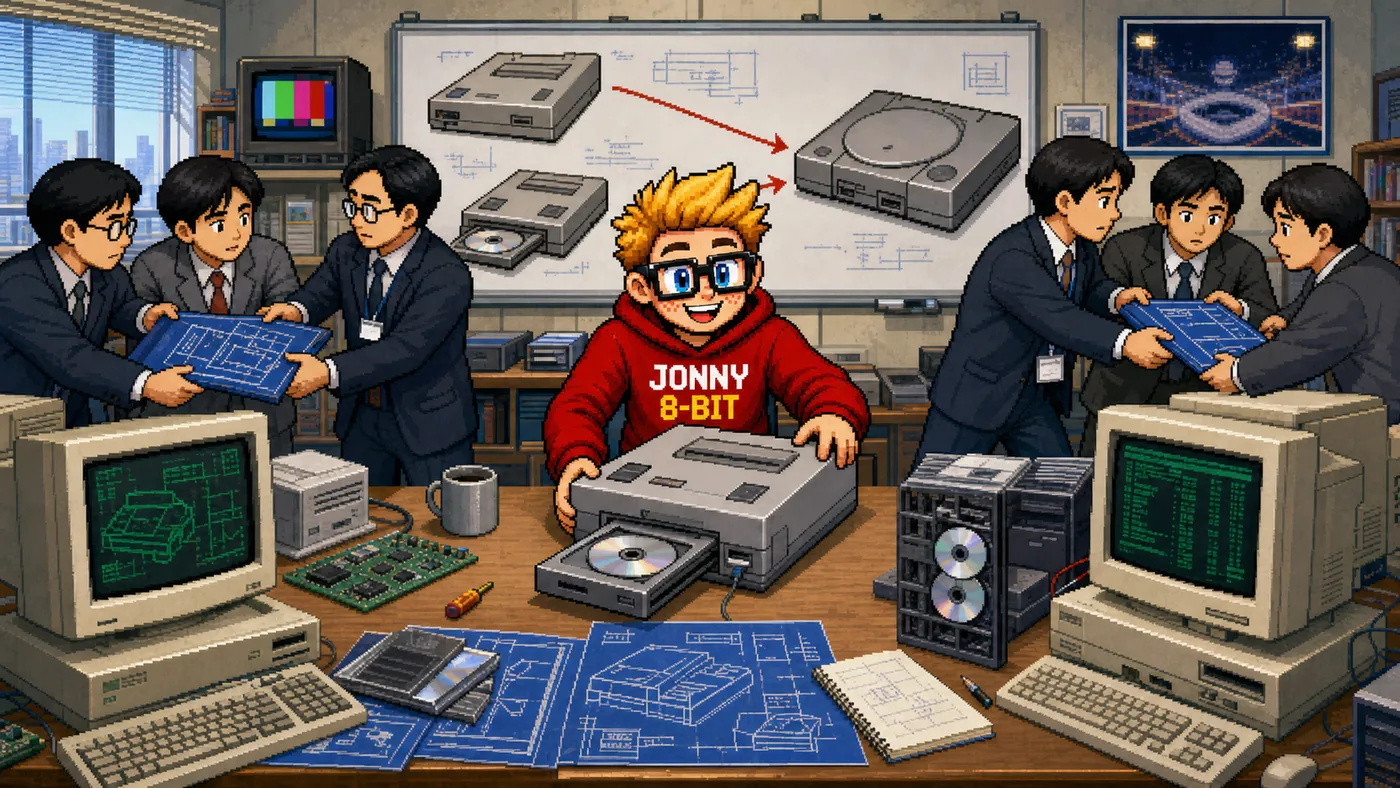
At the 1991 Summer Consumer Electronics Show, Sony presented plans for a machine connected to Nintendo’s coming 16-bit console. The name on the project was Play Station. During the same show, Nintendo announced a different CD partnership with Sony’s rival Philips. People inside Sony suddenly had to explain why the celebrated Nintendo agreement no longer seemed to have a future.
That embarrassing moment is often reduced to a revenge tale: Nintendo rejected Sony, so an angry Sony built PlayStation and defeated its former partner. The broken deal was a real catalyst, but it did not produce a finished console. Sony engineer Ken Kutaragi and his allies still had to persuade skeptical executives, abandon the limits of a Super Nintendo accessory, design new hardware, recruit game companies, and build a business Sony had never operated before.
The relationship began with better sound
Kutaragi was a digital engineer at Sony when he became interested in Nintendo’s game hardware. He thought the Nintendo Entertainment System delivered impressive graphics but weak sound. In a 1999 interview with EE Times, Kutaragi recalled approaching Nintendo with a Sony salesperson and offering the company’s signal-processing knowledge for Nintendo’s next machine. Sony’s audio hardware became part of the Super Famicom and Super Nintendo.
The job created trust between engineers at the two companies and formed a small Sony group with useful game-hardware experience. Kutaragi then proposed a larger project in 1989: Nintendo and Sony would work on a CD-ROM system. Nintendo agreed the following year, according to his account. Compact discs offered far more storage than ordinary cartridges, making room for longer audio, video, and larger game data.
The Play Station was two connected ideas
The partnership covered more than one product. Sony would help develop an optical-disc add-on for Nintendo’s 16-bit console. The companies also explored a separate Sony-built machine that could accept Nintendo cartridges and the new disc format. That hybrid was known as the Nintendo Play Station, commonly written as two words during this period.
The technical goal was promising, but the contract raised difficult business questions. Console companies make money and control quality through software licensing, manufacturing, and approval rules. The World Intellectual Property Organization’s PlayStation history says Nintendo became unhappy with the agreement’s terms and feared losing control over manufacturing connected to the new system. A partnership could work electrically while still pointing the companies toward opposing commercial interests.
The 1991 announcement made the split public
Sony arrived at Summer CES prepared to discuss its Nintendo-compatible Play Station. Nintendo then announced an alliance with Philips instead. Former Sony executive Andrew House later remembered working late in Tokyo as Kutaragi called from the show and the company tried to manage the message. Kutaragi described the moment more simply: the engineers had worked well together, but management chose another direction.
The event is sometimes told as if Nintendo secretly created a rival overnight. In reality, a press-conference surprise did not settle every technical and legal issue immediately, and the proposed Nintendo–Philips console never became a commercial product. What CES did provide was a clear public break. Sony now had technology, a small experienced team, and a reason to decide whether games were worth pursuing without Nintendo.
Kutaragi still had to win inside Sony
Many Sony leaders did not see video games as a suitable business for the electronics company. Kutaragi later recalled resistance to spending serious resources on what some executives viewed as children’s toys. He took his case to Sony president Norio Ohga, arguing that the company already possessed the hardware, software, music, and manufacturing skills needed for a new form of entertainment.
Ohga approved the effort, but the goal changed. The team would not merely remove Nintendo branding from the abandoned accessory. By 1992, Kutaragi was pursuing an independent CD-based console designed for real-time 3D graphics. Engineers worked on a new processor, operating software, libraries, and development tools. Sony Computer Entertainment was established in 1993 as a joint venture between Sony and Sony Music Entertainment Japan, giving the project a company built to publish and support games.
The finished PlayStation was a different machine
The original PlayStation launched in Japan on December 3, 1994, and reached North America in September 1995. It did not play Super Nintendo cartridges and was not the old hybrid prototype placed in a gray box. It was a 32-bit system built around polygons, textured 3D scenes, CD-ROM storage, memory cards, and a controller designed for a new generation of games.
Sony also treated developers as essential customers. Its team created libraries and tools so studios could spend more time making games and less time communicating directly with unfamiliar hardware. Discs were cheaper and faster to manufacture than large cartridge orders, reducing some of the inventory risk faced by publishers. The system was not the first disc console or the first machine to display 3D graphics, but it brought those features together with strong marketing and broad third-party support.
The broken deal opened a door; Sony walked through it
The failed Nintendo project gave Sony a starting point. Kutaragi’s group had learned how console hardware was built, Sony had seen the business questions hiding inside disc technology, and the CES split created urgency. Still, Nintendo did not “invent” the independent PlayStation. The product that launched in 1994 required years of new engineering, executive support, developer recruitment, manufacturing, and games. It eventually sold more than 100 million units because Sony executed that larger plan.
The consequences reached far beyond one console rivalry. PlayStation encouraged publishers to build larger disc-based games and helped make real-time 3D a normal expectation in the living room. Sega responded in the same fast-changing market, later adding online hardware to the Dreamcast’s strategy. Sony carried its entertainment-hub approach even further when the PlayStation 2 combined games with DVD movies.
Videos and further viewing
These videos add demonstrations, interviews, or visual context to the story. A privacy-enhanced YouTube player loads only after you choose a video. Review YouTube’s privacy policy.
PlayStation Started With A Broken Promise | Here's What Really Happened
Video by Gaming Is No Longer A HobbyA chronological account of the Nintendo-Sony CD project, the public split, and Sony’s path toward PlayStation.