Why the Sega Dreamcast Included a Modem
Sega did not want online play to be an accessory that most owners ignored. It wanted every Dreamcast ready to connect from the day it left the box.
 Narrated by Jonny 8-Bit6 min read · Published 8/20/2026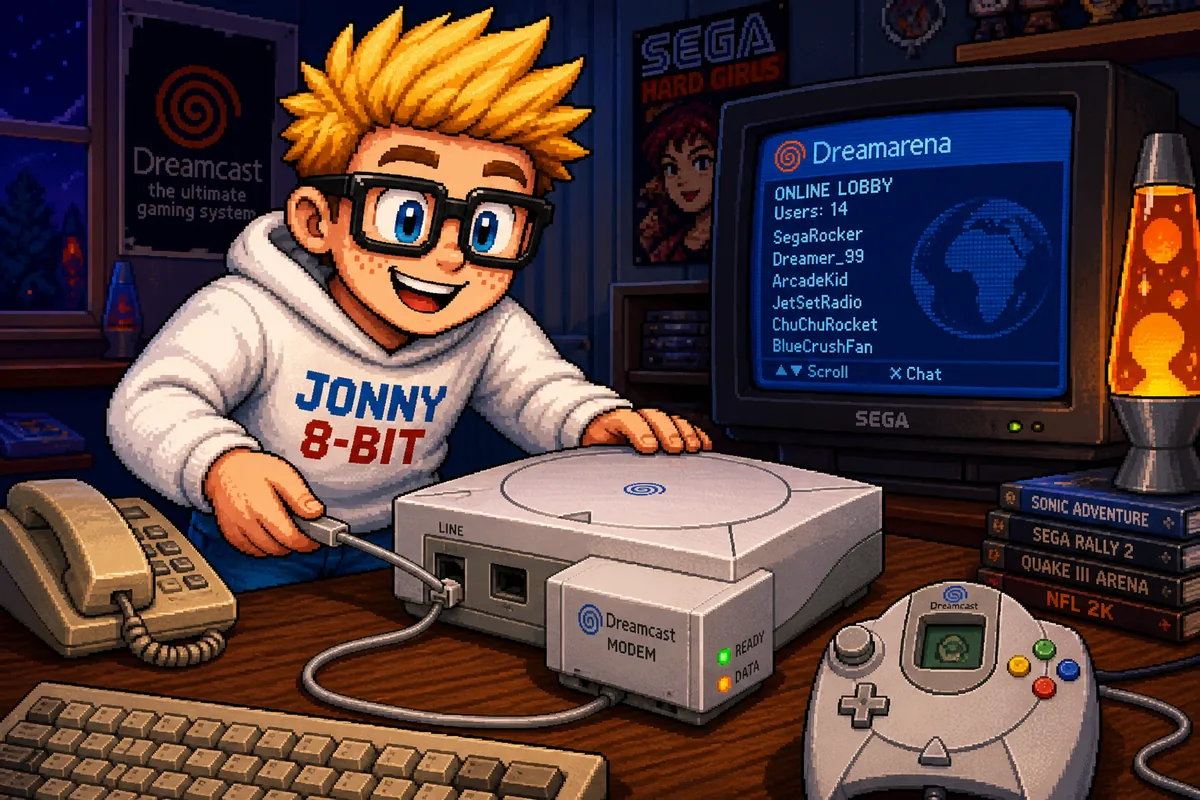
Turn an original Dreamcast around and one port looks more like it belongs on a late-1990s computer than a game console. A telephone cable could plug directly into the machine’s modem. With the right disc and an internet account, the same white box that played Sonic Adventure could browse websites, send email, enter chat rooms, and connect players across long distances.
Online console features existed before the Dreamcast, usually through limited services or separate accessories. Sega’s important move was making the modem standard equipment. Every buyer received network hardware, whether that person planned to use it or not. The decision added cost to a company already fighting for survival, but it gave Sega a chance to sell more than improved graphics. Dreamcast could be a doorway to the internet.
Sega needed an advantage that graphics could not protect
Development of the Dreamcast, then known by the codename Katana, accelerated after the Sega Saturn struggled against Sony’s PlayStation. Sega wanted a less complicated machine that was easier to develop for, but better 3D graphics alone would not stay unusual for long. Rival hardware would improve, and screenshots that looked amazing in one year could look ordinary in the next.
Sega’s official hardware history says the company chose “play and communication” as another major idea for Katana. Online games were growing on personal computers, and Sega believed networking could help extend the useful life of its console. Web access, email, message boards, downloads, and multiplayer games could keep changing after the hardware reached a living room.
The strategy also fit Sega’s habit of experimenting. The company had already tried network services and add-ons during earlier console generations. Those attempts provided experience, but an optional accessory creates a difficult loop: players hesitate because few games support it, while developers hesitate because few players own it. Sega wanted Dreamcast to break that loop.
Putting a modem in every box created a common audience
Sega debated the expense of including communications hardware in every console. Leaving it out of a cheaper model would lower costs, but it would also weaken the entire idea. A developer could never assume that every Dreamcast owner was able to connect. Network features would remain optional extras instead of part of the platform.
The company chose the more aggressive path. Japanese Dreamcast hardware launched with a 33.6-kilobit-per-second dial-up modem, while the North American system included a 56K model. The modem sat in a removable unit on the console, allowing Sega to replace the communications hardware as technology improved. A separate Broadband Adapter eventually offered an Ethernet connection, although it arrived late and worked with relatively few games.
Those speed numbers sound tiny today. Even 56K meant a theoretical maximum of about 56,000 bits per second, and real telephone-line performance was usually lower. Dreamcast games therefore could not treat the network like a modern broadband connection. Developers had to keep messages small, predict movement, hide delays, and avoid constantly transferring large graphics or audio files.
Dreamcast was meant to be an internet device, too
Sega did not include the modem only for head-to-head matches. In Japan, the bundled Dream Passport disc combined a web browser and email software. Sega also prepared internet-provider settings and services to make connecting less confusing for people who had never taken a computer online. Other regions received their own browser discs and services.
That mattered in 1998 and 1999, when a household computer was still expensive and internet use was unfamiliar to many families. A Dreamcast connected to the television offered a less intimidating route onto the web. Players could read game information, communicate, download small pieces of content, or use online functions without owning a full PC.
Microsoft was involved as well. A 1998 announcement described a customized Windows CE development option with DirectX tools and support for standard internet protocols. Dreamcast games did not all run through Windows CE; developers could use Sega’s own environment instead. The collaboration still showed that networking was considered during software development, not attached to the console after its design was finished.
Online games made the promise visible
The modem became meaningful when games gave players reasons to connect. ChuChu Rocket! offered frantic online puzzle matches. NFL 2K1 and NBA 2K1 brought sports competition beyond the couch. Quake III Arena attempted the kind of fast internet action then associated with PCs. SegaNet, introduced in North America in 2000, combined internet access, community features, and support for compatible games.
The clearest example was Sonic Team’s Phantasy Star Online. Players created characters, met in online lobbies, and formed groups of up to four for action-focused adventures. Word Select and symbol-chat systems helped people communicate across languages. Sega’s history says more than 200,000 people played the game, making it an early successful online role-playing experience built for a home console.
The connection changed the feeling of console play. A game no longer had to end at the edge of the television or depend on friends sitting in the same room. Players could return to familiar lobbies, cooperate with strangers, and collect equipment in a world shared through a phone line. Those habits now feel normal, but Dreamcast owners were learning them before console accounts and online subscriptions became standard.
The future arrived before the business was ready
The built-in modem solved only the first problem. A player still needed a working phone line, an internet provider, correct settings, and often regional service support. Going online could make the household telephone busy. Dial-up delays affected play, broadband was not yet common, and publishers had to pay for servers and learn how to operate continuing services.
Former Sega of America president Peter Moore later said online play was meant to help Dreamcast compete with the coming PlayStation 2. He also admitted that Sega’s positioning was premature. North American broadband infrastructure was not ready for everyone, the Broadband Adapter had too little software support, and Sega lacked the long-term game pipeline needed to turn networking into an unbeatable reason to buy the system.
Sega announced the end of Dreamcast production in 2001, well before its online plan could mature. Yet the strategy outlived the machine. Later consoles made network ports, user accounts, digital downloads, online multiplayer, and system updates normal. Microsoft’s Xbox emerged from a team rooted in DirectX technology, while Sega’s developers and ideas continued on other platforms. Dreamcast had not invented online gaming, but it demonstrated that connectivity could be part of a console’s identity.
The cleverest part was not the modem’s speed. It was putting the same basic capability in every box. Sega understood a rule that still shapes online platforms: a network becomes useful when creators can count on the audience being able to join it.
Videos and further viewing
These videos add demonstrations, interviews, or visual context to the story. A privacy-enhanced YouTube player loads only after you choose a video. Review YouTube’s privacy policy.
The Sega Dreamcast and Sega's Final Attempt | VideoGameDocs
Video by VideoGameDocsFollow the Dreamcast’s ambitious launch and the connected-console strategy behind Sega’s final home system.