Mario Was a Carpenter Before He Became a Plumber
Before pipes defined Nintendo’s hero, girders, ladders, hammers, and a tiny arcade sprite gave Mario his first job and his unforgettable look.
 Narrated by Jonny 8-Bit6 min read · Published 8/15/2026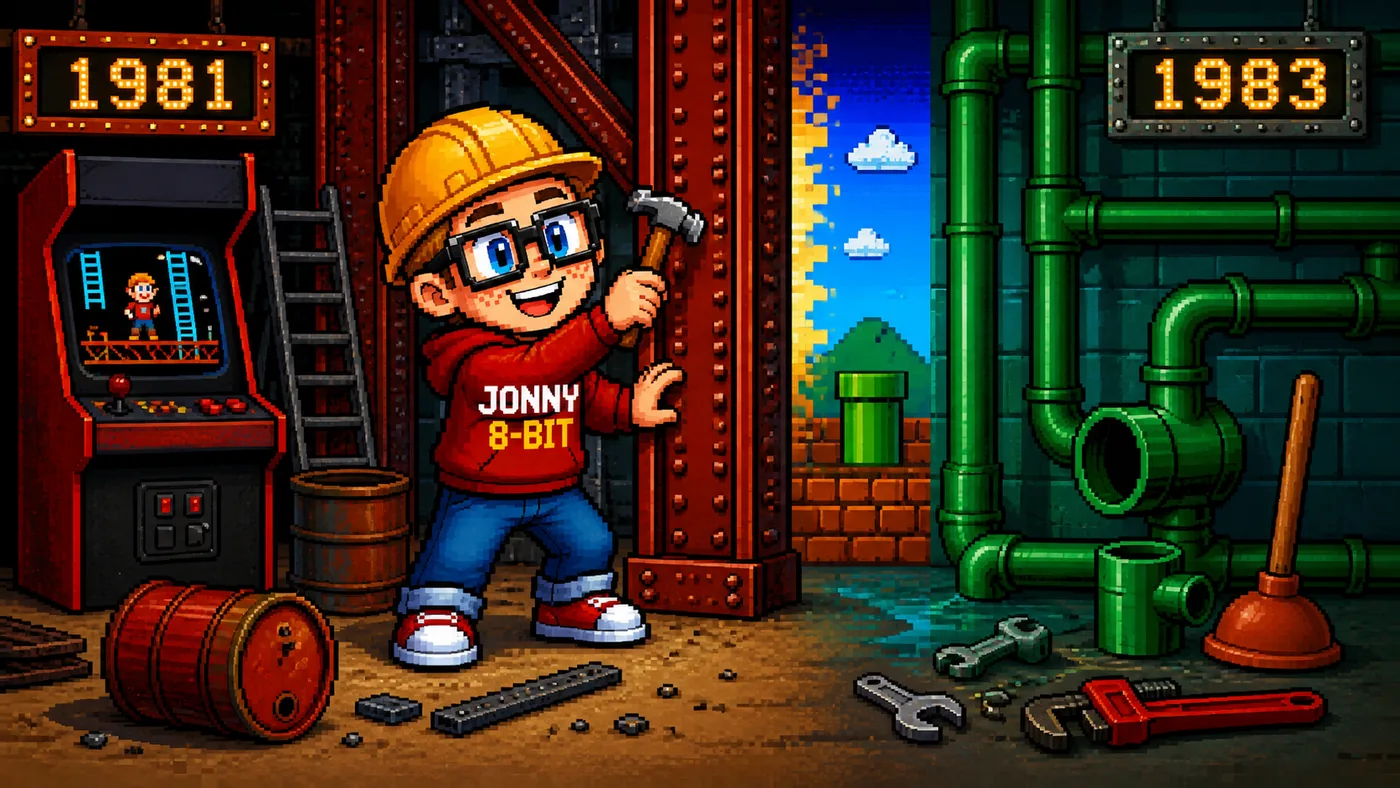
Look at Mario in the original 1981 Donkey Kong. He climbs steel girders, races up ladders, leaps over barrels, and swings a hammer while trying to rescue Pauline. Nothing on the screen says “plumber.” There are no clogged drains, wrenches, or green pipes. Nintendo’s future mascot is working through a construction site, so his first occupation was carpenter.
That fact is true, but it can sound more dramatic than the history really was. Nintendo did not write a story in which Mario quit carpentry and enrolled in plumbing school. His job followed the setting of each game. The construction world of Donkey Kong needed a carpenter; the underground pipes of 1983’s Mario Bros. needed a plumber. Mario’s career change was a design decision, not a major event in his fictional life.
Donkey Kong needed a worker who belonged there
Donkey Kong grew out of a business problem. Nintendo of America had thousands of unwanted Radar Scope arcade machines and needed a more appealing game that could use the hardware. Shigeru Miyamoto, then a young Nintendo artist and designer, led the creation of a new story about an ape, a captured woman, and a determined hero. The full cabinet-conversion story appears in our article about how unsold Radar Scope machines helped create Donkey Kong.
The Strong National Museum of Play describes the hero as a construction worker. Nintendo’s own company history calls him a carpenter. Either label fits the scene: he moves among beams, ladders, barrels, and hammers on an unfinished structure. The occupation quickly explains why this ordinary-looking man is there. Players did not need a long introduction before putting in a coin and starting the climb.
Sixteen pixels shaped a world-famous face
Mario’s job also fit the clothing Miyamoto had designed for him. In Nintendo’s Iwata Asks interview series, Miyamoto explained that the original character was only 16 by 16 pixels. Drawing a realistically proportioned person at that size would leave almost no room for a readable face. Instead, he made the head large and turned each limitation into a feature.
The mustache removed the need to draw a separate mouth. The cap meant the team did not have to show or animate detailed hair. Overalls gave the arms a different color from the body, making Mario’s running motion easier to see. The animation had only three frames, so that contrast mattered. White gloves made his hands more visible when he jumped. These details looked natural on a carpenter, but their real purpose was helping players read a tiny moving figure.
Jumpman, Mr. Video, and finally Mario
Players and Nintendo materials came to know the hero as Jumpman, a name based on his most important move. Miyamoto had another idea for him: “Mr. Video.” He wanted to reuse the same character in different games, much as director Alfred Hitchcock appeared briefly in his movies and some manga artists reused familiar characters in new roles. Mario was meant to be more like a performer than a hero tied to one job.
Nintendo of America employees supplied the name that lasted. The Strong says they named him Mario after the owner of their warehouse. That change gave the character a human identity instead of a label describing what a button made him do. It arrived at the right time. Nintendo sold more than 100,000 Donkey Kong arcade cabinets in the United States, according to the museum, giving the newly named Mario an audience large enough to follow him into another game.
Pipes changed his job description
In 1983, Mario Bros. placed Mario and his newly introduced brother Luigi inside a strange underground space. Creatures emerged from pipes and crossed stacked platforms. The brothers struck the floor from below to flip enemies, then ran up to kick them away. Miyamoto developed the game with Gunpei Yokoi, who suggested building competitive play around the character’s movement.
Miyamoto later explained that the pipes served a practical purpose. Enemies reaching the bottom of the screen needed a believable way to return to the top. He remembered pipes in older manga and noticed drainage pipes in a concrete wall while traveling home from work. A connected pipe system solved the problem. Once Mario was surrounded by pipes underground, making him a plumber was as sensible as making him a carpenter among girders.
The plumber lasted, but the résumé kept growing
Super Mario Bros. carried those pipes into the Mushroom Kingdom in 1985. They became obstacles, entrances, exits, shortcuts, and secret passages. The game’s worldwide success made “Mario the plumber” far more familiar than the earlier carpenter role. Later adventures kept returning to plumbing images even when Mario spent most of his time running, jumping, swimming, flying, or fighting Bowser.
Yet Miyamoto’s Mr. Video idea never disappeared. Mario has worked as a doctor, driven racing karts, refereed matches, played nearly every major sport, explored space, and starred in puzzle and role-playing games. Nintendo’s current character description calls him a plumber by profession and a jack of all trades. His identity rests more on his appearance, movement, personality, and friends than on a fixed work schedule.
Why the carpenter story matters
The carpenter detail shows how efficiently early arcade games communicated. A dangerous construction site justified the ladders and hammers. A carpenter justified the person moving through it. His clothing made sense in the scene while also solving problems caused by a 16-by-16-pixel image. Story, controls, hardware, and art supported one another instead of being designed separately.
The same thinking shaped the next game. Pipes were not added only because plumbers use them; they kept enemies circulating through the playfield. The plumbing occupation then made the strange setting feel coherent. This pattern continued as Nintendo turned pipes into tools for discovery, including the hidden routes discussed in our history of Super Mario Bros. Warp Zones. Mario became durable because his role could change while his design remained instantly readable.
Videos and further viewing
These videos add demonstrations, interviews, or visual context to the story. A privacy-enhanced YouTube player loads only after you choose a video. Review YouTube’s privacy policy.
Mario Was Originally a Carpenter, Not a Plumber! | The Surprising Origin of Jumpman
Video by Araneus GamerA short explanation of Mario’s first occupation, his Jumpman identity, and the setting of Donkey Kong.