How Unsold Radar Scope Cabinets Helped Create Donkey Kong
About 2,000 unwanted space shooters became the starting point for Nintendo’s character-driven arcade breakthrough.
 Narrated by Jonny 8-Bit6 min read · Published 8/20/2026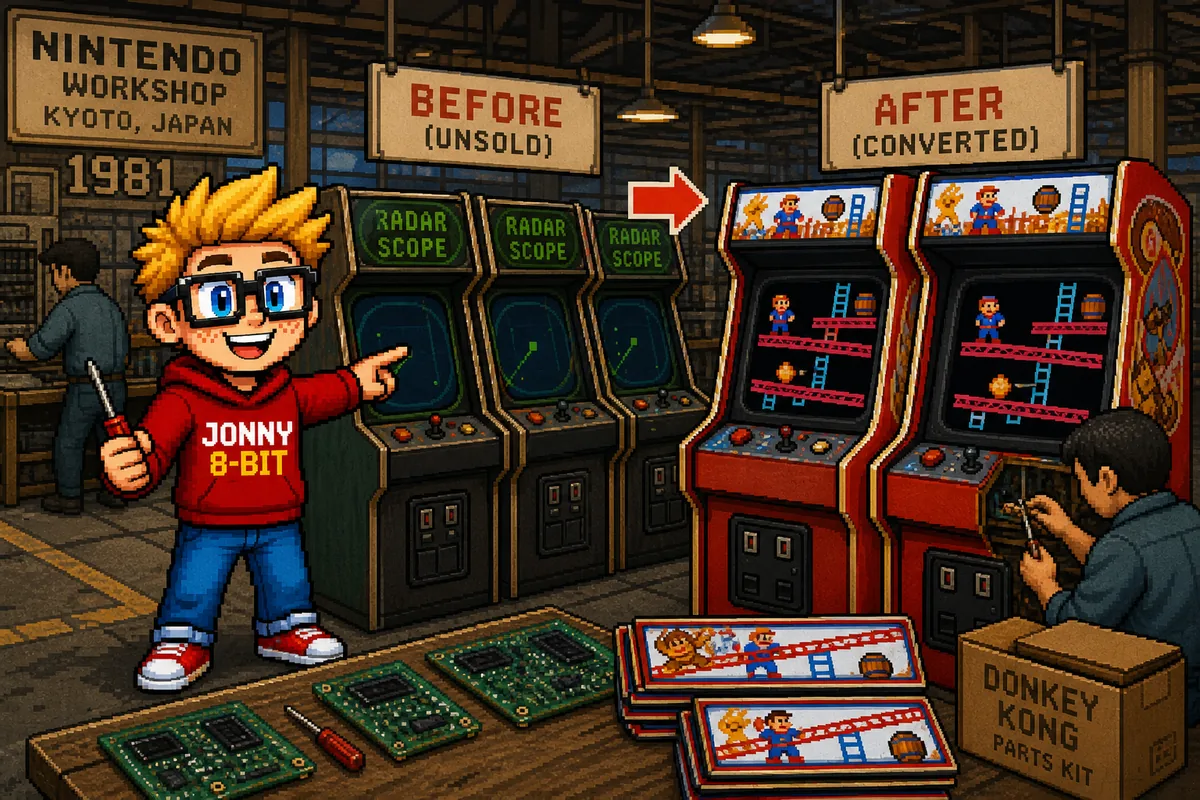
In 1981, Nintendo of America had a warehouse problem shaped like an arcade cabinet. The young U.S. branch had imported thousands of Radar Scope machines from Japan, expecting the colorful space shooter to win over American arcade operators. Only about 1,000 sold. Roughly 2,000 cabinets remained, tying up money that the small company could not afford to lose.
Minoru Arakawa, the president of Nintendo of America, asked the company’s leadership in Japan for a new game that could replace Radar Scope inside the existing cabinets. That rescue assignment led to Donkey Kong, introduced the character who became Mario, and gave Nintendo its first enormous American arcade hit. The leftover machines did not design the game, but they created the urgent problem that made an unusual idea worth trying.
Radar Scope was a hit in the wrong market
Radar Scope belonged to the wave of fixed-screen space shooters that followed the success of Space Invaders in Japan. The player aimed at enemy formations shown from a slanted perspective, while bright colors and electronic effects made the action feel more advanced than many earlier games. According to Chris Kohler’s history Power-Up, it became one of Japan’s most popular arcade games, behind only Pac-Man for a time.
That success did not transfer neatly to the United States. American arcades already had many shooting games from companies operators knew. Nintendo of America was a tiny new distributor without a famous name among U.S. players. By the time its order arrived, Radar Scope looked like one more shooter in a crowded field.
Kohler reports that Nintendo of America sold about 1,000 units but had 2,000 left. A large company might have absorbed the loss. For Arakawa’s small operation, the inventory threatened the entire American effort. Each cabinet was cash trapped in a tall wooden box.
The rescue assignment went to a first-time game designer
Arakawa appealed to Nintendo president Hiroshi Yamauchi, who was also his father-in-law, for a replacement. The new program needed to work with the Radar Scope machines so Nintendo could reuse the cabinets instead of starting over. Yamauchi gave the design assignment to Shigeru Miyamoto, a young industrial designer who had joined Nintendo in 1977.
Miyamoto had designed artwork and physical housings, but he had never led a complete commercial video game. Many arcade games began with a technical action—shoot, steer, or bounce a ball—and added a theme afterward. Miyamoto began with characters, motives, and a story players could understand from the screen.
Veteran Nintendo engineer Gunpei Yokoi advised the project. It was a team effort, not a lone burst of inspiration. Miyamoto shaped the characters, stages, and play ideas, while engineers and programmers turned those drawings into something the reused machines could run.
Losing Popeye helped Nintendo invent its own cast
Nintendo first hoped to build the game around Popeye, Olive Oyl, and Bluto. The setup was a natural fit: a smaller hero would cross obstacles, rescue a captured woman, and confront a much larger rival. When Nintendo could not secure the license in time, Miyamoto replaced the familiar comic-strip cast with original characters that served the same dramatic roles.
The hero was first called Jumpman, a construction worker surrounded by girders, ladders, and barrels. Limited graphics helped define him: a cap avoided animating hair, a mustache made his face readable, and overalls separated his arms from his body. The captured woman became Pauline, while the powerful but not purely evil ape became Donkey Kong. Jumpman soon received the name Mario.
The story directly shaped the controls. Miyamoto experimented with other ideas, including a seesaw, before settling on rolling barrels and a hero who could jump over them. That leap sounds ordinary now, but it gave the player an expressive action that matched the fiction. Jumpman was not firing a weapon from a safe corner; he was scrambling upward through danger to rescue someone.
Four screens made the chase feel like a story
Most successful arcade games of the period repeated one main playfield with faster or harder enemies. Donkey Kong instead used four distinct stages. Jumpman climbed slanted girders, dealt with moving platforms, rode elevators, and removed rivets from a structure. Short scenes showed Donkey Kong carrying Pauline higher or reacting to the player’s progress.
The Strong National Museum of Play describes the plot as unfolding across four scenes. That structure gave a round a beginning, escalation, and conclusion, even though the game eventually repeated at greater difficulty. Players could understand who they were, what they wanted, and why every ladder mattered without reading a manual.
It would be too broad to call Donkey Kong the first game with a story or the first platform game. Earlier games had characters, plots, climbing, and jumping. Its importance came from combining those ideas in a readable cartoon performance across several stages. It helped establish the running, jumping, and climbing style that became a major genre.
Ikegami Tsushinki turned the design into code
The popular version of this history sometimes jumps directly from Miyamoto’s sketches to finished cabinets. An important contributor disappears in that shortcut. Nintendo contracted Ikegami Tsushinki, a Japanese electronics company that had also worked on Radar Scope, to program Donkey Kong from Nintendo’s design specifications.
That experience mattered because the replacement had to fit the target arcade hardware. Time Extension’s history of Ikegami reports that four programmers and two pattern-ROM artists may have worked for about three months on the game. The exact division of work remained little known to players because the cabinet carried Nintendo’s name, but Miyamoto’s design depended on their technical labor.
The later ownership dispute between Ikegami and Nintendo is a separate story, but it reinforces an important point: Donkey Kong was neither an automatic conversion nor one person’s solo creation. It required character design, rules, artwork, sound, circuit knowledge, and code. Reusing the machines saved equipment; creating a new experience still demanded substantial work.
A failed shipment became a new beginning
Nintendo of America converted the unwanted Radar Scope stock with Donkey Kong hardware and presentation, turning cabinets that operators had passed over into machines they wanted. Once the game proved itself, demand grew far beyond that original inventory. The Strong reports that Nintendo ultimately sold more than 100,000 Donkey Kong arcade cabinets in the United States alone.
The success gave Nintendo of America money, credibility, and a character it could build around. Mario became more valuable than the licensed hero Nintendo had originally wanted. Miyamoto went on to shape Super Mario Bros., The Legend of Zelda, and many other series. Years later, Nintendo again used an unusual hardware presentation—R.O.B. beside the NES—to help its games enter a skeptical American market.
Calling Radar Scope a total failure misses part of the truth. It had been popular in Japan, and its cabinets were real, usable assets. The American order failed, but the response succeeded because Nintendo treated the inventory as a constraint instead of a graveyard. The company still needed a strong game, a talented team, willing arcade operators, and players who wanted another turn. The cabinets opened the door; Donkey Kong gave everyone a reason to walk through it.
The fun part is that the warehouse disaster did not lower the team’s ambition. It forced them to make something compatible with old hardware, but the result felt newer than the shooters surrounding it. Sometimes a dead end is just a level that needs a ladder.
Videos and further viewing
These videos add demonstrations, interviews, or visual context to the story. A privacy-enhanced YouTube player loads only after you choose a video. Review YouTube’s privacy policy.
Radar Scope Quickplay - The Failure That Created Donkey Kong!
Video by Silver Blue's RetrocadeCompare Radar Scope with the Nintendo hit created to convert its unsold arcade cabinets.