
Dragon’s Lair and the LaserDisc Arcade Experiment
In 1983, movie-quality animation looked like the future—even when the machinery was fragile.
 Narrated by Jonny 8-Bit6 min read · Published 8/20/2026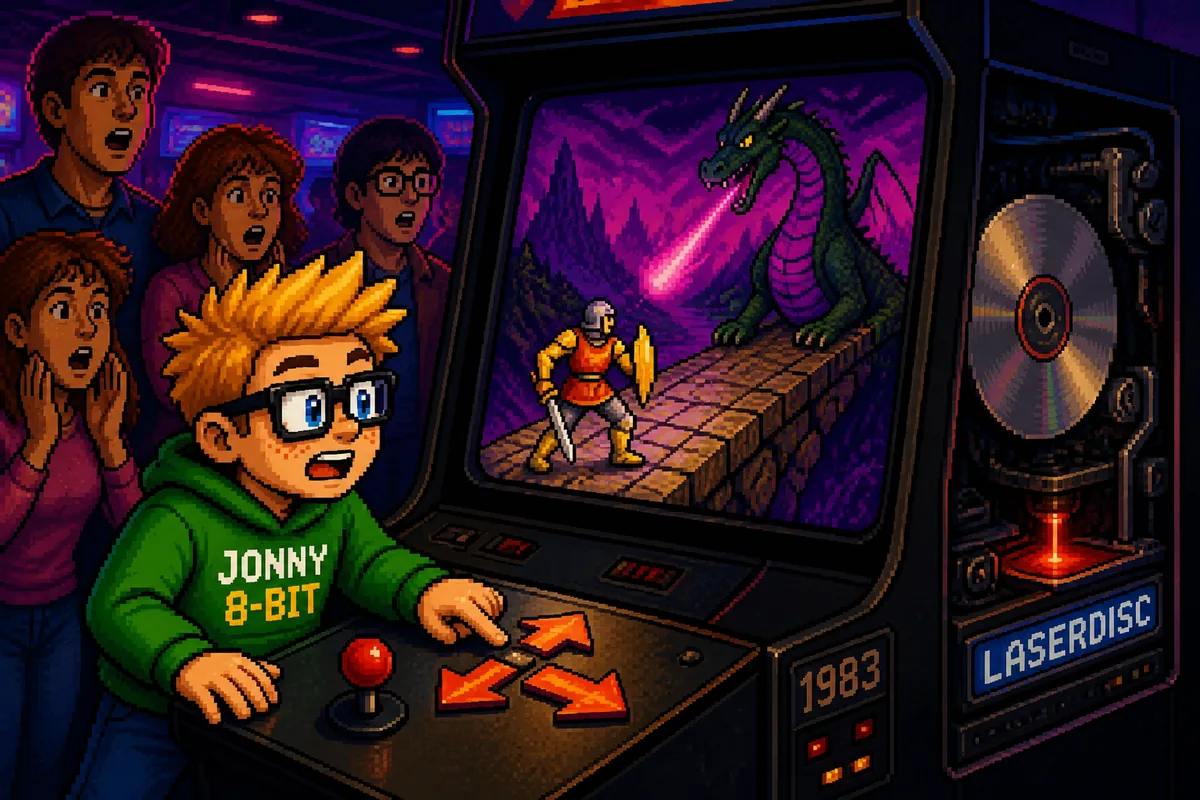
In a busy 1983 arcade, one screen could make every other machine look old. Instead of sprites or glowing outlines, Dragon’s Lair showed a hand-drawn knight stumbling through a richly animated castle. Dirk the Daring swung a sword, escaped traps, fought monsters, and died in comic scenes worthy of a feature film. Crowds gathered around extra monitors just to watch.
The image came with a catch. Players watched a prerecorded scene and pressed a direction or sword button at the right moment; the machine then selected another LaserDisc clip. This mixture of cinema and game design became a commercial success, but it also exposed the cost, limits, and maintenance problems of building an arcade around prerecorded footage.
Rick Dyer brought a game idea to Don Bluth
Designer Rick Dyer had been exploring ways to make a fantasy adventure feel more like an interactive story. In 1982, he saw a demonstration of Sega's Astron Belt, which combined LaserDisc backgrounds with computer-generated action. Dyer recognized that an optical disc could store visual detail far beyond what an arcade board could draw in real time. He approached animator Don Bluth after seeing The Secret of NIMH, Bluth's 1982 feature film.
Bluth left Disney in 1979 with fellow animators Gary Goldman and John Pomeroy. Their independent studio wanted to preserve classical animation, but The Secret of NIMH disappointed at the box office. Dyer's proposal offered a new audience and funding. Advanced Microcomputer Systems developed the game system, Bluth's team produced the animation, and Cinematronics manufactured and released the cabinet.
The collaboration shaped the story. Dyer's group brought fantasy scripts, and Bluth's team revised them into Dirk's rescue of Princess Daphne from the dragon Singe. Dirk was brave but awkward, making his failures entertaining instead of merely frustrating. Even a wrong move might reveal a new animated joke.
Twenty-two minutes of film created a six-minute quest
Bluth told Computer Games that about 70 people worked on the production. The studio spent roughly six months and $1.3 million creating 22 minutes of animation. A perfect run showed only about six minutes; the rest covered alternate paths and failures. The reported budget was around ten times the era's average video-game cost.
That expense bought imagery no normal arcade processor could match. Contemporary games generated pictures in real time from sprites, pixels, or vectors, as explained in our Asteroids history. Dragon’s Lair played photographed animation from an optical disc. It could show fluid characters, painted backgrounds, cinematic angles, voices, and rich sound because the cabinet retrieved finished movie frames rather than drawing the world as the player moved.
Artists drew the movement, painted cels and backgrounds, photographed the frames, and transferred the sequences for disc playback. Arcade electronics handled timing, input, scoring, and instructions to the LaserDisc player. The computer seemed to produce a cartoon on demand, although every possible scene was finished before the cabinet left the factory.
The LaserDisc was storage, not the game itself
A LaserDisc resembled an oversized reflective record and stored analog video read by a laser. Unlike videotape, a compatible player could seek different locations. Dragon’s Lair used that access to jump among short sequences. A correct input requested a success scene; a wrong or late response led to failure or death.
This was a branching decision tree, not a freely simulated castle. The joystick supplied four directions and a button controlled Dirk's sword. At key moments, the program expected one valid action. New players learned by dying, remembering the response, and trying again. Rooms could appear in different orders but still followed limited prerecorded outcomes.
The player needed time to find each clip. A blank screen or pause could appear between scenes, and Bluth discussed a roughly two-second access delay in 1984. Players might accept the break more readily than spectators. It exposed the machinery behind the illusion: the cabinet moved between stored scenes rather than rendering a continuous world.
Fifty cents bought an arcade spectacle
Most arcade games cost a quarter, but Dragon’s Lair commonly asked for 50 cents. Quick deaths were painful for beginners. The Strong National Museum of Play describes a machine rewarding timing and memorization more than open-ended tactics. Skilled players could turn its fixed sequence into a practiced performance for the crowd.
The spectacle justified the premium for many customers. An academic history reports that the game grossed $32 million during its first eight months, although historical revenue figures should be treated as estimates rather than audited totals. It arrived while the North American arcade market was cooling after the rapid expansion that followed hits such as Space Invaders. For a struggling location, a cabinet that drew lines of players and spectators looked like a possible rescue.
Its success encouraged more LaserDisc games. Bluth's team made Space Ace, while other companies released Cliff Hanger, M.A.C.H. 3, and Badlands. Some used animation, others live action or computer graphics over filmed backgrounds. Optical discs briefly seemed ready to replace arcade pixels with television-quality worlds.
The experiment met mechanical and creative limits
LaserDisc cabinets demanded more maintenance than ordinary game boards. Their players repeatedly sought among clips under heavy public use and developed a reputation for unreliability. If the disc, optics, or moving parts failed, the attraction vanished. Dragon’s Lair depended on a specialized playback device remaining clean, aligned, and responsive.
Every branch also needed animation completed in advance. Adding a room, angle, or action meant producing more footage. Players could not go anywhere the artists had not drawn. Beautiful images came with narrow control, while real-time games built larger systems from reusable rules and objects.
The arcade downturn made expensive experiments harder to support. Follow-up LaserDisc titles rarely matched Dragon’s Lair, and the first wave faded within years. Cheaper CD-ROM storage revived interactive movies in the 1990s, but designers still faced the same question: how much control can be traded for a cinematic image before the player feels like a spectator?
The experiment outlived its original machine
Dragon’s Lair survived on later optical formats, computers, consoles, phones, and streaming devices. Modern editions retrieve clips without mechanical seek time, while high-definition releases use preserved film materials. The technology that made the cabinet difficult to maintain also left artwork that could be remastered decades later.
Its deeper legacy is visible whenever a game interrupts real-time action with a timed cinematic choice, branches a story around a button press, or uses presentation to make a simple interaction feel dramatic. Dragon’s Lair did not prove that prerecorded movies would replace game graphics. It proved that players wanted games to look and feel cinematic—and that spectacle works best when the interaction underneath it remains satisfying.
Videos and further viewing
These videos add demonstrations, interviews, or visual context to the story. A privacy-enhanced YouTube player loads only after you choose a video. Review YouTube’s privacy policy.
The History of Dragon's Lair: The Laserdiscs, The Games & The Saturday Morning Cartoon?
Video by Secret GalaxyA documentary tour of Dragon’s Lair, its LaserDisc technology, animated production, and wider media history.