
Minus World: The Super Mario Bros. Glitch That Became a Legend
The most famous negative number in gaming is really a blank space, a normal dash, and a warp pipe using the wrong destination.
 Narrated by Jonny 8-Bit6 min read · Published 8/20/2026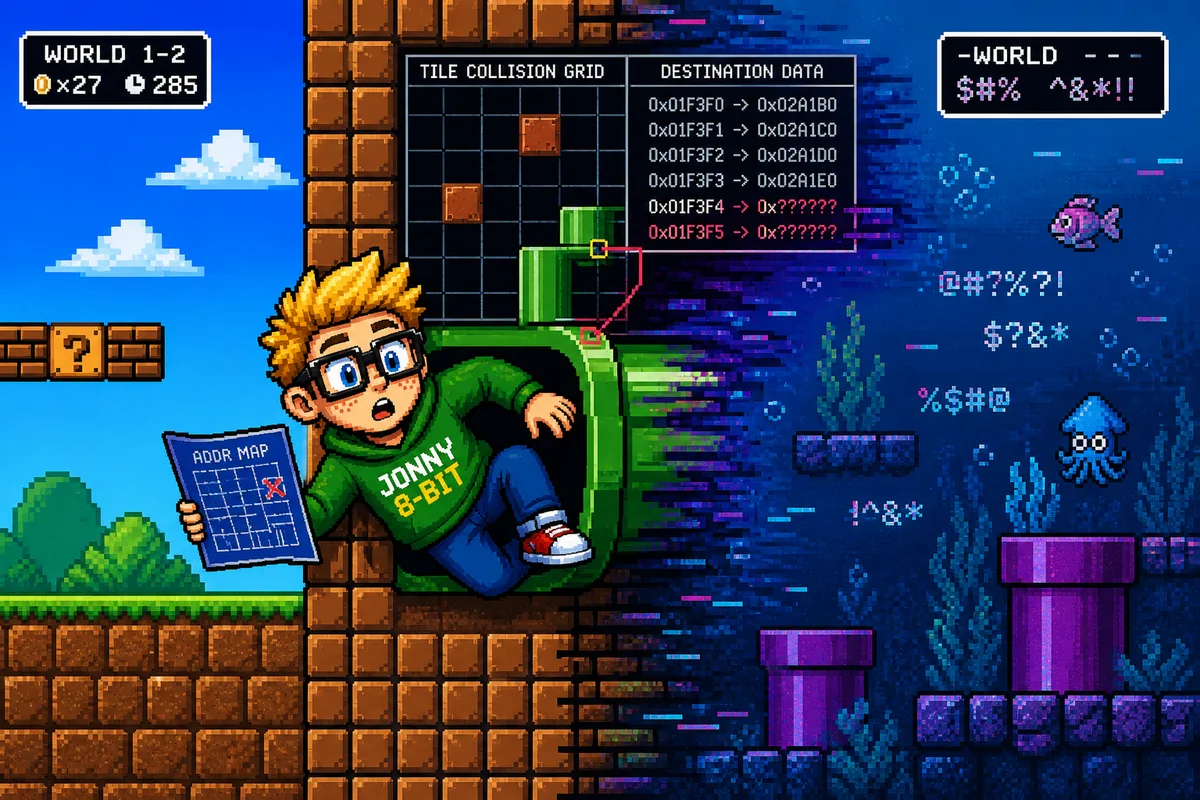
Near the end of World 1-2 in the original Super Mario Bros., Mario can squeeze through a solid-looking wall and enter the Warp Zone from the wrong direction. If the trick is performed correctly, the pipes no longer point to Worlds 2, 3, and 4. The left or right pipe instead sends him to a title card that appears to read “World -1.”
What follows looks like a secret underwater stage, but its final pipe returns Mario to the beginning. The only normal exits are losing every life or resetting the game.
Minus World is real, but it was not designed as a hidden challenge. Several normal systems create it by working in an unintended order. Even its name is a misunderstanding: Mario never enters a negative world.
The wrong way into the World 1-2 Warp Zone
World 1-2 is the first underground stage. Near its exit, a pipe carries Mario back above ground, but players who climb over the brick ceiling can continue into a secret Warp Zone. Under normal conditions, the screen scrolls far enough to reveal the words “WELCOME TO WARP ZONE!” and three pipes labeled 2, 3, and 4. This shortcut is intentional, and its role in exploration is covered in our story about how Warp Zones changed Super Mario Bros..
The route to Minus World starts below that ceiling. The player needs Super Mario or Fire Mario because crouching is part of the setup. By standing in a precise place near the exit pipe, jumping backward, and crouching at the right moment, Mario can become partly embedded in the bricks. The game’s collision system tries to push him out of the solid wall, but it can eject him to the other side.
That movement lets Mario enter the Warp Zone without taking the intended path above the screen. The trick is difficult, but it works on an ordinary retail cartridge. That repeatability helped turn a playground rumor into something players could demonstrate.
The pipes kept the wrong destinations
Clipping through the wall is only the first half of the glitch. The player must also avoid scrolling the screen too far to the right. Normally, reaching the Warp Zone activates an invisible trigger that loads the correct destinations for World 1-2: Worlds 2, 3, and 4. Coming through the wall can place Mario beside the pipes before that trigger appears.
When the correct list is not loaded, the game keeps values associated with the one-pipe Warp Zone in World 4-2: 36, 5, and 36. There, the two 36 values create blank labels around World 5. The unused outer entries are harmless because no outer pipes exist.
World 1-2 does have three pipes. If its proper list never replaces those values, the middle pipe takes Mario to World 5-1, while the left and right pipes try to send him to World 36-1. It is like reaching a train platform before the route board has been updated: the train still runs, but it follows an old destination left in the system.
Why World 36-1 looks like “World -1”
The title card does not actually show a minus sign followed by the number one. It shows a blank space, the ordinary dash that separates every world and stage number, and then a 1. Players naturally read the result as “minus one,” and the name stuck.
The blank appears because Super Mario Bros. uses small graphic tiles for letters, numbers, and empty spaces. The value 36 points to a blank tile. That makes sense when the same value is being used to leave an empty space above an unused Warp Zone position. When the value becomes a world number, however, the game still draws the blank tile. World 36-1 therefore appears as “ -1.”
This is not evidence of a secret negative-number system. The program accepts a destination outside the intended eight worlds and looks up level information. Because the compact game reuses tables and pointers, it lands on data that can still be interpreted as a playable area. The result is strange, but not random noise.
An underwater stage with no escape
On the NES cartridge, World 36-1 uses the underwater geography and enemies seen in World 7-2. Worlds 2-2 and 7-2 already share area data, helping Nintendo save cartridge space. Minus World reaches familiar material through the wrong index, so it feels both recognizable and forbidden.
The stage’s final pipe does not have the destination information it would receive when the underwater area loads normally. Instead of carrying Mario onward, it returns him to the start of the same swimming course. The timer resets when the stage reloads, but the destination never changes. A determined player can repeat the loop, yet there is no flagpole, castle, or correct exit waiting after another lap.
Calling it a “hidden level” can therefore be misleading. Nintendo’s designers did not build a secret endless ocean and hide it behind an expert move. Players reached an existing area with the wrong world number and incomplete travel data. The prison was assembled by the game while it was trying to make sense of instructions that normal play was supposed to prevent.
The disk version opens a different broken door
Not every release produces the same Minus World. The Japanese Famicom cartridge behaves much like the NES cartridge, but the Famicom Disk System version stores and arranges some level data differently. The same basic wall trick therefore points into different material.
In the disk version, World -1 resembles World 5-3 but applies underwater movement to scenery that does not look submerged. Odd objects can appear, including misplaced enemies and incomplete character graphics. Unlike the endless NES stage, it has a goal and leads to World -2, then World -3. Those stages can be completed, and finishing the sequence can return the player to the title screen as though the game had been beaten.
That difference is an important lesson about glitches. A glitch is not a separate feature stored neatly inside a game. Its result depends on the exact code and data surrounding the mistake. Change the arrangement of that data, and the same wrong turn can open an entirely different door.
How a bug became playground folklore
Minus World had everything a great game legend needed. It worked on an ordinary cartridge, required an impossible-looking move, displayed a mysterious name, and led beyond the expected map. Players shared it through friends, magazines, and demonstrations long before online video made tricks easy to verify.
The glitch also rewarded a new kind of curiosity. Beating Super Mario Bros. meant learning its intended jumps and enemies. Reaching Minus World meant asking what happened at the edges of those rules. That spirit now drives glitch hunters, code researchers, and speedrunners who study old games one frame and one memory value at a time. Much like Pac-Man’s level 256 kill screen, Minus World shows how a technical limit can become part of a game’s cultural identity.
Its legend has lasted because understanding the explanation does not ruin the mystery. The “world below zero” may not exist, but the real event is more interesting: players found a reliable path into a level the game created only because its map had failed to update.
Videos and further viewing
These videos add demonstrations, interviews, or visual context to the story. A privacy-enhanced YouTube player loads only after you choose a video. Review YouTube’s privacy policy.
Exploring Minus Worlds in Super Mario Games!
Video by gruzSee how hidden warp behavior leads beyond the famous World -1 and into other unreachable Mario stages.