How the Crazy Otto Hack Became Ms. Pac-Man
Before she had a bow, four mazes, or an official license, Ms. Pac-Man was an unauthorized add-on board built by young arcade operators in Massachusetts.
 Narrated by Jonny 8-Bit7 min read · Published 8/21/2026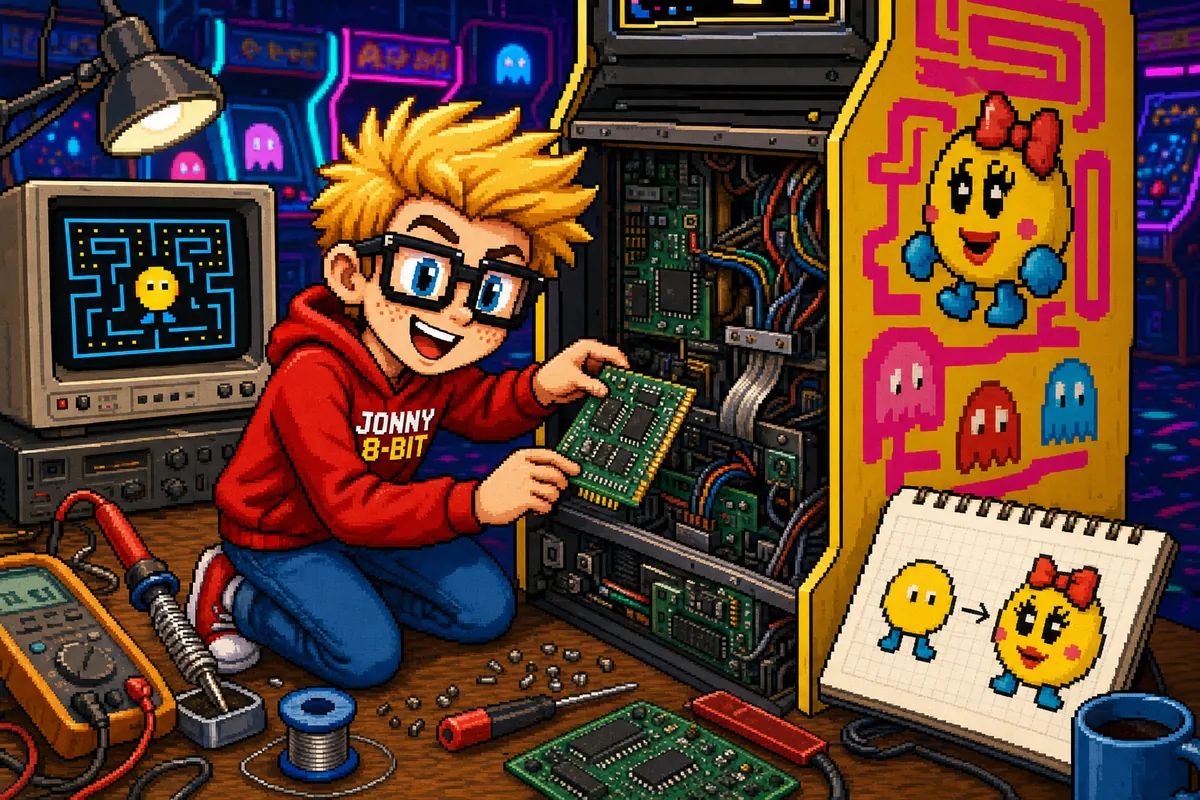
Here is the strangest fact hiding inside an original Ms. Pac-Man cabinet: underneath the new mazes, moving fruit, and famous red bow is still a Pac-Man machine. The sequel began as an unofficial enhancement kit called Crazy Otto. Its young creators reverse-engineered the original arcade hardware, wrote their own improvements, and built a small circuit board that plugged into Midway’s existing game.
So yes, Ms. Pac-Man grew from a hack or mod. Neither Namco nor Midway ordered it. But it was not a pirated copy. General Computer Corporation created new code and hardware that depended on a legally purchased Pac-Man board. A lawsuit involving a different enhancement kit then pushed the team toward permission, negotiation, and one of arcade history’s most unusual licensing deals.
Yes, it began as an arcade hardware hack
In the early 1980s, arcade “enhancement kits” worked somewhat like expansion packs, except installing one required opening a cabinet. An operator could buy an add-on board that changed the original game’s speed, enemies, rules, or difficulty. Most original hardware stayed in place. The new board redirected parts of the game so that the added code could take control.
The word “hack” fits because the creators studied a system they did not design and made it do something new. However, they tried not to copy Namco’s program onto a replacement board. Their approach used the original machine’s ROM chips—the parts containing its software—alongside a daughterboard carrying GCC’s own code. That choice later helped make licensing possible.
MIT arcade operators wanted players to keep dropping quarters
General Computer Corporation grew from a small arcade route run by MIT students Doug Macrae and Kevin Curran. They owned machines placed in campus dorms and watched their earnings decline as players mastered the games. A cabinet that once earned about $600 per week could slow down when experts learned to survive for a long time on one quarter. Macrae and Curran saw a business problem that engineering might solve.
Their first major product was Super Missile Attack, an add-on that made Atari’s Missile Command harder and more varied. The pair sold about 1,000 kits and formed General Computer Corporation, usually shortened to GCC. The core group soon included Steve Golson, Mike Horowitz, Chris Rode, and business partner John Tylko. Several were young enough that their company operated from a rented house in Wayland, Massachusetts, where circuit boards, emulators, and people competed for space.
Crazy Otto already contained the best parts of Ms. Pac-Man
GCC began Crazy Otto in late May or early June 1981. The original Pac-Man used one maze, and the ghosts followed behavior that determined players could study. GCC built four mazes and added enough variation to the enemies’ decisions that a memorized pattern would not work every time. Bonus fruit moved through the maze instead of waiting in the center. New music, sound effects, and animated intermissions gave the game a stronger personality.
The title character was a round yellow creature with blue eyes and legs. GCC called him Crazy Otto because the team was trying to create something recognizable as a maze-chase game without using the Pac-Man name or character directly. In the short story scenes, Otto met a female character, the two chased one another, and a stork eventually delivered their baby. That simple romance would later help decide the sequel’s identity.
A lawsuit forced GCC to seek permission
GCC developed Crazy Otto while Atari was fighting the company over Super Missile Attack. Atari sought $15 million and a court order to stop the unauthorized enhancement kit. GCC argued that its board contained original code and used Atari’s existing ROMs rather than copying the complete game. The dispute never reached a final trial decision. The two companies settled on October 8, 1981, and Atari hired the young engineers to create games.
The settlement included a rule with direct consequences for Crazy Otto: GCC could sell another enhancement kit only if the original game’s manufacturer approved it. That meant the team could not safely ship its Pac-Man modification on its own. Kevin Curran cold-called Midway president David Marofske and asked to show him the project.
Midway licensed Crazy Otto instead of buying a finished sequel
Midway tested the prototype with an experienced Pac-Man player and later placed a more complete version in a Chicago arcade. The results were strong. On October 29, 1981, GCC and Bally Midway signed an agreement for Crazy Otto. Calling this a simple sale misses an important detail: GCC received a royalty, with one payment level if Midway sold the add-on as a kit and a larger amount if it sold a complete cabinet.
Midway also made the decision that changed the product’s future. Rather than release an unofficial-looking upgrade, it wanted a true Pac-Man sequel. Namco still owned Pac-Man, while Midway held the North American manufacturing and distribution relationship. GCC’s team later recalled that Namco knew about the project, reviewed the new character, and continued receiving the normal Pac-Man royalty.
That arrangement was possible because the finished sequel still used the original hardware. Midway built Ms. Pac-Man cabinets with a Pac-Man board and GCC’s data board plugged into it. When the original program reached certain addresses, control jumped to the added software. Doug Macrae explained that removing the add-on from one of those machines would reveal Pac-Man underneath. The commercial sequel never stopped being an enhancement kit at heart.
Crazy Otto became a woman—and then an arcade star
The title changed rapidly, and the creators' later recollections differ slightly on the exact order. They agree that Crazy Otto became Super Pac-Man and passed through names including Pac-Woman and Miss Pac-Man before settling on Ms. Pac-Man. “Miss” caused a story problem because the third intermission showed a baby arriving. “Mrs.” was considered, but “Ms.”—a title that did not define a woman by marital status—fit the changing culture of the early 1980s and sounded better.
Mike Horowitz developed the character artwork with feedback from Midway and Namco. Early versions included long red hair, but Namco president Masaya Nakamura approved the idea while asking that the hair be removed. The bow, eyelashes, lips, and beauty mark helped communicate the character within a sprite only 16 pixels wide. Crazy Otto’s legs disappeared, the familiar ghosts returned, and the enhancement kit became Ms. Pac-Man.
The game made its public debut at a Namco press event in Sherman Oaks, California, on February 3, 1982. Macrae later recalled that Midway produced about 117,000 cabinets and that GCC earned roughly $10 million from the arcade game. Those figures show why the royalty structure mattered. The students had not merely collected a one-time fee for a clever prototype; they shared in the success of the finished release.
Success created new arguments. Ms. Pac-Man appeared in cartoons, toys, clothing, and other merchandise, but GCC believed Midway was leaving its creators out of those earnings. GCC took Midway to court in 1983. The dispute ended in a three-way agreement among GCC, Midway, and Namco that divided rights and royalties for different uses of the characters and games.
The best answer to “Was Ms. Pac-Man a hack?” is therefore yes—with an asterisk the size of an arcade cabinet. It began as an unauthorized, reverse-engineered modification. The creators then secured permission, entered a royalty agreement, worked through Midway’s license with Namco, and turned the same add-on technology into an official blockbuster.
Videos and further viewing
These videos add demonstrations, interviews, or visual context to the story. A privacy-enhanced YouTube player loads only after you choose a video. Review YouTube’s privacy policy.
Steve Golson - From Crazy Otto to Ms. Pac-Man
Video by MIT Game LabCrazy Otto programmer Steve Golson explains how the unauthorized enhancement project developed into Ms. Pac-Man.
👻 Ms. Pac-Man Started As An Illegal Hack
Video by TierZeroModeA compact visual recap of the surprising path from an unofficial Pac-Man modification to a licensed sequel.