
Did Space Invaders Really Cause a Coin Shortage in Japan?
The machines really did fill with coins. The leap from heavy cash boxes to a national shortage and emergency minting is where the evidence breaks down.
 Narrated by Jonny 8-Bit6 min read · Published 8/20/2026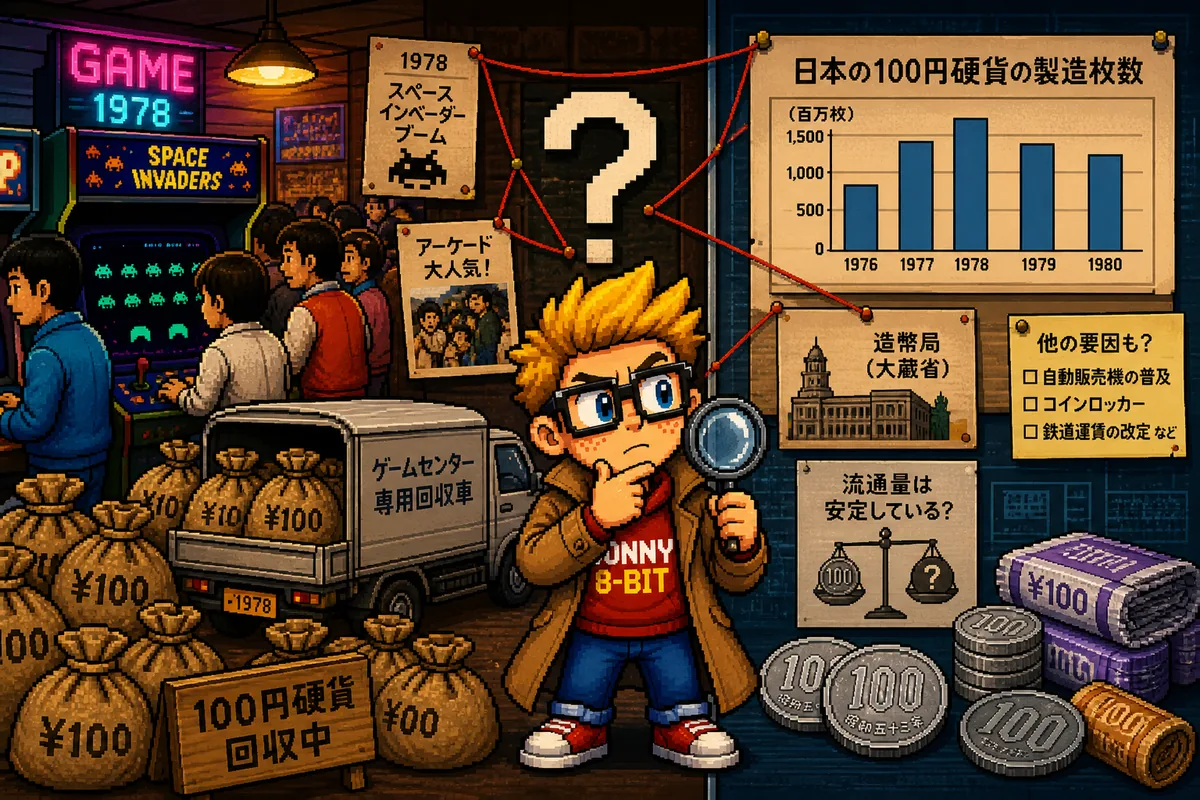
Space Invaders has one of the best success stories in video game history. According to the familiar version, Japanese players became so obsessed with Taito's arcade shooter that the country ran short of 100-yen coins. The government supposedly responded by making more coins, sometimes twice, three times, or even four times the normal amount.
It is easy to understand why people repeat the story. Space Invaders really was a sensation, and every play cost a 100-yen coin. Photographs of crowded arcades and stories about cash boxes packed with coins make a national shortage sound believable. However, the strongest version of the tale does not match Japan's official coin-production records. The most responsible verdict is more interesting than a simple yes or no: the arcade boom was real, full machines and local demand for change were real possibilities, but a nationwide shortage caused by the game—and an emergency response by the Japan Mint—has never been proven.
The boom behind the legend was real
Taito introduced Space Invaders at a product exhibition on June 16, 1978. According to the company's own history, people in the amusement business were not immediately convinced. Some thought the game was too difficult or too strange. That reaction did not last. Orders began surging in September and October, and by 1979 the game had become a social phenomenon.
Space Invaders also appeared in places that did not look like traditional arcades. Its table-style cabinet could be installed in coffee shops, where players sat in front of what looked like a small table and fired at descending aliens. Businesses devoted to the game became known as “Invader Houses.” The game's fixed 100-yen price meant that every successful location gathered large numbers of the same coin. Taito's history describes cash boxes becoming so full that they could cause machine errors. That detail matters: coins piling up inside cabinets were not invented later to make the legend sound better.
For more on what the game changed beyond its cash box, see Space Invaders and the Beginning of Japan’s Arcade Boom. Its alien formation, rising tension, memorable sound, and emphasis on high scores helped establish a new kind of arcade experience. None of that depends on the coin-shortage story being true.
One legend, several different claims
The story becomes harder to trust when its details are compared. One version says banks had to send special trucks to collect coins from arcades. Another says the government ordered the Japan Mint to increase production. The increase is described as double in some retellings, triple in others, and quadruple in still others. Occasionally, the story claims that Japan suffered a general shortage of 100-yen coins; elsewhere, it only says arcade operators or nearby businesses had trouble getting change.
Those are not minor differences. A café briefly running short of change is a local business problem. A nationwide coin shortage is a monetary event. A government decision to mint emergency coins is a separate claim that should leave records behind. Combining all three turns a possible local inconvenience into a dramatic national crisis.
That does not mean every story about scarce coins was imaginary. A row of busy cabinets could remove hundreds or thousands of 100-yen pieces from immediate circulation until an operator emptied the boxes. Nearby shopkeepers might then have found it harder to make change. The problem is the jump from believable local conditions to a documented countrywide shortage caused by one game.
What the Japan Mint numbers show
The Japan Mint publishes annual production totals by coin denomination. Its table reports quantities in thousands of coins. For the 100-yen coin, it lists 440 million pieces produced in 1977, 292 million in 1978, 382 million in 1979, and 588 million in 1980.
Those figures do not support the usual “emergency minting” version. Production actually fell from 1977 to 1978, the year Space Invaders appeared. It rose by about 31 percent in 1979—not by two, three, or four times. Output then increased by about 54 percent in 1980. The 1980 total was roughly double the unusually low 1978 figure, but that change happened over two years. It also remained below the 680 million 100-yen coins made in 1973 and the 660 million made in 1974, years before Space Invaders.
These numbers cannot tell us how easy it was to find a coin in a particular neighborhood on a particular weekend. Producing coins and circulating them are different things. Older coins remain in use, banks redistribute them, businesses deposit them, and collectors may remove some from circulation. Still, the official totals directly contradict the popular claim that Japan immediately doubled, tripled, or quadrupled 100-yen production because Space Invaders had swallowed the existing supply.
Coins inside cabinets were not gone forever
Arcade machines did not permanently consume money. Operators emptied their cash boxes, counted the earnings, and deposited or spent the coins. Banks could then return those coins to circulation. A packed cabinet could temporarily concentrate coins in one place, but it was not a bottomless vault.
Timing could still create short-lived problems. If a popular café collected coins faster than its machines were serviced, money might remain locked inside until the next collection. Customers also needed 100-yen coins before they could play, increasing demand for change near busy locations. Taito's account of overflowing cash boxes supports the idea that operators faced very practical problems during the boom. It does not prove that the entire nation ran out of coins.
Historians have also pointed to other complications in Japan's coin supply. Older 100-yen coins contained silver, and some people may have held onto them rather than spending them. That has been proposed as part of the background, not established as the single answer. The wider lesson is that national coin circulation has many causes. A popular arcade game may affect local movement without controlling the Japan Mint's production decisions.
Why the story refuses to disappear
The legend survives because it explains enormous popularity with one vivid image: an entire country emptied its pockets into arcade machines. “Space Invaders changed game design” is important, but “Space Invaders made Japan run out of money” is easier to remember. Once the claim appeared in books, documentaries, websites, and promotional material, later writers repeated it as proof rather than tracing it back to contemporary records.
Good myth-busting should not replace an exaggerated story with an equally unsupported denial. It is reasonable that some arcades, cafés, or banks experienced unusual demand for 100-yen coins. It is documented that machines filled with them. What remains unproven is the big causal chain: Space Invaders created a nationwide shortage, the government intervened, and the Mint multiplied production to solve it.
The truth still shows how powerful the game became. Space Invaders changed where people played, how arcade businesses operated, and what players expected from a high-score challenge. Its influence was large enough to produce a legend that has lasted almost as long as the game itself.
The game does not need the Japan Mint as a secret final boss. Becoming a social phenomenon, reshaping Japanese arcades, and teaching a generation to fear four marching notes is already an impressive high score.
Videos and further viewing
These videos add demonstrations, interviews, or visual context to the story. A privacy-enhanced YouTube player loads only after you choose a video. Review YouTube’s privacy policy.
The Space Invaders Coin Shortage Never Happened
Video by KonshuA direct examination of the famous Japanese coin-shortage claim and the evidence that contradicts it.