
The Konami Code: From Debug Tool to Gaming Folklore
A programmer's private shortcut escaped into a retail game, rescued countless Contra runs, and became a sequence players could recognize anywhere.
 Narrated by Jonny 8-Bit6 min read · Published 8/20/2026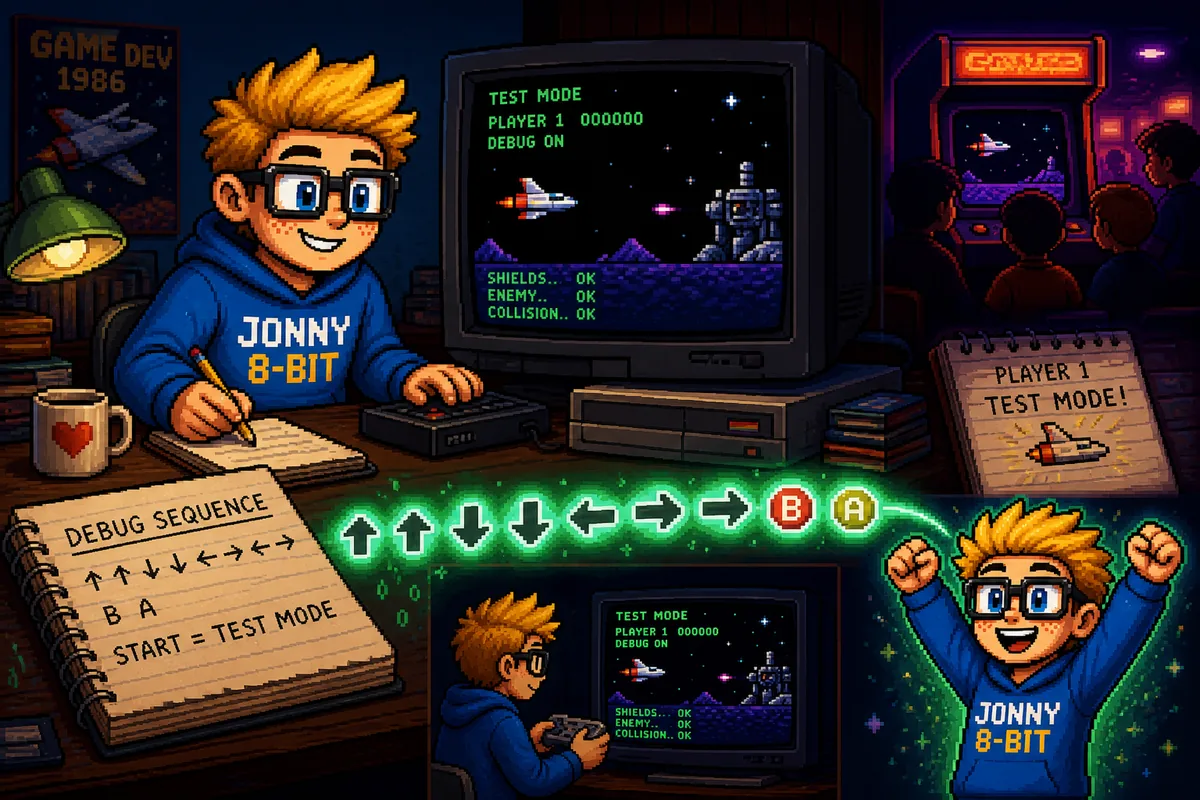
Up, Up, Down, Down, Left, Right, Left, Right, B, A. Many players can recite those ten inputs faster than they can remember an old phone number. Add Start in the right game, and a difficult adventure may suddenly become much more forgiving.
The sequence is known as the Konami Code, but it did not begin as a marketing stunt or a reward for curious players. Programmer Kazuhisa Hashimoto created it while testing the home version of Gradius because he could not reliably finish the difficult shooter. The shortcut remained in the retail game, Contra tied it to 30 lives, and players turned a development tool into gaming folklore.
Gradius was too difficult for its own tester
Konami released Gradius in Japanese arcades in 1985. The side-scrolling shooter placed players in the Vic Viper spacecraft and challenged them to survive waves of enemies, narrow passages, and large bosses. Its power-up system was clever but demanding. Players collected capsules and spent them on upgrades such as missiles, lasers, additional speed, and floating helpers called Options. Losing a well-equipped ship could make recovery painfully difficult.
Hashimoto was part of the small team assigned to bring Gradius to Nintendo's Famicom, the Japanese version of the NES. He had joined Konami in 1981, when the company still focused heavily on coin-operated machines. In a 2003 discussion with fellow Konami veteran Shigeharu Umezaki, he recalled that Famicom projects could be built by teams of roughly four people in four to six months. Programmers often handled planning and design work that would later be divided among specialists.
The arcade version created a practical testing problem. Hashimoto needed to reach later stages and check the conversion, but he admitted that he had not played enough to beat the original game. He therefore programmed a memorable controller sequence that supplied the Vic Viper with its power-ups. It was not created to impress players. It let a developer reach the parts of the game he needed to test.
A private command escaped into the cartridge
Hashimoto's recollection gives the origin a wonderfully ordinary tone. He said there was no grand story behind the sequence; because he would use it, he made it easy to remember. The pattern begins with two pairs of opposite vertical directions, alternates horizontally, and finishes with the NES controller's two face buttons. It feels orderly enough to memorize after only a few attempts.
The command remained in the 1986 Famicom release. Later histories record that Hashimoto forgot to remove it before publication. His surviving interview focuses more on why he created the code than on the exact final production mistake, so there is no need to add a dramatic explanation. The important fact is visible in the retail game: ordinary players could enter the same testing shortcut.
Konami's official history identifies that Famicom version of Gradius as the code's first appearance. It is important to keep that distinction clear. Hashimoto did not invent the first cheat code in all of gaming, and developers had used hidden commands before 1986. He created the particular sequence that became the Konami Code.
Contra turned ten inputs into a playground password
Gradius introduced the command, but Contra made it famous. In the North American NES version, players could enter Up, Up, Down, Down, Left, Right, Left, Right, B, A, and Start at the title screen to begin with 30 lives. Select could be used when choosing the two-player option. That is why many people remember Start—or Select, Start—as part of the code even though Konami now presents the core sequence as ending with B, A.
Thirty lives were a dramatic gift in Contra. Enemies filled the screen, many attacks defeated the player with one hit, and a normal supply of lives could disappear quickly. The code did not make the game effortless, but it gave players enough attempts to learn later stages instead of repeatedly returning to the beginning. For many families and groups of friends, the “30 Lives Code” became the difference between briefly sampling Contra and finally seeing its ending.
The late 1980s had no quick web search waiting beside the television. A secret spread through magazines, strategy guides, rental counters, siblings, and schoolyard conversations. Knowing the sequence was useful information, and teaching it gave a player instant credibility. The directions sounded almost like an incantation, so they survived even when someone had not played Gradius and knew it only as the Contra Code.
Was it cheating, accessibility, or both?
The word “cheat” suggests breaking a rule, but the Konami Code complicates that idea. In a single-player game, using extra lives does not secretly disadvantage another person. The code can reduce the punishment for failure while leaving the same levels, enemy patterns, and controls in place. A beginner gets more time to practice; an experienced player can ignore it.
Players have long disagreed about whether outside help breaks the imaginary boundary of play. Some believe a game should be completed only under its default rules. Others use hints, codes, or guides when the alternative is frustration and quitting. The Konami Code became famous partly because it sat directly on that boundary: it was hidden, but it was also deliberately recognized and reused by developers.
That role connects it to later shortcuts such as IDDQD and IDKFA in Doom. Debug commands could escape the development process and become part of how players enjoyed a finished game. A code might be a testing tool, a difficulty adjustment, a joke, or a badge of insider knowledge—all without changing a single line on the box.
Repetition turned the code into a Konami signature
After players discovered the sequence, Konami kept bringing it back. Different games used it for lives, power-ups, options, or jokes. Some changed the final buttons to fit a new controller, while others deliberately punished players who assumed the familiar input would always help. The stable rhythm mattered more than one exact reward.
That reuse changed the code's meaning. In Gradius, it solved one developer's testing problem. In Contra, it helped players survive. In later appearances, it became an Easter egg—a hidden acknowledgment that the developer and player shared the same memory. Entering the sequence was no longer just a request for assistance. It was a way of asking whether the people who made the game were in on the joke.
Other famous codes used secrecy in different ways. Mortal Kombat's Genesis blood code unlocked a controversial feature that directly affected the console war. The Konami Code was more portable. Its directions could be adapted to new controllers, spoken aloud, printed on clothing, or referenced without displaying violent content or even naming a game.
The code escaped video games
Over time, the sequence appeared in non-Konami games, websites, software, advertisements, television, and other media. Sometimes it unlocked a small animation; sometimes it simply served as a joke for people who recognized it. The reward was often less important than the moment of recognition.
The code endured because it combines memory and motion. Its first eight inputs trace a simple pattern on a directional pad, while B and A finish the phrase with a satisfying beat. It can be spoken, performed, or represented with arrows. Even players separated by age, location, or favorite console can recognize the same tiny piece of controller choreography.
The Konami Code grants something more durable than 30 lives: instant membership in a club. No card is required. Just remember Up, Up, Down, Down, Left, Right, Left, Right, B, A—and try not to press Start before everyone is ready.
Videos and further viewing
These videos add demonstrations, interviews, or visual context to the story. A privacy-enhanced YouTube player loads only after you choose a video. Review YouTube’s privacy policy.
The Story of the Konami Code
Video by Gaming HistorianA documentary account of Kazuhisa Hashimoto’s debugging shortcut and its spread through Konami games and pop culture.