Did Blowing Into NES Cartridges Actually Make Them Work?
The ritual sometimes ended with a working game, but the useful step was usually giving the cartridge another chance to make a clean connection.
 Narrated by Jonny 8-Bit6 min read · Published 8/20/2026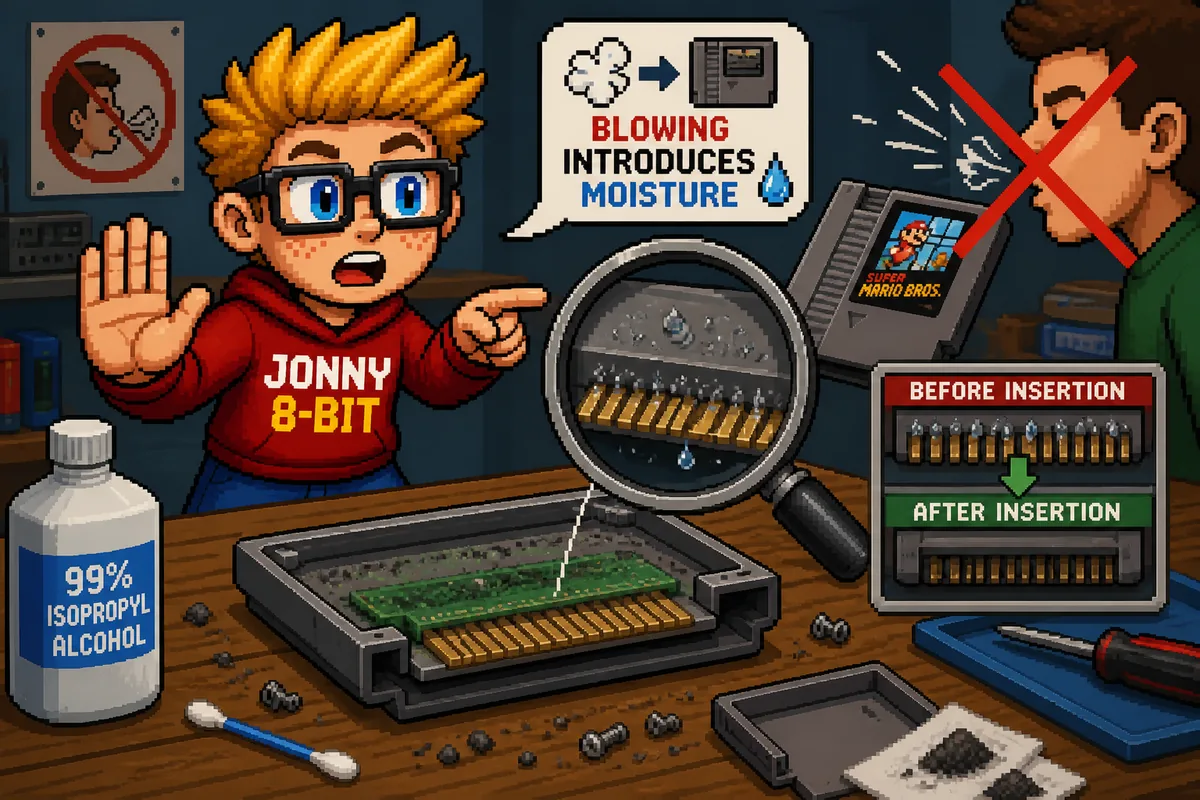
The television showed a gray screen. The red power light blinked. A moment earlier, the same Nintendo cartridge had worked perfectly, but now the console acted as if no game was there. For millions of NES owners, the solution became a ritual: turn off the system, pull out the Game Pak, blow across the exposed end, slide it back in, press it down, and try again.
The strange part is that the game often started afterward. That made the technique feel proven, even though the cartridge had also been removed, repositioned, and reinserted. Blowing might move loose dust or briefly alter a weak connection, but it did not repair the hardware. Reseating usually deserved the credit, while repeated moisture created a risk of contamination and corrosion.
The cartridge was part of the computer
An NES Game Pak was more than a plastic box containing a finished game. Inside was a circuit board with memory chips and a row of exposed metal contacts along its bottom edge. When the cartridge entered the console, those contacts had to line up with a 72-pin connector. The system used those connections to receive the game's program and graphics, supply power, and communicate with other cartridge hardware.
That meant a cartridge could be perfectly healthy and still fail to start. Dirt on its contacts, grime inside the console, corrosion, worn connector pins, or slightly poor alignment could interrupt communication. The result might be a blank screen, scrambled graphics, or a game that froze. Players saw a failed game, but the actual problem was often a weak physical connection between two working pieces of electronics.
The North American NES used its famous front-loading tray. Players slid in the cartridge and pushed it down, much like loading a videocassette. The shape helped Nintendo separate the NES from consoles associated with the industry crash, as explained in How Nintendo Rebuilt Consumer Trust With the NES. It looked distinctive, but age, dirt, and repeated use could make its connector unreliable.
Why one bad contact could create a blinking screen
The NES also checked for a security chip inside authorized cartridges. This system, commonly called 10NES, paired a “lock” in the console with a “key” in the Game Pak. When communication failed, the console repeatedly reset. To a player, that could appear as a blinking power light and a television picture flashing between blank screens.
A dirty or misaligned contact did not necessarily mean that the security chip itself was broken. The console simply could not complete the expected conversation through the cartridge connector. Pushing the Game Pak down a little differently or reinserting it could restore enough contact for the check—and the rest of the game—to work. That is why owners sometimes discovered other rituals, such as nudging the cartridge sideways or leaving it at a particular angle.
The blowing ritual changed more than one thing
Imagine testing the method as a child. The first attempt fails. You remove the game, blow into it, and try again. If the second attempt works, blowing receives the credit. If it fails, you blow harder and repeat the process until the game starts. The failures become part of the repair ritual, while the eventual success becomes proof that the ritual worked.
The problem is that this was not a controlled test. Every attempt reseated the cartridge and created another chance for dozens of metal contacts to align properly. Players also changed how far they inserted the Game Pak, how firmly they pushed it down, and sometimes how long the console remained off. To show that breath was the helpful step, someone would need to compare many blown cartridges with otherwise identical cartridges that were removed and reinserted the same number of times without blowing.
Blowing could move loose dust, but it could not remove tarnish or repair worn pins. Some repairers believe moisture temporarily improved conductivity across a marginal connection. That is possible, but it has not been shown to be a safe or reliable fix. The cartridge was also getting another chance to sit correctly.
Moisture could turn a short-term trick into a long-term problem
Human breath is humid, and a forceful blow can carry tiny droplets of saliva. Those droplets may leave moisture and contaminants on electrical contacts. Repeated exposure can encourage corrosion or create residue that makes a clean connection harder later. The effect from one childhood puff might be too small to notice, but the ritual was often repeated for years across entire game collections.
Nintendo's printed NES instructions warned owners not to get Game Pak connectors wet or dirty. The company later made its advice even more direct for cartridge-based systems: do not blow on the connectors because moisture can cause trouble. Nintendo also sold an NES Cleaning Kit, recognizing that dirty cartridges and console connectors were real maintenance problems even if breath was the wrong cleaning tool.
A widely shared informal experiment photographed two copies of Gyromite while one was blown on repeatedly for a month. The treated contacts developed visible buildup, but the test was not a scientific laboratory study. The boards were not guaranteed to be identical, and it did not measure whether either cartridge became less reliable. It is useful as a warning about what breath can leave behind, not as final proof of a precise corrosion rate.
What actually helped an aging NES
The first useful action was the one hidden inside the ritual: turn off the power and carefully reseat the cartridge. If that restored the game, it suggested an inconsistent connection rather than a repaired circuit board. If several cartridges failed in the same console, the shared 72-pin connector was a more likely suspect than every Game Pak suddenly breaking at once.
Vintage electronics should be cleaned or repaired with the power off and with guidance appropriate to the hardware. Nintendo cautioned against wetting contacts or using common solvents. Repair specialists may use electronics-safe methods or service a worn connector. Abrasive household tricks can remove protective plating along with dirt.
The important distinction is between one successful boot and a repair. A cartridge that starts after five tries still has an unreliable connection. Proper cleaning, alignment, or connector service addresses the cause. Blowing adds a variable that can leave moisture behind.
How a questionable fix became gaming folklore
There was no tutorial video waiting when many NES owners encountered the blinking screen. Children learned from siblings, friends, rental-store clerks, and whoever happened to be holding the controller. The technique was easy to demonstrate, required no tools, and produced occasional success. It spread like a playground cheat code.
The ritual also gave a frustrated player something active to do. Waiting and reinserting a cartridge felt random; blowing into it felt like cleaning and repair. Because the NES problem was so common, millions of people repeated nearly identical experiences and carried the habit to the Super NES, Nintendo 64, Game Boy, and other cartridge systems—even when those machines used different connector designs.
If your childhood cartridge started after a heroic puff, you were not imagining the successful boot. You were probably just thanking the most theatrical part of a much less exciting fix: taking the game out and trying the connection again.
Videos and further viewing
These videos add demonstrations, interviews, or visual context to the story. A privacy-enhanced YouTube player loads only after you choose a video. Review YouTube’s privacy policy.
Did Blowing Game Cartridges Really Work 🤔
Video by Zack D. FilmsA short visual explanation of why reinserting a cartridge could help while moisture from blowing could cause damage.