Why Super Mario Bros. 2 Began as Doki Doki Panic
Calling the Western sequel a simple reskin misses the stranger truth: its design traveled from a Nintendo prototype to a festival tie-in and back to Mario.
 Narrated by Jonny 8-Bit7 min read · Published 8/15/2026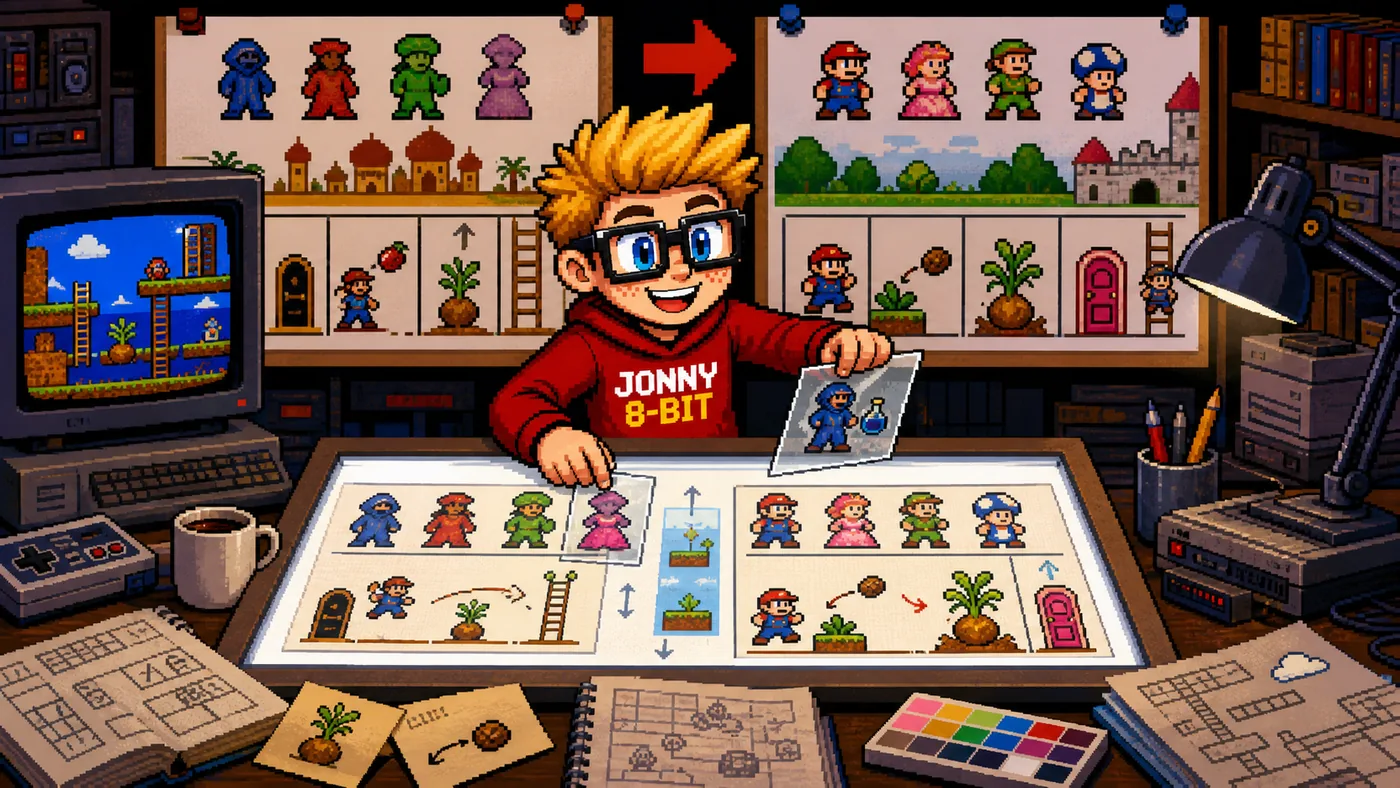
Anyone who played the first Super Mario Bros. knew the rules. Run right, stomp enemies, break blocks, and rescue Princess Toadstool. Then the 1988 sequel seemed to throw that rulebook away. Mario pulled vegetables from the ground. He picked up enemies instead of stomping them. Luigi, Toad, and the princess became playable, and each one moved differently.
There is a familiar explanation for all of this: Nintendo took a Japanese game called Yume Kōjō: Doki Doki Panic, replaced its heroes with Mario characters, and sold it as a sequel. That is true, but calling the result a simple reskin leaves out the best part. The design began inside Nintendo as an experimental platform game, became a television-festival tie-in, and then circled back to Mario. It was less a case of Mario borrowing a stranger’s game than Nintendo finding three different lives for one strong idea.
Japan already had a different Super Mario Bros. 2
Nintendo released a direct sequel to Super Mario Bros. in Japan in June 1986. It ran on the Famicom Disk System, an add-on for Japan’s version of the NES. This sequel looked much like the original game, but it was built for experienced players. It added poison mushrooms, strong wind, hidden blocks, backward warp zones, and stages designed to punish careless jumps. It was familiar, but much tougher.
That Japanese sequel did not come to North America at the time. It is often said that Nintendo rejected it only because American players could not handle the difficulty. The real decision was broader than that. Nintendo needed a sequel that would work for a growing NES audience, and the Japanese game offered similar graphics and rules with a much harsher challenge. Nintendo designer Takashi Tezuka later said the company was unable to release that Disk System sequel outside Japan. The levels eventually reached Western players in 1993 as Super Mario Bros.: The Lost Levels in Super Mario All-Stars.
The game began as an unusual multiplayer experiment
While that direct sequel followed the old formula, another Nintendo project was moving in a stranger direction. Programmer SRD created a prototype for a vertically scrolling, two-player action game. Players climbed upward by stacking blocks. They could also pick up and throw each other to reach higher platforms. Kensuke Tanabe, who later directed the finished game, examined the prototype with Shigeru Miyamoto.
The idea sounded playful, but the Famicom hardware struggled with the complicated two-player action. Tanabe also found that the prototype was not much fun with only one person. Miyamoto suggested adding traditional side-scrolling and making the game feel more like a Mario platformer. The team kept the most enjoyable physical actions—lifting, carrying, stacking, and throwing—and built a fuller single-player game around them.
This is why the usual “unrelated game” story is misleading. The prototype was not yet a commercial Mario sequel, and it did not begin with the final Mario cast. However, Mario’s creator helped shape it, an experienced Nintendo partner programmed it, and the team deliberately mixed its new carrying system with Mario-style side-scrolling. Even before Mario put on the starring costume, the design shared his creative family tree.
Fuji Television gave the project its first cast
The project found an identity through a partnership with Fuji Television. The broadcaster was promoting Yume Kōjō ’87, or “Dream Factory,” a large media event in Japan. The event had a family of mascot characters, and Tanabe recalled being handed their designs and asked to make a game with them. Nintendo turned its developing platform game into Yume Kōjō: Doki Doki Panic, released for the Famicom Disk System in July 1987.
Its four playable heroes were Imajin, Mama, Lina, and Papa. Each had different strengths. Imajin was balanced, Mama could jump high, Lina could float briefly, and Papa could lift objects quickly. Those abilities made character choice part of the level strategy. A player could use Lina to cross a long gap or rely on Papa when a stage demanded fast lifting and throwing.
The prototype’s block-stacking idea also survived in a new form. Pulling a vegetable from the ground grew out of picking up blocks, while grabbing and throwing an enemy replaced throwing the second player. Instead of merely changing the art, Nintendo turned the prototype’s physical actions into the main language of the game.
Nintendo rebuilt Doki Doki Panic for Mario
When Nintendo needed a different sequel for the overseas NES, Doki Doki Panic offered a tested foundation. The Disk System was never released in North America, so the game already needed conversion to a standard cartridge. Tanabe explained that this technical move created an opportunity to make other changes. The Yume Kōjō mascots were tied to a Japanese event, while Mario was already the face of the NES.
Nintendo replaced Imajin with Mario, Mama with Luigi, Lina with Princess Toadstool, and Papa with Toad. Their abilities came with them. Mario became the balanced option. Luigi inherited the high jump, the princess kept the floating ability, and Toad became the fastest lifter. That unusual lineup helped give the characters gameplay personalities that lasted well beyond this one adventure.
The conversion went further than swapping sprites. Tanabe’s team improved animation and sound, adjusted enemies, and added references to the Mario series. The familiar mushroom system also created a funny design problem. Small characters could slip through spaces they were not meant to enter, so the developers gave their reduced forms oversized heads to block the shortcuts. It is a tiny visual joke created by a practical level-design fix.
Its differences made the Mario world larger
The finished sequel still felt surprising. Instead of defeating most enemies with a jump, players stood on them, lifted them, and threw them at other targets. Doors led into dark mirror rooms. Magic potions revealed hidden spaces. Some stages climbed upward instead of following the steady left-to-right movement taught by the original game’s warp zones. Health hearts allowed several mistakes before a life was lost.
Those differences did not disappear when the next Mario game returned to more familiar rules. Shy Guys, Bob-ombs, Pokeys, and Birdo became lasting members of the Mario cast. Picking up objects and choosing characters with different abilities also returned in later games. What once looked like evidence that Super Mario Bros. 2 did not belong became part of the series itself.
The story made room for the strange setting by placing the adventure in Subcon, the land of dreams. Wart, rather than Bowser, served as the final enemy, and vegetables were his weakness. The dream framing was convenient, but the game’s influence was real. Nintendo did not seal these ideas away as a one-time experiment.
The design completed its trip around the world
North America received Super Mario Bros. 2 in 1988, and other regions followed. The game became a major NES release rather than a forgotten substitute. Nintendo later brought the Mario version back to Japan in 1992 under the title Super Mario USA. Meanwhile, the difficult Japanese sequel eventually gained its Western name, The Lost Levels. Both versions became recognized parts of Mario history.
That history explains why the word “clone” does not fit. Nintendo did not copy an outside developer’s work or hide where the design came from. The same company created the prototype, adapted it for Fuji Television, and then rebuilt it around Mario for a different audience and piece of hardware. Along the way, the team improved the game and gave Mario new characters, new moves, and a new kind of world.
Videos and further viewing
These videos add demonstrations, interviews, or visual context to the story. A privacy-enhanced YouTube player loads only after you choose a video. Review YouTube’s privacy policy.
How Doki Doki Panic Became Mario 2
Video by The Voiceover GamerCompare Doki Doki Panic with the Western Super Mario Bros. 2 and see how Nintendo transformed one into the other.