
Was Herobrine Ever Secretly Hidden in Minecraft?
The white-eyed figure was never hiding in vanilla Minecraft, but players built a legend so powerful that Mojang chose to play along.
 Narrated by Jonny 8-Bit6 min read · Published 8/20/2026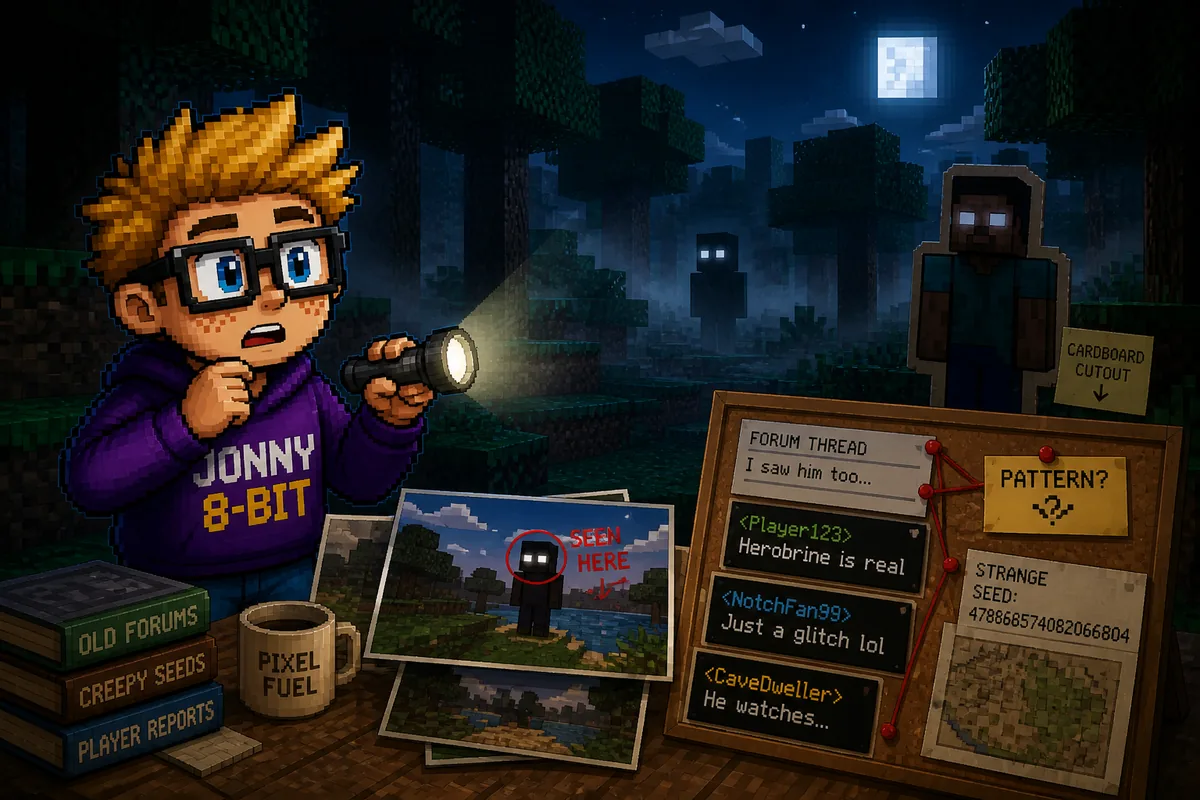
A pale figure stands between the trees at the edge of Minecraft's fog. He has the blocky body of the game's familiar player character, but his eyes are solid white. The screenshot is unclear enough to invite doubt. Is it an undiscovered creature, another player who should not be there, or a trick added to the image?
That distant figure became Herobrine, the supposed ghost haunting single-player worlds. Stories blamed him for strange tunnels, leafless trees, sand pyramids, missing blocks, and the uneasy feeling that someone was watching from beyond the player's view. The legend was perfectly shaped for early Minecraft, but Herobrine was never secretly included as an official character in an unmodified version of the game. He came from community storytelling, staged encounters, and later mods—not a hidden piece of Mojang's code.
A ghost appeared at the edge of the fog
Herobrine's earliest history is not preserved as one neat original webpage. Posts disappeared, screenshots were copied, and later retellings changed details. The best-known version appeared in 2010, while Minecraft was still in its alpha era. An anonymous player shared a foggy screenshot and claimed that a white-eyed figure had appeared in a single-player world before vanishing.
The accompanying creepypasta—an internet horror story presented like a personal experience—made the image more unsettling. The narrator supposedly found unnatural structures and tried to ask other players about them, only to have forum posts removed. A user named Herobrine allegedly sent a message containing one word: “stop.” The story later claimed that the figure was connected to Minecraft creator Markus “Notch” Persson's dead brother. Persson denied both having such a brother and placing Herobrine in the game.
The picture did not need to be sharp. Early Minecraft used heavy distance fog, simple textures, and a world made from large blocks. A few light pixels on a Steve-like face were enough to suggest glowing eyes. The low detail made the evidence weaker, but it made the story stronger because viewers could fill in what the image did not show.
Staged streams made the legend move
A still image can be dismissed as editing. A livestream feels more immediate, especially when viewers believe they are watching events unfold without preparation. Soon after the original story circulated, streamers known as Copeland and Patimuss staged their own Herobrine sightings. These performances helped push the character from a forum scare into a community-wide mystery.
Copeland later explained that he liked the original creepypasta and first edited Herobrine into screenshots to get a reaction from his audience. For a livestream encounter, he changed an in-game texture so that a white-eyed figure appeared inside a room. He reacted with alarm and ended the encounter quickly. The event looked convincing to viewers who did not know how easily Minecraft's textures could be replaced.
For years, much of the original stream was treated as lost media, leaving screenshots, memories, and recreations to stand in for the event. A recording resurfaced in 2024, giving historians a better look at a performance that had already influenced Minecraft culture for more than a decade. The recovery did not reveal a secret mob; it preserved an important early example of online game folklore being performed live.
What was—and was not—in vanilla Minecraft
No verified official Minecraft release has contained Herobrine as a hidden creature. A real mob needs code that controls when it appears, how it moves, what it looks like, and how it interacts with the world. Players and modders have examined Minecraft releases for years without finding such a system for Herobrine. Persson also directly denied that the character had been in the game.
Many later “sightings” were still real images of Minecraft. They simply were not evidence of vanilla, or unmodified, Minecraft. Players could use custom skins, replace textures, edit screenshots, build suspicious structures, or install mods that added a white-eyed enemy. Multiplayer friends could quietly alter a world and let Herobrine take the blame. These creations made the legend playable, but they did not move it backward into the original code.
Ordinary game behavior supplied more false alarms. Fire could leave trees without leaves. Random terrain could create shapes that looked intentional. Cave sounds played without showing their source, while fog and low render distances turned animals, blocks, or other shapes into distant silhouettes. Once players knew the legend, an unexplained event no longer felt random. It felt like evidence.
“Removed Herobrine” was a joke, not a confession
Mojang eventually joined the fun. Beginning with early update notes and continuing across later releases, changelogs repeatedly included the line “Removed Herobrine.” The official notes for Java Edition 1.15.1, released in December 2019, placed it beside genuine performance improvements and bug fixes. The deadpan presentation was the joke.
The line did not mean that developers had located and deleted a hidden character. There was no Herobrine feature listed as added, no official behavior to document, and no secret encounter removed from normal play. Each repetition acknowledged that the community would immediately understand the reference. Mojang could deny the character's technical existence while treating his cultural existence as obvious.
That official wink also kept the mystery alive. A new player reading “Removed Herobrine” could reasonably ask why something nonexistent needed to be removed again. The joke rewarded experienced fans and recruited curious newcomers at the same time. Instead of ending the rumor, the patch notes became another part of its history.
Minecraft was the perfect place for this myth
Minecraft gives players a huge world but very little fixed story. Especially in its early years, a solo world could feel peaceful, empty, and slightly eerie. The player entered caves without knowing exactly what was ahead, heard sounds from unseen spaces, and watched terrain appear through fog. Herobrine supplied a personality for that uncertainty.
Research from Stockholm University interviewed players who remembered the legend's peak from roughly 2010 through 2013. Participants described Herobrine as changing how Minecraft felt even after they stopped believing he was real. Some connected cave noises or strange world features to him, performed supposed summoning rituals, or frightened friends with staged evidence. A community-created character changed real play without ever existing as official code.
Herobrine spread for the same reason that the Mew-under-the-truck rumor survived playground debate: the game left just enough uncertainty for players to investigate. Yet Minecraft gave the legend an extra advantage. Anyone could build the “evidence,” record a sighting, install a mod, or create a new ritual. Every player was both an audience member and a possible storyteller.
A character can be real without being official
The technical question has a simple answer: Herobrine was not secretly hidden in vanilla Minecraft. The cultural question is different. Fan art, videos, mods, stories, jokes, and years of patch notes made him one of the game's most recognizable figures. Players created a shared villain without waiting for Mojang to design one.
That is more interesting than a hidden mob. Herobrine shows how communities can add meaning to an open-ended game and then pass it from one generation of players to the next. Like the fictional Polybius arcade legend, the lack of solid evidence did not kill the story. It gave people room to keep rewriting it.
Mojang may have “removed” him many times, yet players kept reinstalling him with every foggy screenshot, unexplained cave sound, and friend who swore, “I didn't build that.” For a character who never officially spawned, he has had an incredible survival rate.
Videos and further viewing
These videos add demonstrations, interviews, or visual context to the story. A privacy-enhanced YouTube player loads only after you choose a video. Review YouTube’s privacy policy.
The Story Of Herobrine in Minecraft
Video by JustSayStevenFollow the screenshots, forum posts, and community storytelling that turned Herobrine into Minecraft folklore.